
When company conversation turns to AI governance, what springs to mind? Most picture legal teams poring over regulations and compliance documents.
And while this role is undeniably critical in navigating the complex world of regulatory AI and compliance, seeing governance solely as a legal concern misses its larger operational potential. Governance’s scope goes beyond avoiding penalties and staying compliant.
It brings a strategic level of control able to transform your operations and AI alignment, adding trust, and accelerating innovation with technology that is onboarded correctly: A superpower. For organizations embracing AI, understanding the benefits of its governance beyond the legal realm is big.
AI is increasingly woven into the fabric of daily operations — from optimizing supply chains to personalizing customer interactions.
The confidence created in deploying an AI model where you can clearly understand its decision-making process, trace its impact on any given workflow, and demonstrate its adherence to both internal policies and external regulations is paramount to AI adoption's success
Without proper governance, this integration can become a web of digital confusion, leading to unforeseen risks and hindering the very progress AI promises. The power of responsible AI emerges, when fostered with transparency, and traceability that enables confidence in its use across the business — while enabling customization that gives you the advantage of AI that acts as you need it to.
By providing clear guardrails and a systematic process for managing risks, governance allows teams to experiment and deploy AI solutions with greater confidence and speed. It moves the focus from "is this too risky?" to "we can do this responsibly." And it paves the way for standardized AI input as opposed to ad-hoc manual use.
For process analysts and managers, the notion of AI governance for operations teams might, at first glance, seem like yet another added layer of complexity. But the confidence created in deploying an AI model where you can clearly understand its decision-making process, trace its impact on any given workflow, and demonstrate its adherence to both internal policies and external regulations is paramount to AI adoption's success.
This clarity exceeds benefiting just auditors; governing AI with workflow orchestration software empowers teams to perform faster, identify bottlenecks, and refine their AI-driven processes with precision. From a head of operations perspective, this translates into enhanced efficiency, and reducing operational risk with and without AI.
AI compliance across departments doesn’t need to be an isolated challenge for your legal department to grapple with alone. It's a shared responsibility that demands an all-hands-on deck approach, across the board. And orchestrating AI use, means that standardized and reusable guardrails make its responsible use manageable company wide.
AI governance enables you to understand your AI’s decisions, its impact — and critically — to adjust how it performs within your tasks and teams to push ongoing improvement.
Let's take a closer look at specific departmental applications, where effective AI governance, powered by robust orchestration, can enable you to send productivity and performance on an upward trajectory. For example, in the realm of claims handling AI compliance, the capability to trace every step of an AI-driven claim assessment, from initial data input to final payout recommendation, is invaluable — especially as regulators like the FCA demand demonstrable fairness and accountability.
Orchestration software ensures that each AI decision is logged, auditable, and aligned with company policies, managing adherence to strict financial regulations but also mitigating the risk of bias or unaligned input by onboarding and guardrailing AI at the level of an internal employee. This level of risk management helps maintain the customer trust you wish you to uphold.
Similarly, in customer service AI governance, where AI-powered and automated inquiry responses with AI agents handle sensitive customer data and resolve key issues, the need for transparency is essential. For example, where HIPAA regulations in healthcare underscore the need to safeguard patient information.
An AI orchestrator allows organizations to monitor interactions, identify potential data breaches, and ensure that AI models are handling personal data securely, and in full compliance with privacy laws. Leaning into a proactive approach like this to governing automation fosters trust with customers and safeguards your organization not only from legal but reputational damage.
For managers in roles leading digital transformation, this translates into a positive and secure digital customer experience, a key differentiator in today's competitive landscape. While citizen developers, empowered to build AI-powered solutions, need guardrails and clear guidelines to ensure their innovations are manageable, while being effective and compliant.
Without governance, AI is an external actor without the onboarding, management, or guidance of that of an internal employee. With it, transparency, traceability, and innovation that matches your business culture are all on the (digital) table.
An orchestrator centralizes AI initiatives and AI use, regardless of its origin, within your organization. It provides the necessary infrastructure for AI governance for industry compliance, making it easier to meet sector-specific demands. But it's also an important missing link in your tech stack, providing the essential framework for smooth, scalable AI operations through configurable control. Adopting a centralized approach simplifies the scaling of AI, boosts compliance with regulations, and enhances performance and security. With governance guardrails in place, you control your AI use and have the confidence to add new products and extend initiatives to any teams or workflows.
Flowable supports AI orchestration within processes, ensuring that your initiatives are compliant, transparent, and trustworthy. By understanding AI governance as an operational superpower, organizations can drive its adoption with confidence and transform their operations for a future where AI is intelligent and responsible — allowing it to be truly impactful.
Explore the Flowable Platform to start implementing AI both responsibly and effectively. With a helping hand, your organization can look forward to smoother, more scalable AI-powered operations.
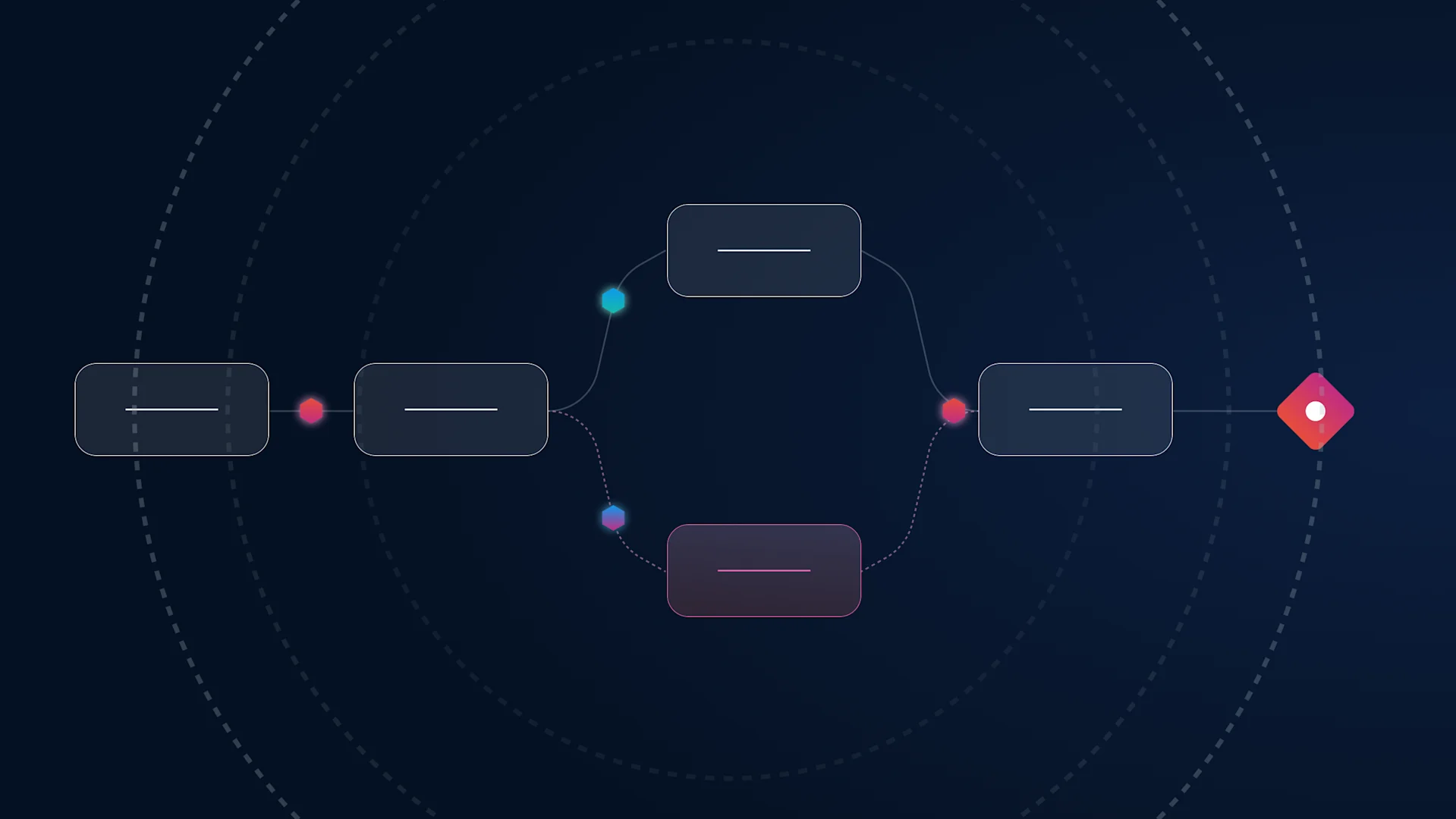
n agentic workflow is more than a multi-agent diagram. See what the standard patterns omit once workflows meet exceptions, oversight, and audit requirements. Primary keyword: agentic workflow

Automating single functions leaves the process broken at the handoffs. See why end-to-end orchestration beats function-by-function financial process automation.
A criteria-led framework for evaluating workflow orchestration tools, covering open standards, governance, exceptions, and lock-in, not another ranked listicle. Keywords: workflow orchestration tools