Enterprise case management software is the category of platform used to run case-based work, where each case — an application, a claim, a complaint — brings together the information, tasks, decisions and people needed to reach an outcome. The term covers several genuinely different kinds of software, which is why buyers so often end up comparing tools that were never built for the same job.
This guide covers general enterprise case management: the cross-industry platforms a bank, insurer or government body would evaluate for exception-heavy work in regulated industries. It does not cover the vertical point solutions that borrow the same name, such as legal practice management or HR case management, which are built for one department and one workflow. If that is what you need, the market is narrower than the one described here.
• Enterprise case management software is a category, not a single product: three architecturally different approaches sit under the same name.
• The three approaches are content-management-first platforms, purpose-built case and BPM suites, and open-standards orchestration platforms that run case, process and decision logic as one governed model.
• The right choice depends on the work: document-heavy, process-heavy, or regulated and exception-heavy with a need for auditability.
• For regulated case work, the questions that matter most are whether the platform is built on open standards and whether every action shares one audit trail.
Enterprise case management software supports work that cannot be reduced to a fixed, linear process. Some vendors call this dynamic case management.. Instead of following the same steps every time, a case unfolds based on its own facts: new information arrives, a decision changes the path, a person steps in to exercise judgment. The software holds all of it around a single case record, so the history, the documents, the decisions and the people involved stay in one place from case intake to resolution.
This is close to how Gartner defines case management solutions: applications that support work combining human tasks with electronic workflow, such as an incoming application, a submitted claim or a complaint, handling the collaboration, content, decisioning and processing a case needs along the way. The common thread is that the case, not a rigid workflow, is the thing being managed to an outcome.
Most of the confusion around enterprise case management software comes from treating it as one market. It is really three, each with a different starting point and a different set of trade-offs.
The first grew out of enterprise content management (ECM). These platforms began as systems for storing and governing documents and records, then added case workflows on top. The second was purpose-built for case and business process management (BPM): suites designed from the start to model and automate structured, staged work. The third treats case management as one governed engine alongside process and decision automation, built on open standards so the same model stays portable and auditable.
The table below compares the three by what they suit, their main strengths and their limitations.
Category | Best for | Key strength | Limitation |
|---|---|---|---|
Content-management-first platforms | Document-heavy, records-centric case work | Deep content, records and retention management | Case logic and orchestration sit on top of a content core, so exception-driven work is harder to model |
Purpose-built case and BPM suites | Structured, process-centric work with defined stages | Strong workflow modeling and process automation out of the box | Case, process and decision logic often live in separate or proprietary models, which raises switching costs over time |
Open-standards orchestration platforms | Regulated, exception-heavy work that needs auditability and flexibility | One governed model across case, process and decision logic, on open standards with a shared audit trail | More platform than a single-department, single-workflow need may require. |
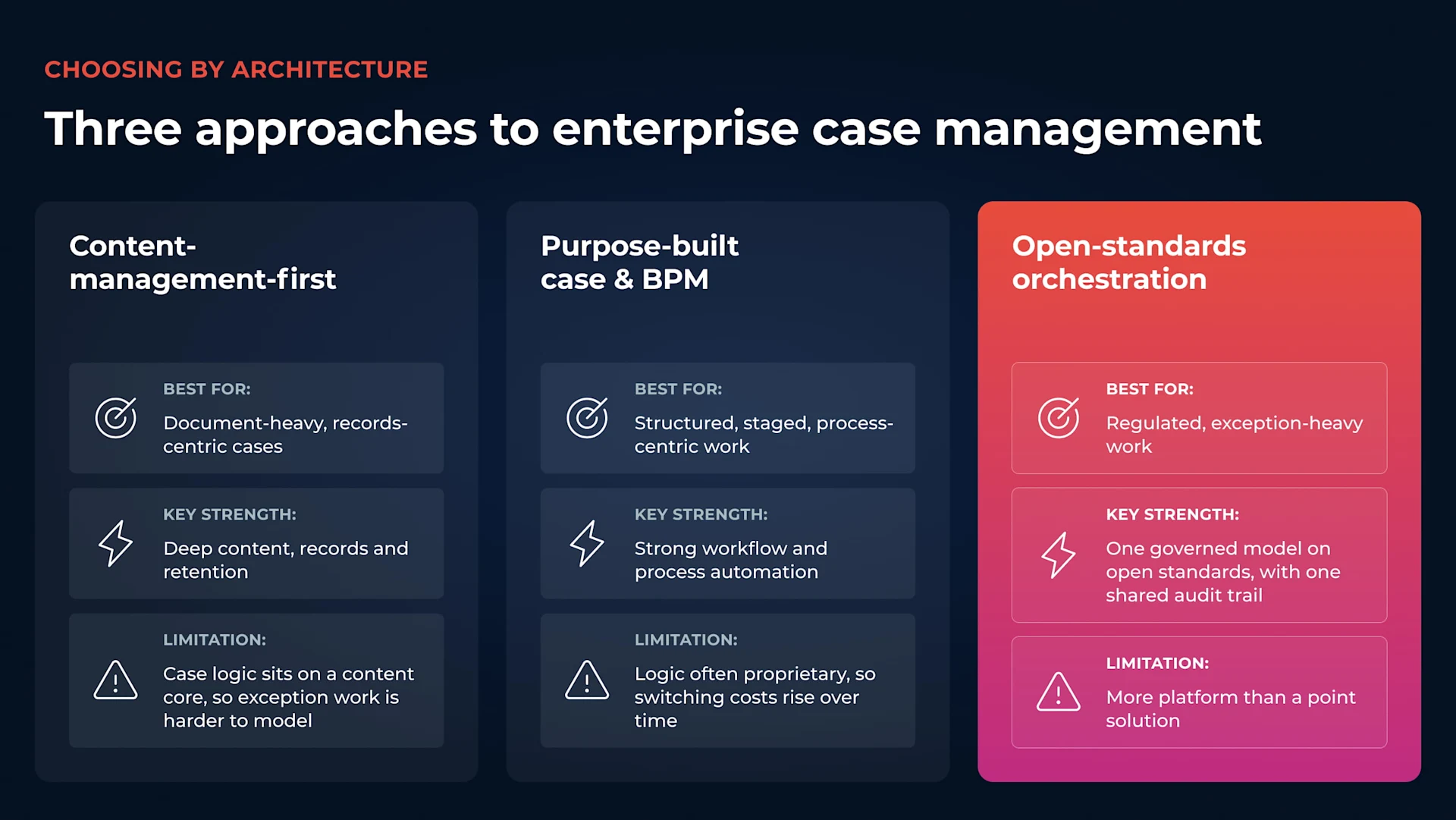
Three approaches to enterprise case management software compared by architecture: content-management-first, purpose-built case and BPM, and open-standards orchestration, each with what it is best for, its key strength, and its main limitation.
The right approach follows from the work you actually do, not from a feature list. These four questions should help you define which approach is right for you:
How predictable is the work?
Cases that follow a known path most of the time point toward a purpose-built case or BPM suite. Cases where the next step is decided case by case, on new information, point toward open-standards orchestration, which is built for exactly that.
Is the center of gravity content or decisions?
If a case is mostly documents and records to capture, govern and retain, a content-management-first platform plays to its strength. If it turns on decisions and case routing, with content as one input among several, a platform that models decisions as a first-class part of the case fits better.
One department or cross-enterprise?
A single team with one workflow is often served well, and more cheaply, by a focused tool, including a vertical point solution. Work that spans functions, or that you expect to extend into new case types later, rewards a platform built to orchestrate across them.
How much does auditability weigh?
In regulated, exception-heavy work where every outcome may have to be explained, the shared audit trail and open standards of an orchestration platform move from nice-to-have to the deciding factor.
Few organizations are a clean fit for one box. A bank runs predictable onboarding and exception-driven complaints side by side. The useful question is which approach fits the cases that carry the most risk and change, because that is where the wrong architecture costs the most.
Whichever approach fits, a handful of capabilities separate a platform that will serve regulated case work from one that will not. For each, it helps to know what good looks like and what to probe in a demo.
Good looks like one record holding every email, document, task and decision for a case, visible to everyone working it. Ask to see a live case rather than a slide: if the history is spread across three screens, it is not unified.
Good means the routine path runs automatically and the exceptions are modeled in the system, not handled over email. The trap is a demo that only shows the happy path, so ask to see what happens when a case goes off-script.
Good is clean, supported connections to the core systems a case touches, from policy and core banking to identity and document stores, without a custom rebuild each time. Ask which integrations are productized and which are professional-services work.
Good means AI classifies, extracts and routes incoming cases, with a person able to review and override where it matters. Gartner expects at least 15% of day-to-day work decisions to be made autonomously through agentic AI by 2028, so the controls matter as much as the automation; ask where every agent action is logged.
Good is a tamper-evident record of what happened, who did it and why, reconstructable for any single case on demand. Ask to pull the full history of one closed case in the demo: if that is slow or partial, it will be worse under a real review.
Good tracks every case against its time limits and escalates automatically before one breaches, not after. Ask how the system behaves when an SLA is about to be missed.
Good means case, process and decision logic modeled in open standards (BPMN, CMMN, DMN) you could read and move, not a proprietary format only one vendor can open. The lock-in only shows at renewal or migration, so ask what it takes to export your models and run them elsewhere.
A few patterns trip up case management buyers more often than any single feature gap.
• Buying for the happy path. Teams evaluate against today’s clean, predictable cases and find out too late that the exceptions, escalations and reopened cases are where the work and the risk actually live.
• Underweighting integration and auditability. Both feel like back-office detail in a demo and become the whole project in production; a platform that cannot show a clean audit trail or connect to core systems costs more than its license suggests.
• Mistaking a point solution for an enterprise platform. A tool built for one department’s workflow can look like a bargain until a second use case arrives and it will not stretch to meet it.
• Ignoring open standards. Logic locked in a proprietary format is fine until you want to change platform or evidence a decision to an auditor, at which point the lock-in becomes the story.
• Treating AI as the selection criterion. Agentic features sell demos, but the value depends on the governance around them rather than the model itself.
Flowable sits in the third category: an agentic case management platform built on open standards. Case management runs on CMMN, process automation on BPMN, and decision logic on DMN, as three faces of one platform rather than separate products stitched together. A case, its process, and the decisions inside it share one model and one audit trail.
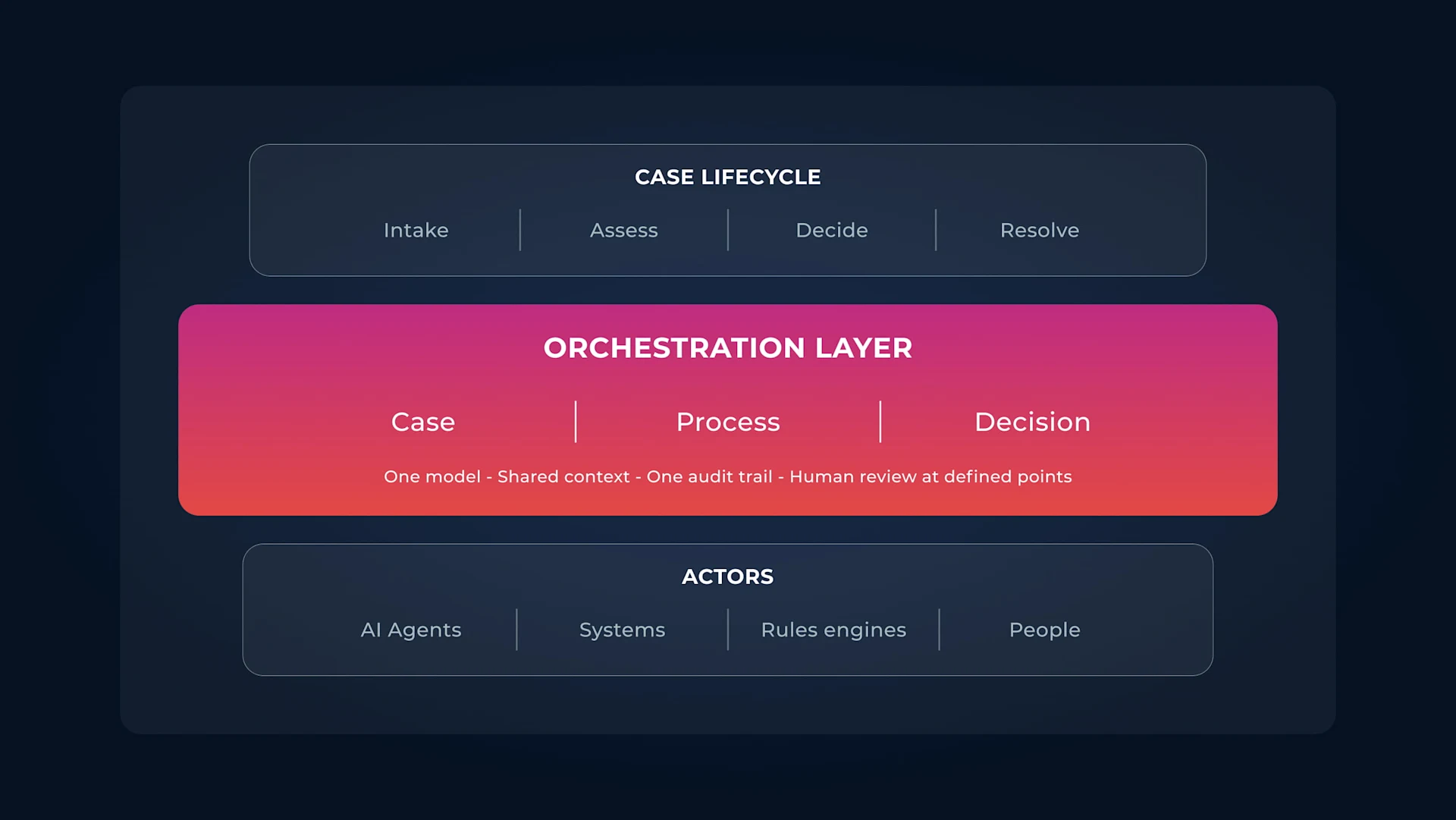
How Flowable runs enterprise case management on one platform: the orchestration layer coordinates case (CMMN), process (BPMN) and decision (DMN) logic across the case lifecycle and its actors, with shared context, one audit trail, and human review at defined points.
That design is built for regulated, exception-heavy work: an insurance claim, a loan origination or KYC/AML case in banking, a benefits application in government.. The reason an outcome was reached, the data behind it, and the point where a person stepped in are all recorded in one place, which turns an audit from a scramble into a lookup. For how case work adapts as it runs, see our guide to adaptive case management, and for the platform itself, Flowable’s case management.
The agentic part matters more as AI enters this work, and so does the control around it. Gartner expects over 40% of agentic AI projects to be canceled by the end of 2027, citing escalating costs, unclear business value and inadequate risk controls.
Agentic case management answers the risk-control half of that directly: AI agents can classify a case, draft a decision or recommend a next action, but process orchestration governs when an agent runs, when a case pauses for human review, and how every step is recorded. Human review is a designed point in the case, placed where the stakes call for judgment, not a fallback bolted on when automation falls short. That governing layer is what makes the agentic capability dependable at enterprise scale.
Flowable runs case management on CMMN alongside process and decision automation, so every case carries one audit trail from intake to resolution.
Explore Flowable case management here.
It is software for running case-based work, where each case brings together the information, tasks, decisions and people needed to reach an outcome. It covers several different architectures, from content-first platforms to open-standards orchestration platforms.
For regulated, exception-heavy work, the strongest fit is a platform built on open standards with one shared audit trail across case, process and decision logic, so any outcome can be explained and evidenced later. The best choice still depends on your systems and the kind of cases you handle.
Yes. Flowable is an agentic case management platform that runs case management on the open CMMN standard alongside process automation (BPMN) and decision automation (DMN) on one platform, with a shared audit trail.
BPM automates structured, repeatable processes that follow a known path. Case management handles work that cannot be fully predicted, where a person often decides the next step. Many platforms support both, and open standards let them work together on one platform with a shared audit trail.
No. Legal practice management and HR case management are vertical point solutions built for one department. Enterprise case management software is the general, cross-industry category this guide describes.
Start from your own cases, especially the exceptions and the ones that carry the most risk, and match them to one of the three approaches: content-first, purpose-built case and BPM, or open-standards orchestration.
Then judge shortlisted platforms on unified case files, integration, audit trails, SLA handling and whether they run on open standards, and test each against a real scenario of your own rather than a scripted demo.
It depends on how many case types you start with and how many systems it must integrate, but a focused first use case is usually live in weeks to a few months, while a broad multi-department rollout runs longer. Platforms built on open standards and reusable models tend to shorten each case type after the first.
Learn what a decision engine is, how DMN separates rules from process logic, and how Flowable governs decisions across every case.

See a real decision table example for business rules automation, plus how Flowable models it using the open DMN standard.
Business process management software covers very different tools in 2026. See how the category shifted towards BOAT and what buyers should evaluate.