
Solutions
Business Orchestration and Automation Technologies (BOAT)
Integrate and manage multiple automation technologies with one platform.
Business orchestration and automation technologies (BOAT) is a concept coined by Gartner. It refers to a unified platform that integrates and manages multiple automation technologies. Think of it as the connective tissue that combines RPA, BPA, iPaaS, low-code platforms, and AI-driven tools into one seamless ecosystem.
BOAT is not just about automating tasks — it’s about orchestrating end-to-end processes. From document ingestion and task mining to predictive decision-making and cross-system integrations, BOAT ensures every element of your business runs like a well-oiled machine.
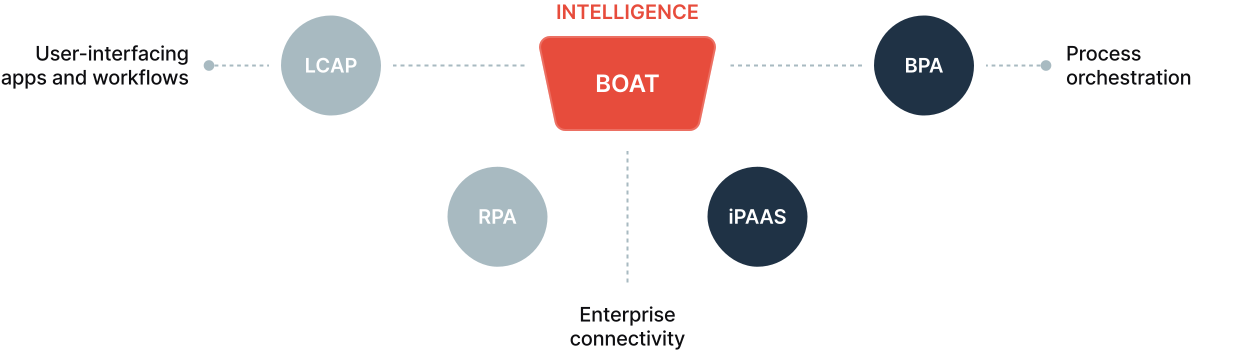


As enterprises face mounting pressure to streamline operations and scale automation, BOAT emerges as the solution to unify fragmented tools and tackle the growing complexity of modern workflows.
Organizations often juggle disconnected tools for different purposes. One application for robotic process automation (RPA), another for business process automation (BPA), and yet another for integrations is commonplace. This fragmentation creates maintenance nightmares, escalating costs, and bottlenecks when scaling automation efforts. BOAT consolidates these tools into a single source of truth, making automation simpler, smarter, and more scalable.
The days of only needing to automate simple, repetitive tasks are long gone. Enterprises need tools that can handle dynamic workflows, adapt to changing business conditions, and scale across departments. BOAT’s modular architecture ensures that businesses can orchestrate even the most complex processes — from customer onboarding to compliance management and beyond.
Gartner’s concept of hyperautomation emphasizes integrating and scaling automation technologies across an organization. BOAT takes this further by embedding orchestration and intelligence at its core, enabling enterprises to achieve hyperautomation without piecemeal solutions.
With its unified framework and intelligent capabilities, BOAT delivers measurable value, transforming how businesses manage processes, optimize data, and drive innovation.
Unlike standalone tools, business orchestration and automation technologies (BOAT) focus on the big picture — managing workflows from start to finish across systems, teams, and technologies. This completeness ensures seamless handoffs between automated tasks, improving efficiency and accuracy.
By embedding AI and machine learning, BOAT doesn’t just automate — it optimizes. Whether it’s fraud detection, sentiment analysis, or process mining, BOAT adds intelligence to every step of your workflow.
Simplifying automation and toolsets into a single platform minimizes disruptions and reduces the need for constant system integration and maintenance.
Low-code environments mean faster innovation cycles, enabling businesses to respond quickly to market changes and customer demands.
With BOAT, all your data is accessible from one place. This unity improves data quality, enhances reporting, and lays the groundwork for advanced analytics and AI-driven insights.
BOAT is future-proof. Its cloud-native, modular design allows enterprises to scale automation efforts, integrate new technologies, and adapt workflows as business needs evolve.
As an established provider of intelligent process automation and orchestration solutions, Flowable has been delivering a suite of capabilities that align perfectly with the principles of BOAT for many years. Navigate through the categories and discover how:
Join Flowable CEO, Agim Emruli, alongside Business Analyst Consultant, Paul Vincent, and find out how BOAT is being used as a strategic framework for business transformation.

While integration with RPA tools through APIs has always been possible, Flowable's new RPA out-of-the-box connector highlights Flowable’s commitment to delivering a comprehensive automation and orchestration platform rooted in the principles of BOAT.
Flowable integrates with a wide range of systems, technologies and applications for streamlined automation. Connect your technology landscape for end-to-end orchestration.

In precision-driven industries, case management is vital for success, as companies manage thousands of complex, multi-touchpoint cases daily.

IT democratization enables a wide range of users, from developers to business users, to create workflows using low-code tools, reducing reliance on internal IT departments.

CMMN was mainly designed with case management in mind to handle dynamic, human-driven processes. But in reality it can do much more. Here's why you need case management if you want a unified technology landscape.