A decision engine is software that separates the logic of a decision from the code of the process around it, so the rules that drive an outcome can change without rewriting the application. That definition sounds settled, and yet the term is used inconsistently across vendors. Some mean rule-based automation. Some mean customer-facing personalization. Others treat “decision engine”, “rules engine” and “DMN” as if all three were the same thing.
This guide sets those terms straight: what a decision engine is, how one works, what it is used for, and why the open standard worth looking for, Decision Model and Notation (DMN), is the detail worth paying attention to when you evaluate one.
A decision engine separates decision logic from process code, so business rules can be updated without redeploying software.
DMN (Decision Model and Notation) is the open standard that makes that logic portable, readable, and auditable rather than locked to one vendor.
Decision engines drive high-stakes, rule-heavy outcomes such as credit decisioning, claims eligibility, fraud flagging, and pricing.
The strongest question a buyer can ask is whether the decision engine runs on open standards and shares one audit trail with the surrounding process.
As described above, a decision engine is software that evaluates business rules and returns an outcome. In practice, it sits between the data coming in and the action that follows: it takes in facts, applies a defined set of business rules, and produces a decision, usually approve or decline, flag or clear, or a price tier.
What makes it an engine, rather than a block of code buried inside an application, is separation. The decision logic lives on its own, so a policy change becomes an edit to a rule instead of a software release.
(Image)
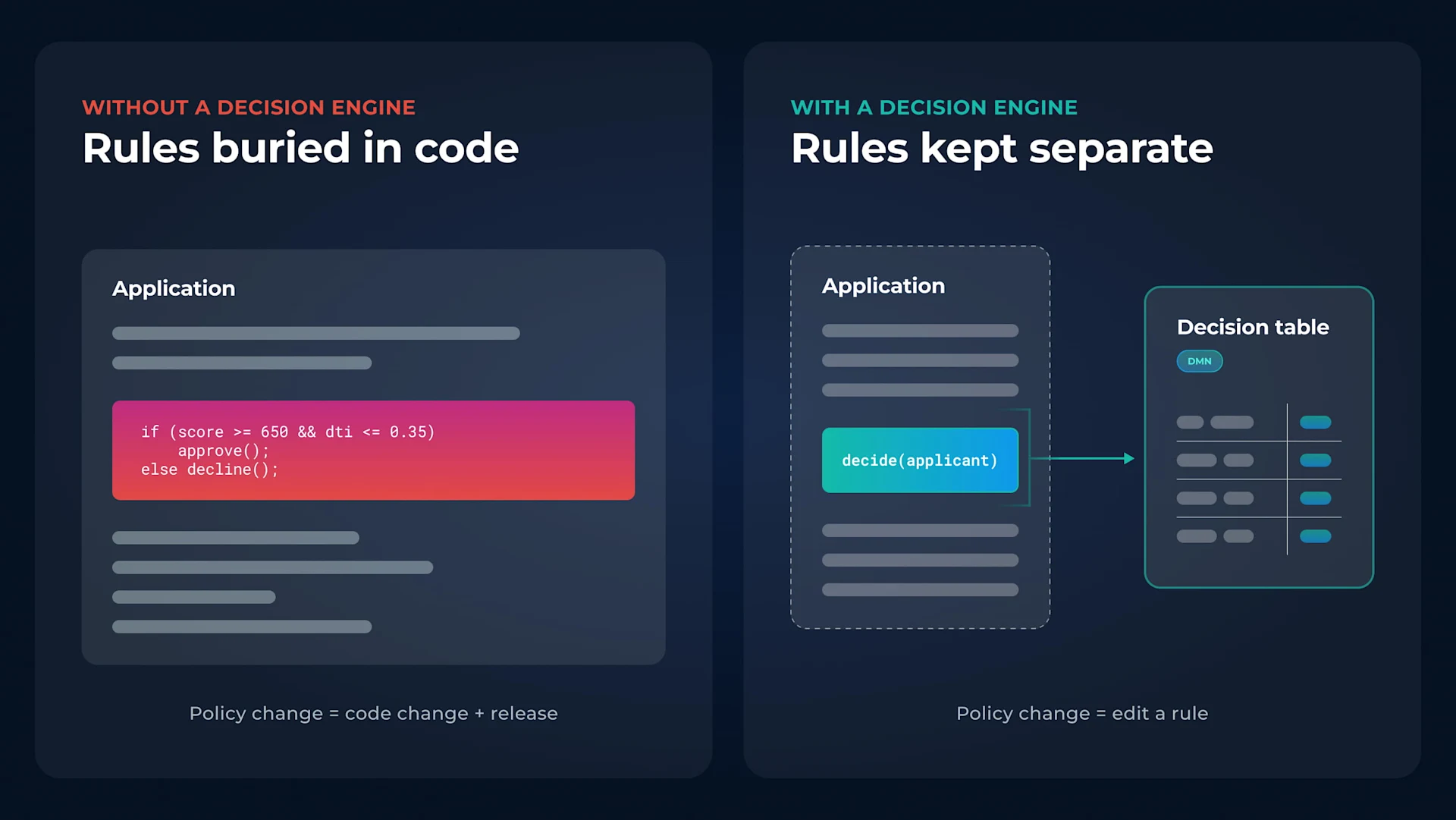
That separation matters because decision-making is where a great deal of organizational time goes to waste. One McKinsey survey, found that managers were spending 37% of their time making decisions, and more than half of this time was thought to be spent ineffectively. Encoding repeatable, rule-based decisions in an engine takes a whole category of routine judgment off people’s desks and makes every outcome consistent and traceable.
Every decision engine follows the same shape: inputs go in, rules are evaluated, an output comes out.
Inputs are the facts a decision needs, such as an applicant’s income, a claim amount, or a transaction’s size and location. Rules are the conditions that turn those facts into a result. Outputs are the decision itself, usually with a reason attached.
Most engines express those rules as decision tables: a grid where each row is a rule, the columns on the left hold the conditions, and the columns on the right hold the result. A business analyst can read a decision table without reading code, which is much of the point.
For decisions with several moving parts, a decision requirements diagram (DRD) maps how smaller decisions feed a larger one, so a final outcome can be traced back through every sub-decision that shaped it.
The open standard behind both is DMN, or Decision Model and Notation. DMN defines how decision tables and DRDs are written, so the same model is interpreted consistently across tools that conform to the standard.
Decision engines earn their place wherever the same kind of decision is made many times a day against clear criteria, and where getting it wrong carries cost or risk.
Credit and loan decisioning. A lender encodes affordability and risk policy as rules, so an application for a $15,000 loan is assessed against the same thresholds every time, with the reason for any decline recorded.
Claims eligibility. An insurer checks a claim against policy terms automatically, clearing straightforward cases in seconds and routing the rest for review.
Fraud flagging. A payments team scores each transaction against rules, holding a $4,000 payment from a new device in an unfamiliar country while letting routine spending through.
Pricing. A retailer adjusts prices by segment, volume, or demand without a developer touching the checkout.
What these share is volume, repeatability, and consequence. They are also, in regulated settings, decisions that someone may later have to explain, which is where the way a decision was reached matters as much as the decision itself.
These terms overlap, which is why they cause so much confusion.
A business rules engine is the broader category: any system that executes business rules separately from application code. A decision engine is a rules engine pointed at a specific job, returning a decision for a given set of inputs. In practice the two are often used interchangeably, and the label matters less than knowing what the tool actually does. For the wider landscape of business rules tooling, see our guide to the business rules engine.
Decisioning is the term to watch. Some vendors use it to mean rule-based decision automation, close to everything above. Others use it to mean customer-facing personalization: choosing the next best offer or message for a given customer. That second sense is a different concept, driven by predictive models rather than business rules, and a searcher who wants one will not want the other.
DMN is maintained by the Object Management Group, the standards body behind BPMN, CMMN, UML and other widely used modeling notations. Being an open standard has practical consequences for a buyer.
A decision engine built on proprietary rule syntax ties every rule to that vendor’s product.
Switch platforms and the rules must be rebuilt, and the team must relearn a bespoke language."DMN avoids that. Rules written to the standard are portable, readable by business and technical staff alike, and expressed in a notation designed to be inspected rather than reverse-engineered.
This is worth turning into a question when you evaluate any decision engine: is the decision logic held in an open standard, or in a format only this vendor can read? The answer shapes how much of the investment survives a change of platform, and how easily a decision can be shown to an auditor. For a closer look at how these are built in practice, see our guide to DMN decision tables.
A few questions separate a decision engine that will still serve you in five years from one that locks you in. Is the decision logic held in an open standard such as DMN, or in a format only this vendor can read? Does the engine share one audit trail with the process and the case around it, or does it govern decisions in isolation? Can a business analyst change a rule without a software release? And where does human judgment sit: is review a designed step placed where the stakes call for it, or an afterthought bolted on when automation falls short? The answers decide how much of the investment survives a change of platform, and how easily any decision can be explained later.
Most decision engines run as a separate component, connected to whatever process or application calls them. That works, but it splits governance. The decision has one audit trail, the process around it has another, and the case the decision belongs to has a third.
Flowable takes a different route. Its decision engine runs on DMN, its process automation on BPMN, and its case management on CMMN, and all three are faces of one platform rather than separate products stitched together. These standards are designed to work together, each handling the type of work it suits best:
Standard | Best suited to | Examples in a decision context |
|---|---|---|
BPMN | Structured, predictable processes | The steps around a decision: gathering inputs, routing, notifications |
CMMN | Event-driven or less predictable work | Cases that reopen on new information, escalations, exception handling |
DMN | Explicit decision logic and business rules | Credit scoring, eligibility rules, pricing and routing decisions |
A decision made inside a loan application, an insurance claim, or a client onboarding case therefore executes with the same governance and the same audit trail as everything else in that case. The reason for an outcome, the data behind it, and the point at which a person stepped in are all recorded in one place.
That last point matters more as decision engines start working alongside AI. Gartner expects that by 2027, 50% of business decisions will be augmented or automated by AI agents for decision intelligence. The value of an AI-suggested decision still depends on the control around it: a defined point where a rule, a model, and a person’s judgment meet, and a record of which one drove the result.
Process orchestration is what supplies that control. It is the governing layer that decides when a decision runs automatically, when it pauses for human review, and how the outcome is logged. Human review is a designed step, placed where the stakes call for judgment. It is not a fallback for when automation falls short.
Flowable runs decision logic on DMN alongside process automation and case management, so every decision carries the same audit trail as the case it belongs to.
Find out more here.
A decision engine is software that evaluates business rules against a set of inputs and returns a decision, separately from the application around it. Because the rules live on their own, they can be changed without rewriting or redeploying code.
They are closely related and often used interchangeably. A business rules engine is the general category of software that runs business rules apart from application code; a decision engine is a rules engine focused on returning a specific decision for a given set of inputs.
DMN, or Decision Model and Notation, is an open standard from the Object Management Group for modeling business decisions. It defines how decision tables and decision requirements diagrams are written, so the same decision logic is readable across any tool that supports the standard
Yes. A decision engine can pass a case to an AI agent, take an AI-generated recommendation as an input, or hand off to a person for review. What keeps this dependable at scale is the orchestration layer around it, which governs when each decision runs automatically, when it pauses for human judgment, and how every outcome is recorded.
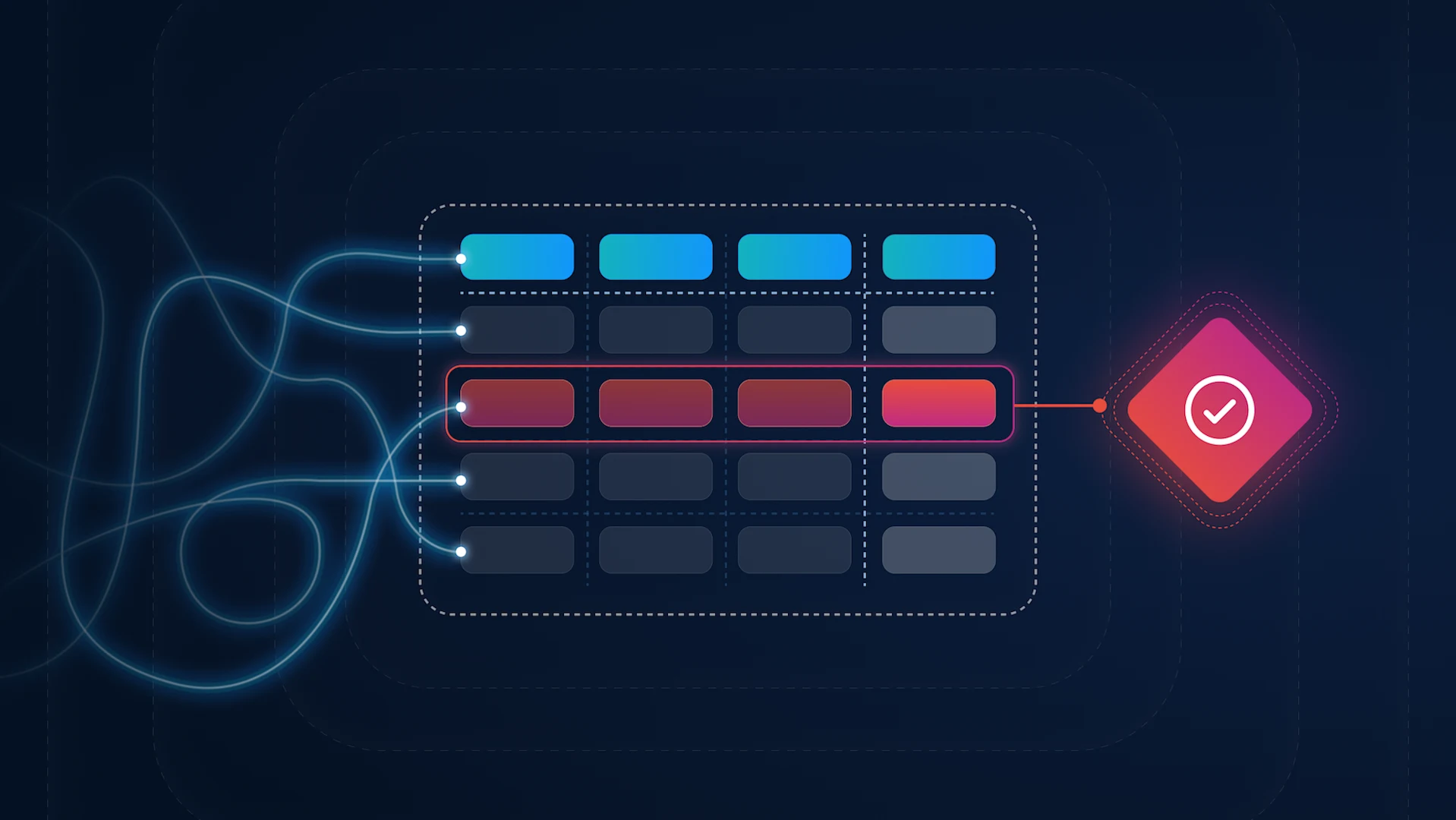
See a real decision table example for business rules automation, plus how Flowable models it using the open DMN standard.
Business process management software covers very different tools in 2026. See how the category shifted towards BOAT and what buyers should evaluate.
Client lifecycle management in banking goes beyond onboarding. See how case management keeps client context intact through KYC, reviews and offboarding.