
As AI agents become more autonomous — and more embedded — in enterprise workflows, a new challenge emerges: how to make AI agents reliable, scalable, and governable in practice.
As a software entity, an AI agent is designed to perceive its environment, make decisions, and act autonomously to achieve set goals. They leverage artificial intelligence techniques such as machine learning, natural language processing, and reasoning to interact with their surroundings, including humans, other systems, and tools. They range from simple, task-specific bots, to sophisticated agents capable of addressing dynamic, multi-step goal-oriented actions.
Which means effective control and governance are needed to accompany them within a business context.
How much autonomy should an AI agent have?
When and where should a human be involved in reviewing or overriding the decisions of an AI agent?
Environment and context play a key role in them functioning effectively. Providing structure — both in the input and context that guides an agent’s behavior, and in the generated output — is essential to ensure reliable outcomes. This article will walk you through how to define agent autonomy, apply governance guardrails, and use structured orchestration to make AI agents more reliable and scalable in enterprise environments.
AI agents can operate with configurable levels of autonomy, from full human oversight with validation at every step to complete autopilot mode with continuous monitoring capabilities.
Organizations can onboard AI agents like new employees by combining global knowledge from large language models with local business rules, data, and protocols through retrieval-augmented generation.
Flowable's case model management provides AI agents with structured context, state awareness, and access to relevant data while maintaining governance throughout the agent's lifecycle.
Human-in-the-loop integration allows organizations to track intervention frequency, refine agent performance, and deploy secondary AI agents to review outputs and determine when human involvement is required.
Enterprise AI agent governance typically evolves in stages, as organizations move from experimentation to scaled, business-critical use. Understanding where your organization is today helps determine what level of structure, oversight, and control is needed next. Here are the most common stages:
Experimental and manual: AI agents are used in isolated tasks or pilots, often with heavy human oversight and ad hoc controls. Governance relies largely on manual review, with limited consistency or repeatability across use cases.
Structured and supervised: Agents are embedded into defined workflows with clearer rules around inputs, outputs, and decision boundaries. Human-in-the-loop review is formalized at key steps, and early guardrails are introduced to manage risk and reliability.
Orchestrated and governed: AI agents operate within structured processes or cases that provide context, state awareness, and access to approved data. Autonomy is configurable, monitoring is continuous, and governance is enforced across the full agent lifecycle.
Scaled and adaptive: AI agents operate autonomously across multiple processes, with real-time monitoring, auditability, and automated escalation when exceptions occur. Human oversight and secondary AI review are applied dynamically, enabling scale without sacrificing control.
The following sections provide practical steps for governing AI agents in enterprise workflows. You don't need to implement these in order — start where your organization is right now. Early-stage implementations might focus on autonomy guardrails and human oversight, while more mature deployments will leverage the full governance framework.
Asking "what should an AI agent be allowed to do on its own?" is a fundamental question as organizations move from experimental to more orchestrated AI use.
The good news is that defining and managing AI agents in a controlled and governed manner is an achievable priority. Flowable’s automation software allows you to define the autonomy for each of your AI agents based on what your organization is comfortable with.
Some agents might require strict governance, with every step subject to human review. For example, you might add a human in the loop directive within a process to validate decisions or verify data extracted by an agent at certain stages before moving forward. This is one way to ensure control over outcomes in precision and compliance critical processes.
At the other end of the spectrum, fully autonomous agents can operate in more of an ‘autopilot’ mode, independently taking decisions and actions. In this case, the Flowable Platform gives you the power to monitor and govern AI agent performance, ensuring they remain aligned with your defined goals.
You might add a human in the loop directive within a process to validate decisions or verify data extracted by an agent at certain stages before moving forward.
Deploying your AI agents with Flowable also allows you to put guardrails in place for fully autonomous agents by providing available data, context, and expected outcomes so that they dynamically select the next best action based on these, to ensure you’re driving efficiency and scalability without compromising oversight and direction.
You can also opt for more restrictive configurations initially to build trust and gain experience with AI agents, while also hashing out the guard rails you’ll need in place. Over time, as confidence in the system grows, you can adjust this and gradually extend the autonomy of your agents within specific processes while maintaining full compliance and end-to-end regulation.
Large language models can be used as the foundation training for an AI agent to equip it with access to vast, global knowledge, especially as teams progress toward more structured and supervised AI use. While this is powerful, it’s also often insufficient when more specific and localized expertise is required. This enables the handling of a wide range of tasks, from extracting commonly known information, like addresses, to composing meaningful content, such as emails or customer responses. While this is powerful, it’s also often insufficient when more specific and localized expertise is required.
Your organization has its own unique requirements. And will have specific rules for decision-making or protocols for handling certain tasks. For example, a bank's credit card application process follows set rules and relies on critical data points. These nuances reflect local knowledge that can be used to effectively onboard your AI agents — much like training a new employee to be up to speed with your internal operations.
Orchestrating and building AI agents with Flowable means you can leverage “retrieval-augmented generation.” This sets parameters for your AI upon receiving a query to first retrieve relevant documents or data from a set of sources specified by you, in a local knowledge base. That information is then combined with its existing knowledge to ensure apt responses and actions. Which allows you to enhance your agents by enriching them with your organization's local rules, data, and contextual information where and when necessary.
By combining the broad capabilities of global knowledge with tailored, localized expertise, you gain complete control over what information is available to AI agents. And that ensures tasks are performed with accuracy and precision, while aligning with your organizational needs.
For your AI agents to operate effectively they need the right context. Which means access to structured data they can understand and build upon. For simple task-based agents, well-defined input and output data may be sufficient. But more complex agents will need a deeper awareness of their operating state to understand when human intervention is needed, when external services should be invoked, or how to adapt based on evolving information.
Flowable’s case model management, designed for agile process automation, is perfect for just that. By embedding AI agents within a case model — essentially a blueprint for how to handle a specific but fluid situation — organizes all the steps, information, and actions an AI agent needs to take to get the job done specifically as it should, even as unpredictable events occur.
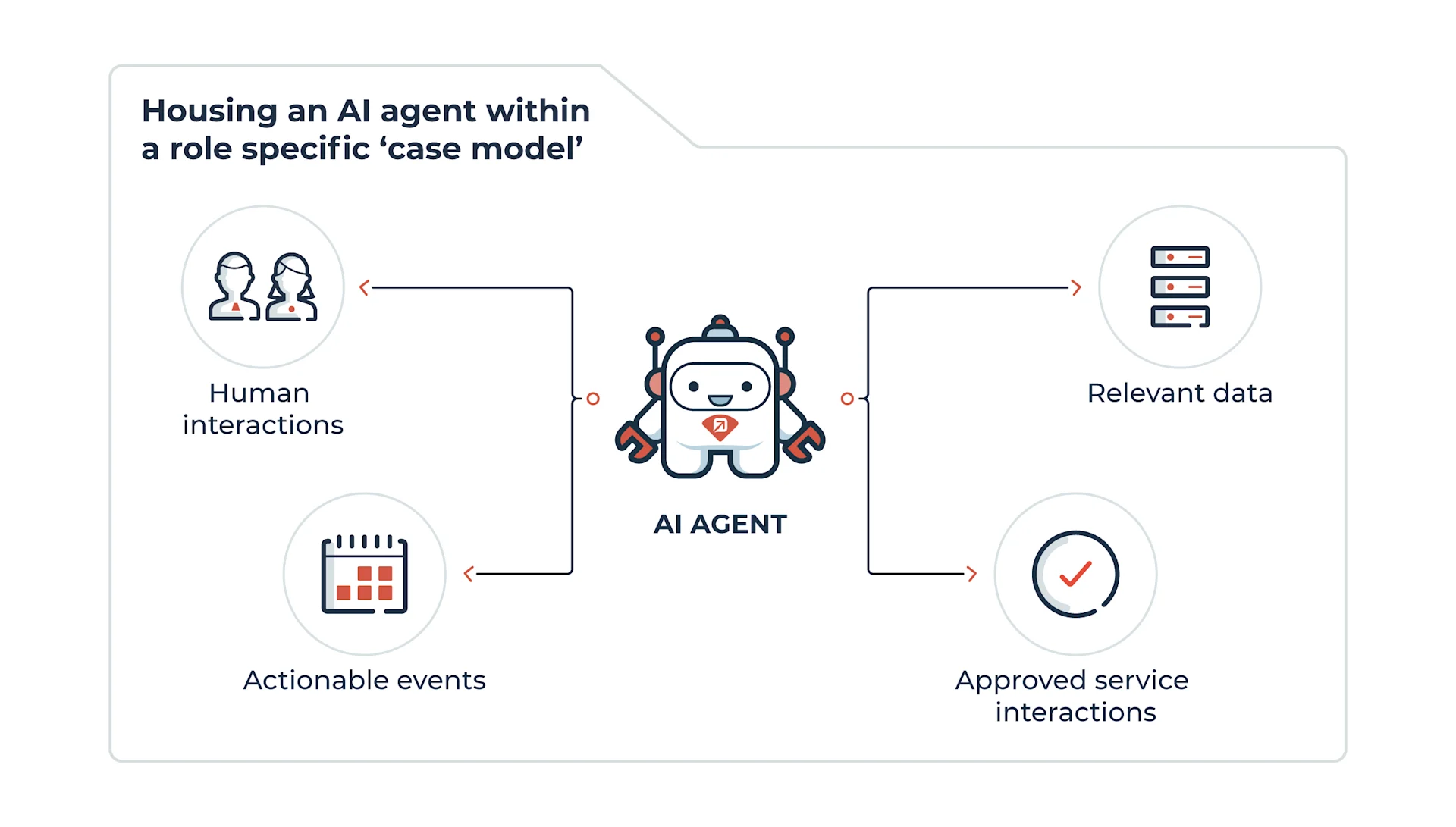

This provides a structured environment that maintains state, context, and governance throughout an agent’s lifecycle. The case that you assign to an agent ensures it has access to all relevant data, events, and service interactions while also enabling human-in-the-loop oversight where necessary.
By situating AI agents within automation cases in Flowable, organizations gain precise control over how the agent operates, what data it uses, and how it interacts with its environment. This structured approach ensures that agents are not just intelligent but also context-aware: acting with purpose and accuracy while aligning to business goals.
Human-in-the-loop oversight helps organizations balance AI autonomy with accountability, especially in processes where accuracy, compliance, or trust matter. For instance, an AI agent might extract and analyze data from a loan application, but a human reviewer validates the credit decision before approval — ensuring both efficiency and regulatory compliance.
Flowable provides a practical way to bring human-in-the-loop oversight into enterprise AI workflows when accuracy and accountability matter.
With Flowable, the level of autonomy for each agent becomes entirely configurable — ranging from full autopilot to observed or assistive modes — depending on the specific task, use case, and context. Even when an AI agent operates autonomously, extracting structured data, making decisions, or providing analysis, a human can still be involved to review and refine the output before it moves forward, following your configuration.
But beyond optimized manual oversight, Flowable also enables continuous monitoring and improvement. You can track how often human intervention is required and use this feedback to either refine the agent’s learning process or adjust its model and prompts for better results. Additionally, secondary AI agents can be assigned to review outputs and determine whether human involvement is needed, factoring in elements like sentiment when the agent is used in customer interactions.
Flowable Agentic Case Platform is an enterprise-grade platform for designing, governing, and orchestrating AI agents within mission-critical business workflows. It transforms disconnected AI tasks into secure, compliant, and fully traceable processes through multi-agent orchestration, real-time monitoring, and built-in governance controls. By combining structured process and case modeling with flexible agentic AI, Flowable enables organizations to move from isolated AI experiments to scalable, enterprise-ready automation, without losing oversight or control.
Try out Flowable Agentic Case Platform today and see how you can scale AI agents with confidence, accuracy, and control.
Organizations should begin with tightly governed AI agents that operate under human-in-the-loop controls through a platform like Flowable. As reliability and confidence improve, you can expand autonomy incrementally.
Early deployments should limit agents to well-defined tasks with structured inputs and outputs, while monitoring intervention frequency, error rates, and decision quality. As agents consistently meet governance requirements, autonomy can be extended within specific processes by adjusting guardrails, expanding access to data, and reducing mandatory human approvals.
Human-in-the-loop review should be required whenever AI agent decisions impact regulatory compliance, financial outcomes, customer trust, or legal accountability. This includes scenarios involving data validation, risk assessment, customer communications with emotional or reputational impact, and decisions made under uncertainty or an incomplete context.
Human review is also essential during early deployments or when agents encounter exceptions, low-confidence outputs, or novel situations that fall outside of predefined rules and training data.
Enterprise AI agents should operate under clear guardrails that define allowed actions, data access, decision boundaries, and escalation paths to humans.
Key controls include:
Structured input/output schemas
Access only to approved data via RAG
Explicit workflow/state management
Configurable autonomy levels
Business process management software covers very different tools in 2026. See how the category shifted towards BOAT and what buyers should evaluate.
Client lifecycle management in banking goes beyond onboarding. See how case management keeps client context intact through KYC, reviews and offboarding.
n agentic workflow is more than a multi-agent diagram. See what the standard patterns omit once workflows meet exceptions, oversight, and audit requirements. Primary keyword: agentic workflow
