
The insurance industry faces unique challenges compared to other sectors, often dealing with large volumes of unstructured data and unpredictable scenarios. From responding to natural disasters to managing complex risk profiles, the industry demands efficiency without sacrificing accuracy.
Agentic AI offers a solution. Unlike traditional AI that follows pre-programmed rules or generative AI that creates content, agentic AI can handle complete workflows by analyzing situations, determining actions, and executing tasks to achieve specific objectives.
This article explores how insurers are deploying agentic AI across four critical use cases, including claims processing, underwriting, policy renewals, and fraud detection. You'll also learn how platforms like Flowable help insurers maintain governance and compliance while automating mission-critical workflows, enabling them to operate faster and more efficiently without sacrificing the oversight regulators demand.
AI orchestration improved claims accuracy by up to 99.99% by automatically classifying severity, cross-referencing policy data, and routing complex cases to human adjusters.
Flowable's BPMN and CMMN frameworks enable insurers to combine AI automation with human decision-making, reducing processing times and operational costs while maintaining the compliance and governance critical to regulated industries.
AI automations reduce insurance fraud by continuously monitoring claim patterns and correlating data from multiple sources, helping combat the $308.6 billion annual cost of fraudulent claims.
Agentic AI refers to autonomous systems that independently pursue goals, make decisions, and take actions without constant human oversight. In insurance, this represents a fundamental shift from how AI has traditionally been used:
Traditional AI: Follows pre-programmed rules (if X happens, do Y)
Generative AI: Creates content based on prompts and learned patterns
Agentic AI: Analyzes situations, determines the best course of action, and executes tasks to achieve defined objectives
In practice, this means AI agents can accomplish far more than traditional systems while maintaining greater accuracy. For instance, when processing a claim, an AI agent doesn't just extract data — it classifies severity, cross-references policies, checks external data sources, calculates damages, and routes the claim appropriately. Each step builds on the previous one, adapting based on what it discovers.
These capabilities mean that AI agents can create tangible value across core insurance operations in ways that you may have never thought possible before.
AI agents can transform insurance operations, but with so many potential applications, it's hard to know where to begin. These four use cases deliver the fastest returns and should be on every insurer's automation roadmap for 2026.
One of the most time-sensitive areas in insurance is claims processing. After major events like storms, insurers can receive hundreds of new claims within a short period. Each claim must be assessed for validity and severity, assigned to an adjuster, and tracked through resolution. Traditionally, this process involves manual triage, data entry, and coordination across multiple systems, leading to delays and potential errors.
AI agents enhance this process by automating critical steps through integrations between Flowable and policy databases, weather information services, and internal systems. They classify claims by severity, cross-reference policy data, and estimate potential damages using external data sources. The system can automatically assign the claim to a local adjuster when it meets specific criteria. However, more complex or high-value claims needing human oversight can be routed for intervention. This approach ensures timely responses and minimizes human triage, allowing staff to concentrate on the most challenging cases.
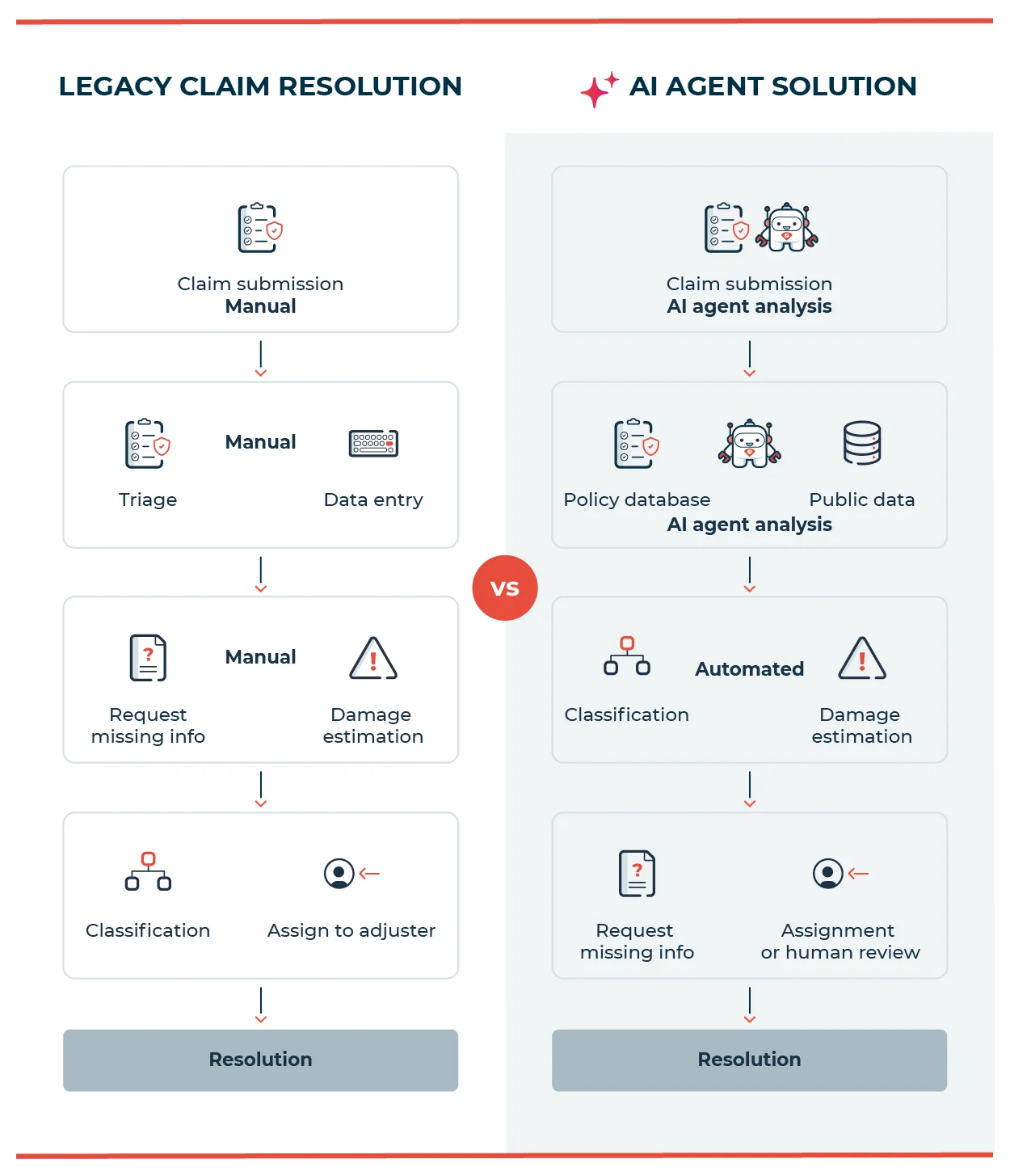

Forbes discovered that AI in insurance led to a 99.99% enhancement in claims accuracy and a 95% improvement in customer experience.
To manage these processes efficiently, Flowable allows insurers to use Business Process Model and Notation (BPMN) and Case Management Model and Notation (CMMN) frameworks. BPMN is an industry standard for modelling business processes in a structured and repeatable way, while CMMN focuses on handling dynamic, unpredictable tasks that require human judgment. In the context of claims processing, BPMN might govern routine steps like initial data gathering, while CMMN enables flexible triage and escalation processes when the situation requires human input.
AI agents also improve traceability by recording every action within a case management model. This structured approach centralizes data and provides a complete audit trail, essential for compliance and quality assurance. Using the case management frameworks within Flowable, insurers can monitor claim progress, trigger human involvement when needed, and ensure consistent follow-ups, all from a single system.
Or, meet with a Flowable expert for a demonstration tailored to your business use.
Underwriting complex policies, such as life or specialty insurance, often requires gathering medical records, financial data, and input from external experts. This data must be processed, verified, and cross-referenced before any risk assessment can occur. Manually handling these steps can slow down the process and increase potential errors.
AI agents assist by automating data retrieval from multiple sources, identifying anomalies, and flagging potential risks. For example, when underwriting a life insurance policy, the agent can access medical databases and financial histories using REST APIs, highlight discrepancies, and escalate questionable cases to human underwriters. With the policy approved, the system can generate the necessary documentation for approval or e-signature. The entire workflow is managed within the Flowable case management environment, allowing underwriters to track progress, access relevant data, and maintain clear records throughout the decision-making process.
By leveraging CMMN and BPMN within Flowable, insurers can combine structured data processing with flexible decision-making. BPMN handles tasks that follow a set sequence, while CMMN addresses scenarios where human input or decision-making is necessary. This dual approach ensures that AI agents can efficiently handle routine data checks while flagging complex cases for more thorough review.
Renewal processes are essential for maintaining customer relationships, but they often lack any form of personalization. Insurers commonly send out generic notices without considering individual customer needs or recent changes, missing opportunities for upselling or coverage adjustments, and making customers feel undervalued.
AI agents can use Flowable’s case management to monitor each policy’s renewal window and automatically analyze usage patterns, claims history, and recent policy updates to craft personalized proposals. For example, if a customer has recently added a dependent, the agent might suggest updating a life insurance policy. By leveraging data integration to associated systems through REST APIs, the agent can gather relevant insights and create highly targeted offers. If the system detects a potential coverage gap, it can trigger a follow-up with a sales representative. This proactive engagement helps build customer loyalty and ensures clients receive the most relevant insurance solutions.
Insurance fraud is a persistent issue, with companies losing billions yearly to false or exaggerated claims. However, detecting fraud manually is challenging, as it often involves spotting subtle patterns and inconsistencies.
The Coalition Against Insurance Fraud claims that insurance fraud is the crime we all pay for, costing consumers more than $308.6B each year.
AI agents help by continuously monitoring claim data, identifying unusual patterns, and correlating inputs from various sources. Using connections to data sources such as law enforcement databases, previous claims records, and anomaly detection algorithms, Flowable’s AI agents can flag suspicious claims for further review. For instance, if a high volume of similar claims arrives from the same area after a minor incident, the system may flag these for additional scrutiny. By integrating these checks into the workflow, insurers can identify potential fraud earlier, reducing the risk of paying out false claims.
The regulatory landscape for AI in insurance is evolving rapidly. As of late 2025, nearly half of all US states have adopted the National Association of Insurance Commissioners' Model Bulletin on AI systems, establishing a framework for responsible AI deployment.
These regulations require insurers to implement documented governance programs emphasizing transparency, fairness, and accountability. Plus, the bulletin expects insurers to maintain documented AI governance programs, robust documentation and controls (including traceability of AI usage), to analyze and minimize bias, and to maintain human‑centric oversight over AI that affects consumers.
Regulators are particularly focused on third-party AI vendors, with insurers maintaining full responsibility for any models they deploy, regardless of whether they're built in-house or acquired externally.
Flowable addresses these governance requirements through its BPMN and CMMN frameworks, which provide built-in traceability and compliance controls. Every AI agent action is logged within the case management model, creating the complete audit trail regulators expect. The platform enables insurers to define when human intervention is required, ensuring AI automation doesn't operate without oversight. This structured approach also simplifies vendor management, allowing insurers to monitor third-party AI performance and maintain documentation for regulatory examinations.
The key is balancing innovation with accountability. AI agents can transform insurance operations, but only when deployed within governance frameworks that ensure transparency, fairness, and regulatory compliance. Flowable provides that foundation, enabling insurers to automate confidently while meeting evolving regulatory expectations.
The insurance landscape is constantly evolving, and the role of AI agents within this space will change accordingly. Flowable allows insurers to integrate AI agents into core operations using REST APIs and robust case management models, alongside BPMN and CMMN frameworks, positioning them to proactively reduce manual workload, maintain compliance, and deliver faster, more personalized service.
Implementing AI agents requires thoughtful integration with existing systems to ensure data accuracy and process reliability. As insurers continue to leverage AI-driven solutions, the key will be balancing automation with human insight to build a more responsive, efficient, and customer-focused insurance experience. The tools to achieve this balance already exist within Flowable. The question is, are you ready to make the most of them?
Try Flowable today and see how you can orchestrate AI agents across your claims processing, underwriting, and fraud detection workflows while maintaining the governance and compliance your organization needs.
AI agents automate claims processing by classifying claim severity, cross-referencing policy databases, and estimating damages using external data sources like weather information services. Routine claims that meet specific criteria are then automatically assigned to local adjusters, while complex or high-value claims are routed to human experts for review. This automation reduces manual triage time and improves response speed during high-volume events like forest fires, earthquakes, or floods.
AI agents detect fraud by continuously monitoring claim data and correlating inputs from law enforcement databases, previous claims records, and anomaly detection algorithms. If the system notices any suspicious patterns, like high volumes of similar claims from the same area, it will be flagged for human review. This proactive monitoring helps insurers identify the subtle inconsistencies that characterize fraudulent claims before payouts occur.
AI agents offer personalized renewal recommendations by analyzing each customer's usage patterns, claims history, and recent life changes during renewal windows. For example, if a customer recently added a dependent, the agent might suggest updating life insurance coverage.

Head of Customer Success
Flowable

Business process management software covers very different tools in 2026. See how the category shifted towards BOAT and what buyers should evaluate.
Client lifecycle management in banking goes beyond onboarding. See how case management keeps client context intact through KYC, reviews and offboarding.
n agentic workflow is more than a multi-agent diagram. See what the standard patterns omit once workflows meet exceptions, oversight, and audit requirements. Primary keyword: agentic workflow