
A bank's AI agent approves a high-value wire transfer at 02:14 on a Sunday. The agent had access to the customer's transaction history, the counterparty's risk profile, and a clean sanctions feed. The agent reasoned well and logged every step.
Two days later, a compliance officer asks who authorized releasing funds and on what basis. The audit trail shows the agent's decision. It does not show which other systems the agent consulted, in what order, and which inputs weighted most. Or whether a human should have reviewed the threshold before funds moved.
The agent's framework recorded the agent's reasoning. Nothing recorded the process around the agent: which policy version was in force, how cross-system context was assembled, why no human reviewer was inserted at that threshold.
Because no layer above the agent was capturing those facts, they were gone by Tuesday morning. The compliance officer cannot defend the decision, the bank cannot promise the next audit will go better, and every subsequent transfer the agent approves carries the same exposure until something above the agent starts keeping the record.
Agentic AI has crossed from demonstration into production faster than most enterprises planned for. According to International Data Corporation (IDC), 50% of organizations already have ten or more agents in production, with 65% expecting full deployment within two years.
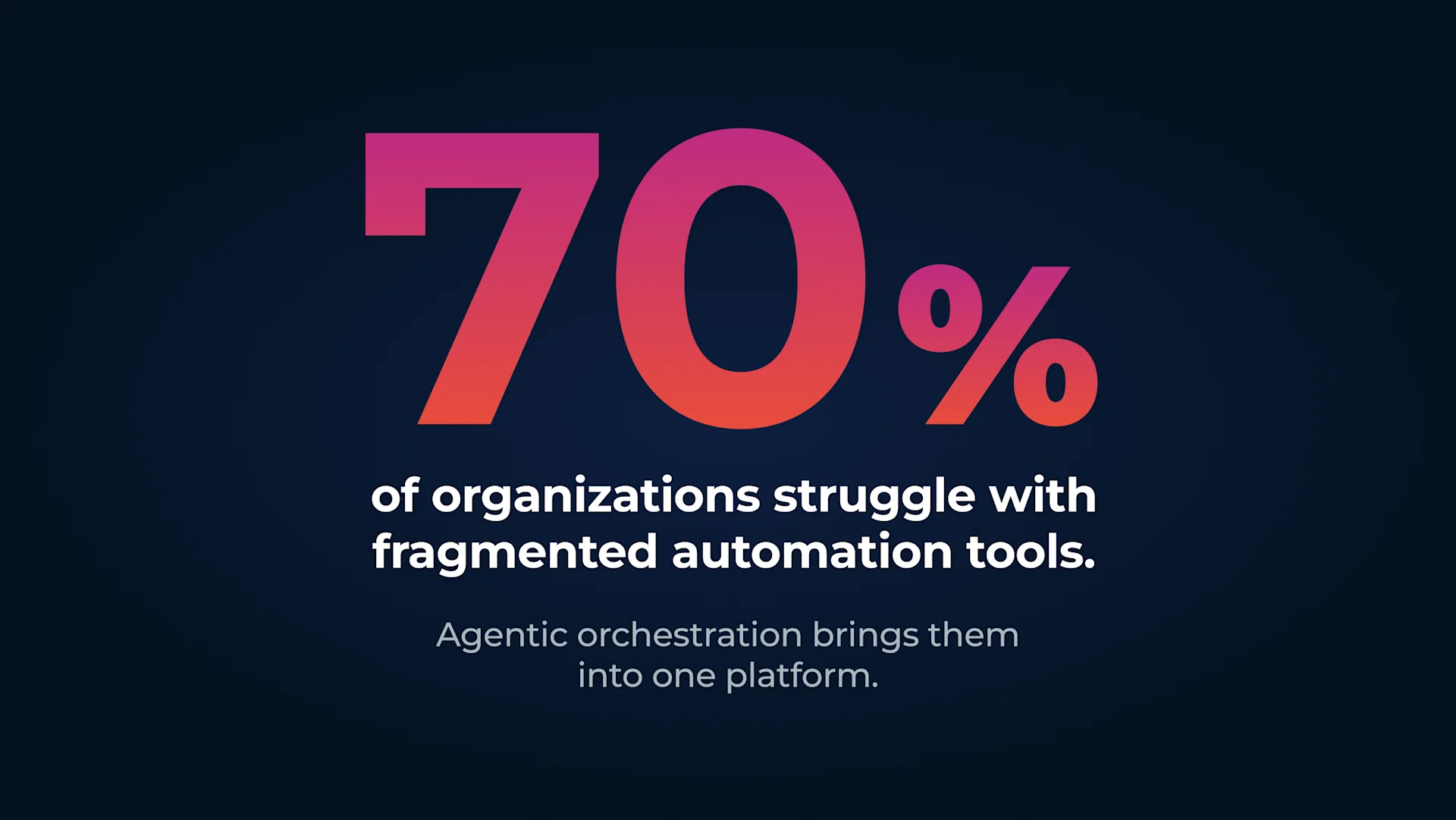
The agents work. They reason, call tools, pass context, and complete tasks that would have required human judgment a year ago. The orchestration layer has not kept pace. Gartner predicts over 40% of agentic AI projects will be canceled by the end of 2027, citing inadequate risk controls as a primary cause.
Agentic orchestration is the software layer that coordinates AI agents, deterministic systems, and human decision-makers across an end-to-end business process. It assigns work to whichever actor is best placed to do it, maintains shared context as work moves between actors, and produces a complete audit trail of what happened, in what order, and on whose authority.
Multi-agent systems create capability. The orchestration layer creates accountability. Process orchestration has governed how enterprises coordinate people, systems, and decisions for decades. Agentic orchestration applies that same discipline to processes that now include AI agents alongside the people and systems already in the flow.
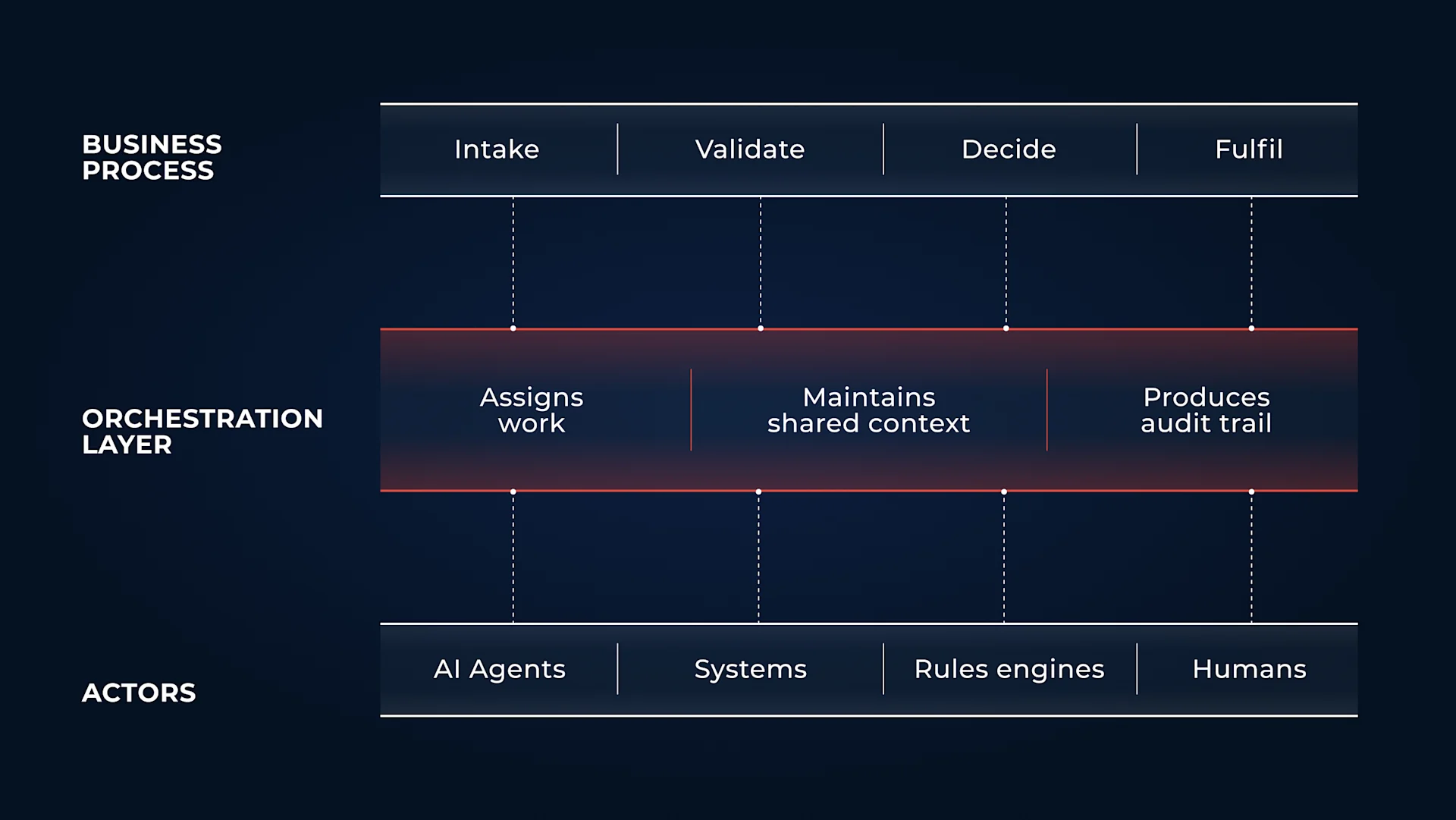
The distinction from an agent framework matters. A framework lets a single agent reason, call tools, and remember what happened earlier in its own task. The agent's interior life is one thing. Where the agent fits in the work the business does is another.
An orchestration layer governs the exterior: when an agent runs, what data it receives, where its output goes, who reviews it, what happens when it fails, and how the next actor picks up where it left off. Without that exterior, every deployment is a single agent doing a single job, and the business stitches everything else together by hand.
The same distinction separates agentic orchestration from enterprise workflow automation. RPA orchestration sequences deterministic bots through predictable steps. The bots do what they were configured to do, in the order specified, and the orchestration handles scheduling and exceptions.
Agents are not deterministic. They reason, and reasoning produces variation. An orchestration layer designed for agents must accommodate variation without losing control of the process: holding the agent to a defined role, checking its output against policy, and routing the result to the right next actor, whether another agent, a deterministic system, or a person.
The failure patterns are consistent across industries. They share a root cause: the agent did its job, but the process around it could not keep up.
An LLM-driven agent declines a credit application. The applicant complains. The bank's regulator asks for the reasoning.
The agent's log shows the inputs it received and the answer it produced, but the chain of reasoning has been summarized by the model and the supporting data has been pulled from four systems that no longer hold the same values. Reconstructing the decision is impossible. The bank cannot defend it.
Under the EU AI Act, high-risk AI systems in financial services must meet full explainability and auditability requirements by August 2026. Auditability is not a feature you bolt on after deployment. The design must build it into how agents are invoked, what context they receive, and how their outputs are recorded.
A claims process uses three agents: one to extract data from the customer's submission, one to triage severity, one to draft an initial response. Each agent works in isolation. Between them, information leaks. Research finds one in three agents lack the customer context needed at handoff and the consequences show up exactly here.
The extraction agent flags a possible fraud indicator. The triage agent never sees the flag because the first agent passed it as unstructured text in a handoff the second agent's prompt did not weight. The response goes out. The fraud team finds out a week later.
Agents working in sequence need to read from and write to a shared record of what the process knows. When context passes agent-to-agent in prompts, it gets summarized, reshaped, and degraded at every handoff. The first agent saw the fraud flag. The third never did, because nothing held the flag in a place the third agent had to check.
A procurement agent autonomously negotiates terms with suppliers under a set threshold. The threshold logic lives in the agent's prompt.
A supplier offers a discount that takes the deal under threshold while introducing an unusual indemnity clause. The agent accepts. Legal sees the contract two weeks later. The clause is unenforceable in the supplier's jurisdiction.
Human-in-the-loop is a process design question. The workflow must know which decisions require human judgment, route them to a human at the moment that judgment is needed, and pause until the human has responded. Treating human review as a catch-all at the end of an agent's run means most of the agent's work has already moved downstream before anyone has looked at it.
The hardest enterprise work is not linear. A complex onboarding might involve seven possible paths depending on what the KYC checks return, what the customer corrects, which jurisdiction owns the case, and whether a relationship manager intervenes.
A claim might progress, pause for medical records, restart with new information, and split into a fraud investigation that runs in parallel. Flowcharts built for predictable processes do not accommodate this.
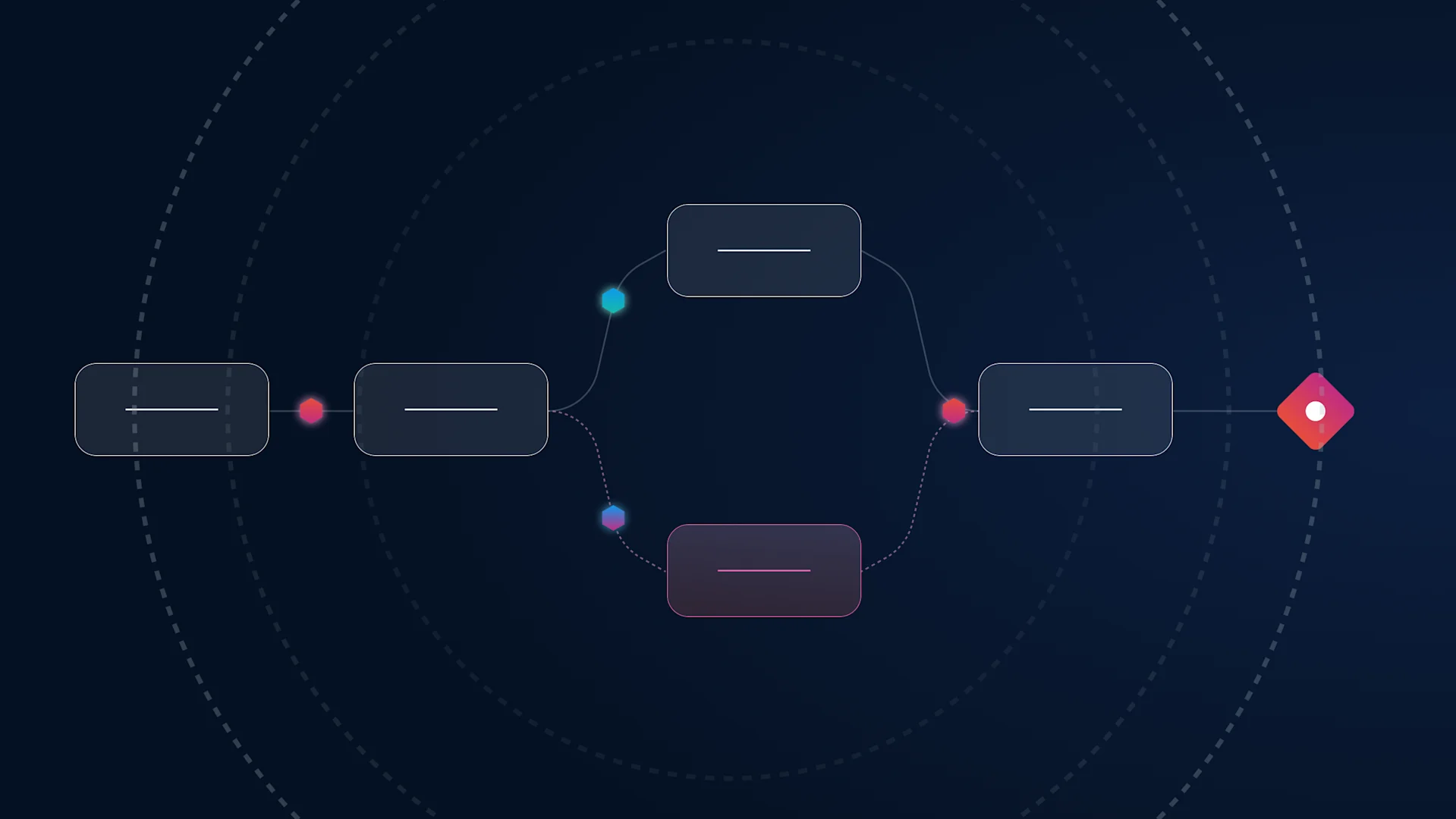
The orchestration layer's job is to model work which does not follow a single path. It holds a representation of the process including the branches the work might take, the conditions determining which branch is active, the points at which the process pauses to wait on a person or an external system, and the rules for how a paused process resumes when new information arrives.
The same process instance can split into parallel tracks, recombine when both complete, and reshape itself if the agent or the human discovers something invalidating the earlier path. The orchestration layer keeps all of this coherent without forcing the process into a structure the work does not have.
An agentic AI orchestration platform working on a controlled demo is not the same thing as one holding up under the conditions a regulated enterprise presents: thousands of concurrent process instances, processes running for weeks, audits arriving without warning, and the constant pressure to scale deployments and add new integrations without rewriting what already works.
Four properties carry the weight.
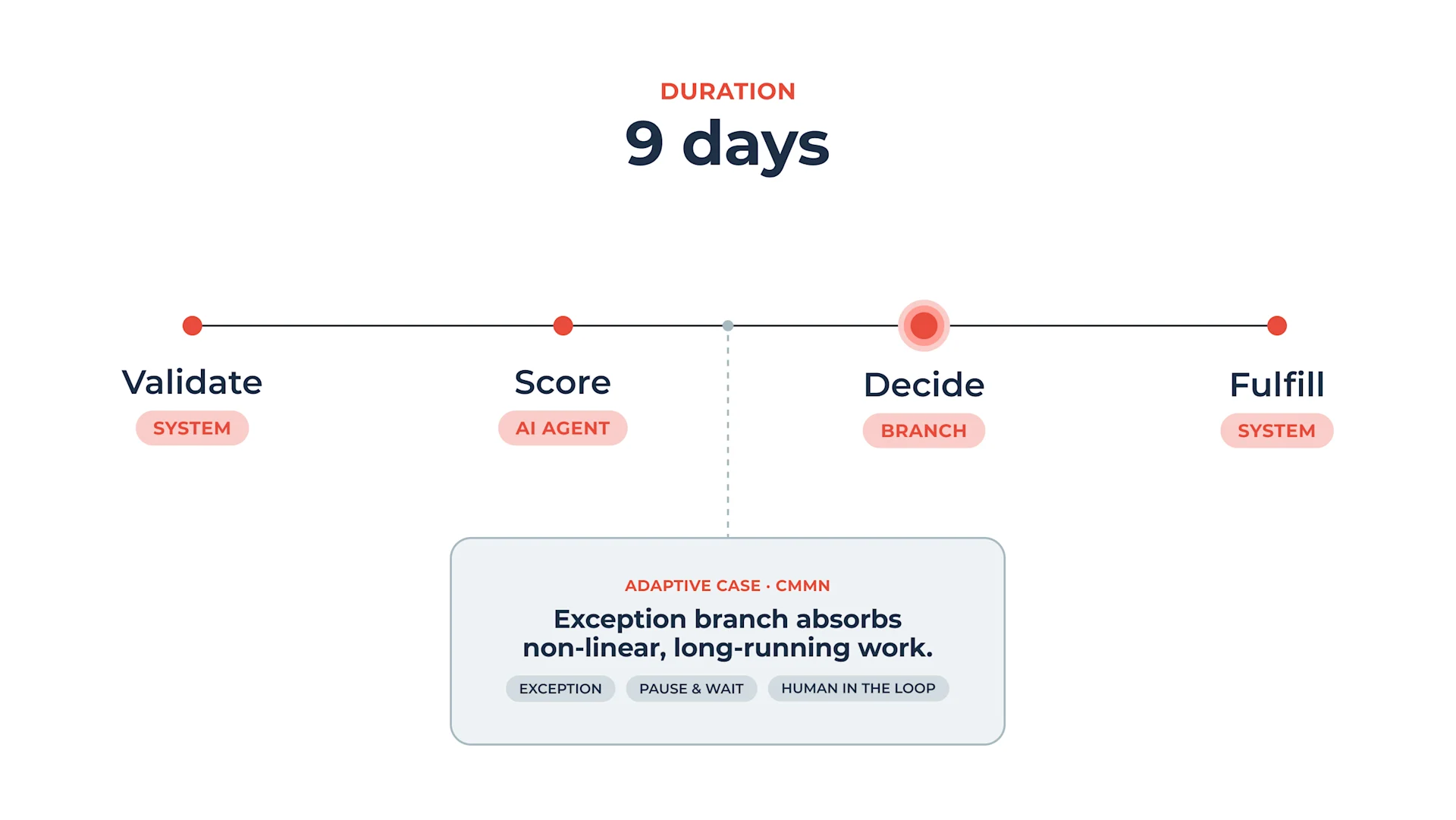
Enterprise processes contain predictable work and unpredictable work in the same flow. A loan application follows a defined sequence: validate, score, decide, disburse. An exception in that loan application does not.
BPMN (Business Process Model and Notation) is the standard for modelling predictable, structured work. CMMN (Case Management Model and Notation) is the standard for modelling adaptive, exception-driven work where the next step depends on what just happened. DMN (Decision Model and Notation) handles the rules that drive both.
An orchestration layer supporting only BPMN forces every process into a straight line, which means the judgment-heavy work either runs outside the platform or gets shoehorned into a structure obscuring what is happening.
The interesting enterprise work happens at the seams. An agent extracts data. A deterministic system validates it against a system of record. A human approves an exception. Another agent drafts the customer communication. A rules engine checks it against policy.
The mechanism that makes this work is a shared process instance that every actor reads from and writes to. Each actor receives typed, structured data rather than a natural language summary of what the previous actor did. A fraud flag set by the first agent is not passed as unstructured text into the next agent's prompt, where it can be summarised away.
It is a named field in the process record that every downstream actor must explicitly handle. The orchestration layer enforces that handling, which is why the audit trail stays intact across the full sequence rather than fracturing at each tool boundary.
An agent completing its work in 200 milliseconds is easy to orchestrate. A process taking nine days, because it's waiting on a customer to upload a document, then on an underwriter to assess it, then on a counterparty to confirm, is harder.
Persistent state must survive restarts, deployments, and the agent's own forgetfulness. The orchestration engine needs to know where each instance of the process is, what it's waiting on, and what to do if the wait exceeds expected time.
An LLM's reasoning trace is unstable. Ask the model to reconstruct its logic after the fact and you get a plausible account, not a verified one. An orchestration layer solves this by capturing structured records at the point of execution, the inputs passed to the agent, the policy version in force at that moment, the output produced and any human action taken. Because this is recorded at the orchestration layer rather than inside the model, it is stable, versioned, and independent of what the model would say if asked again.
Observability uses that same record to surface what is happening across running process instances in real time. Control means the process can be paused, redirected, or overridden without corrupting its state. All three depend on a process engine that treats every actor's action as a durable, structured event.
The value is sharpest in industries where every agentic AI workflow carries regulatory weight: decisions must be explainable, exceptions are inevitable, and someone needs to prove afterwards what happened and why.
H3: Financial services
Transaction monitoring escalations are the clearest example. A monitoring system flags an unusual pattern. The standard playbook covers most cases.
The remaining cases require investigation that may pull in sanctions data, customer correspondence, related accounts, and human judgment about whether to file a suspicious activity report. An agent can do much of this work. The orchestration around it determines whether the bank can defend the decision to the regulator afterwards.
High-stakes onboarding and trade exception handling within financial services have the same shape: predictable in the center, judgment-heavy at the edges, all of it auditable.
Claims triage with anomaly detection sits in the same territory. Most claims process without issue. A meaningful minority show patterns that suggest fraud, ambiguous coverage, or unusual loss circumstances.
An agent can read the claim, pull related data, flag the anomaly, and recommend a path. The orchestration determines what happens next: which adjuster takes it, what evidence they see, when the customer is contacted, how the decision is recorded.
Underwriting non-standard risks follows the same pattern. Each non-standard case is its own small project. The orchestration handles it as one.
These are not industries that need more AI. They need AI that operates inside a process that can prove what happened, why, and on whose authority. The cases where that matters most are explored in our article on agentic case management.
Most agentic AI orchestration evaluations compare feature lists. Every vendor claims agents, humans, integrations, and an audit trail. AI agent governance is what determines whether any of it holds up under scrutiny. The questions that matter are about architecture.
BPMN, CMMN, and DMN are ISO standards. Models written in them are portable, readable without vendor tooling, and defensible to regulators. A proprietary modelling language creates lock-in that compounds every time you extend the platform.
Pro tip: For a deeper look at how open standards hold up under regulatory scrutiny, Flowable's on-demand webinar Agents in Regulated Industries: Open Standards walks through the architectural reasoning in detail. Worth watching before shortlisting vendors.
Long-running processes in regulated industries can span days or weeks. A platform that cannot migrate running instances cleanly forces you to choose between operational continuity and keeping your deployments current. A trade-off regulated businesses can’t make consistently.
A designed review step runs every time on defined criteria. A fallback triggered by agent uncertainty runs inconsistently on criteria the vendor controls.
A regulator needs to reconstruct what happened, who or what did it, and why. A trail limited to agent actions cannot do that when the process spans agents, deterministic systems, and people.
Flowable’s agentic case platform runs BPMN, CMMN, and DMN in a single process orchestration platform, so structured and exception-driven work share one model, one context, and one audit trail. Agentic, deterministic, and human steps are all first-class participants in the process, not integrations bolted around it. In-flight process instances survive agent updates and model redeployments without data loss or manual intervention.
The architectural decisions that determine whether you can defend a process to a regulator are made at design time, not after an audit letter arrives. Most enterprises have proven their agents operate. The question now is whether your agentic AI orchestration can produce processes the business, the auditor, and the regulator can stand behind. That is what the layer underneath does.
Book a demo to see how Flowable orchestrates agentic AI in regulated enterprise environments.
n agentic workflow is more than a multi-agent diagram. See what the standard patterns omit once workflows meet exceptions, oversight, and audit requirements. Primary keyword: agentic workflow
Automating single functions leaves the process broken at the handoffs. See why end-to-end orchestration beats function-by-function financial process automation.
A criteria-led framework for evaluating workflow orchestration tools, covering open standards, governance, exceptions, and lock-in, not another ranked listicle. Keywords: workflow orchestration tools