In banking and insurance, the mandate to adopt AI arrived before the means to govern it. A model that makes a lending decision does not absorb responsibility for that decision. The institution does, and inside the institution, a named person does. Accountability stays with that person whether or not the system they authorized can be explained afterwards.
Risk and transformation leaders have stopped debating whether AI can be used in a regulated process. They are deploying it, and they are accountable for demonstrating control over it on demand. Most AI process governance today cannot demonstrate anything of the kind.
It consists of a policy, a model inventory, a monitoring dashboard, and reports assembled after the fact, which together satisfy an AI governance process on paper without proving that a single control operated when the process ran. That gap between paper and practice is what separates responsible AI automation from automation with a compliance file attached to it.
Governed AI automation describes the alternative: automation in which the controls execute as part of the process rather than sitting beside it. This article sets out what the term means, what an auditor needs to see, and why the layer that runs the process, rather than the layer watching it, is what makes control provable.
Governed AI automation is automation in which the controls are part of how the process runs, rather than a layer observing it from outside. The rules about who can decide what, what gets recorded, and where a person must intervene are properties of the process itself.
They execute when the process executes. They cannot be skipped, because skipping them would mean not running the process.
Set that against the common meaning of AI governance, which describes an organizational practice: policies, committees, model registries, risk assessments, periodic review. That practice is necessary.
Standards including ISO/IEC 42001 and the NIST AI Risk Management Framework describe how to establish it, and most institutions do not operate without one. But a management system describes what should happen. It does not enforce what does happen. The distance between the two is where audit findings live.
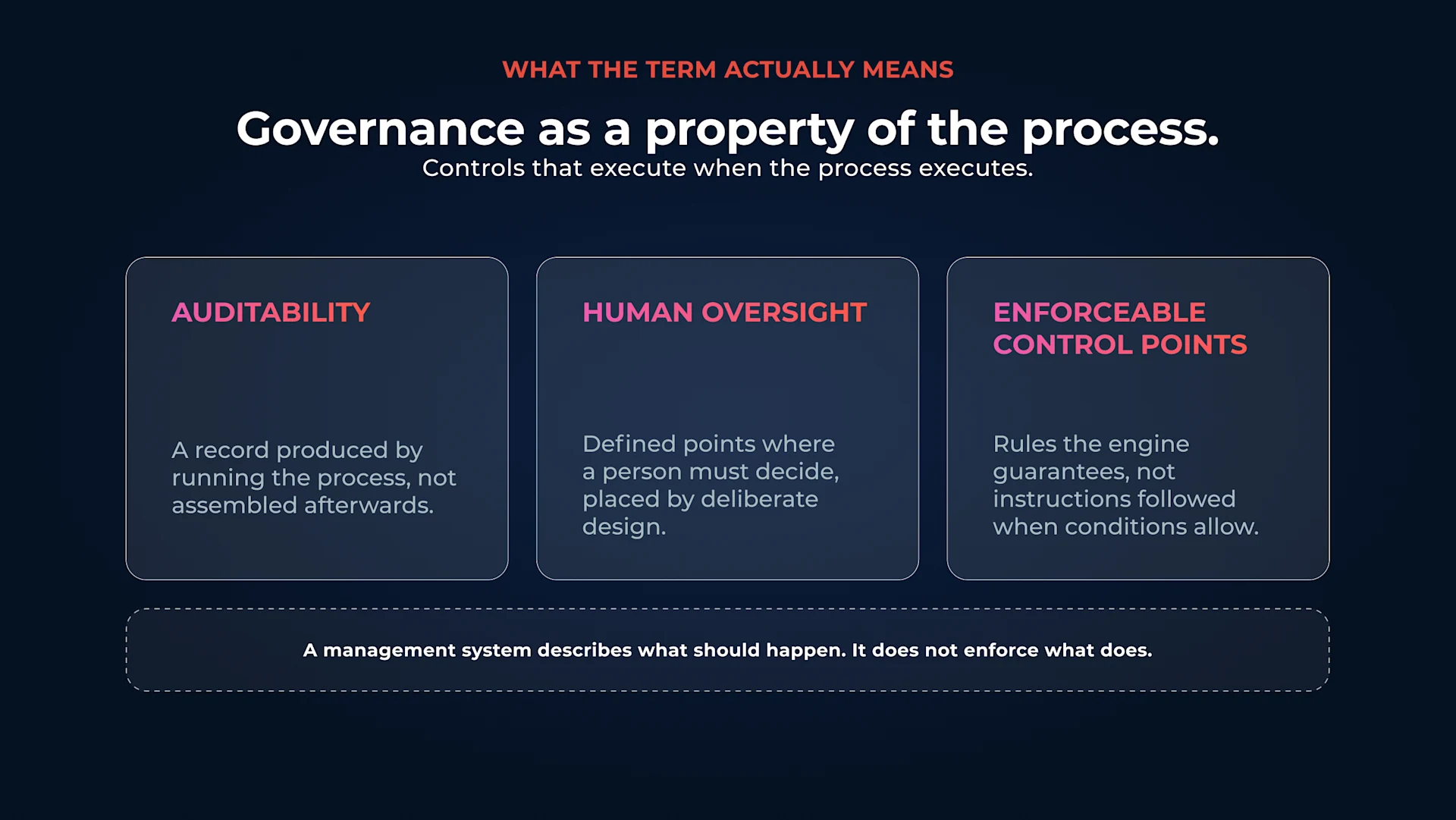
Three pillars separate governed AI automation from governance as documentation.
A complete record of what the system did, what a person did, and why each decision was made, produced as a byproduct of running the process rather than assembled afterwards.
Defined points where a person must decide, chosen deliberately and placed in the process by design.
Rules the process guarantees, rather than instructions the system follows when conditions allow.
AI process governance meets this standard when a control cannot be violated by the running system.
Take any control an institution claims to operate. If what prevents its violation is a policy, a training module, or a review conducted afterwards, the control describes intended behavior.
If what prevents it is something the execution engine will not do, the control operates.
The governance platform market has settled on a shape: a control layer that sits beside the systems doing the work, holding the model inventory, mapping policies to controls, monitoring outputs, and logging what it observes.
These products are right about the principle. Control has to be built in rather than retrofitted, and accountability cannot be outsourced to a model.
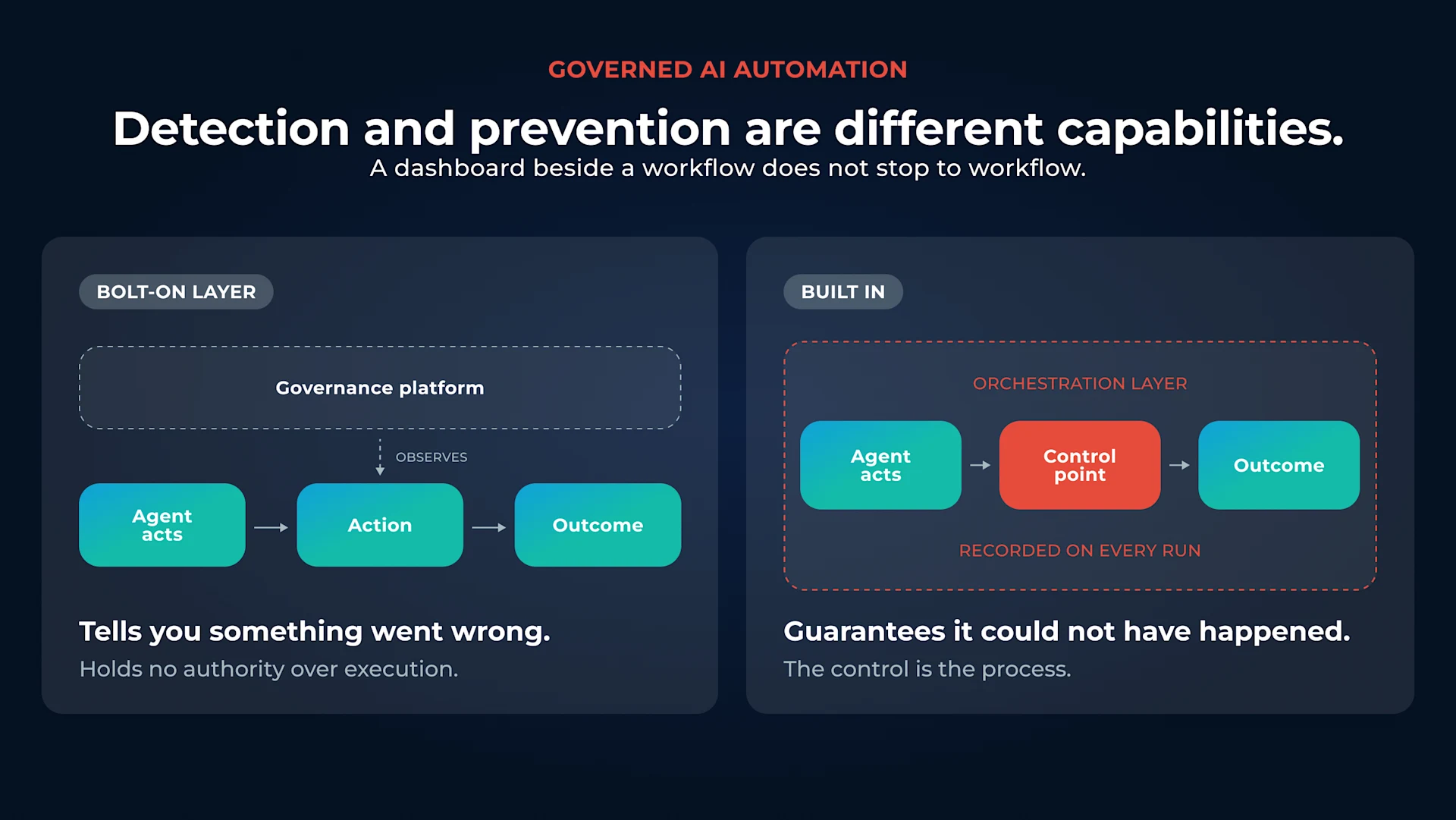
The difficulty is what a monitoring layer can and cannot do. It observes. It can tell you that something went wrong, sometimes quickly. It cannot guarantee that the thing could not have happened, because it holds no authority over execution. A dashboard beside a workflow does not stop the workflow.
A retrospective log of an AI agent's tool calls does not prevent the call. Detection and prevention are different capabilities, and an obligation to keep a process inside defined limits is satisfied by the second.
That obligation, in regulated industries, is specific. You are required to maintain audit trails, to demonstrate that human oversight occurred where it was required, and to explain the reasoning behind decisions that affect customers.
Human oversight of high-risk systems is written into law as a design requirement, meaning the system must be built so oversight is possible, rather than have oversight promised around it.
Provable control has to be intrinsic to the process. Anything else produces an account of what happened, offered in place of evidence that it could not have happened otherwise. In an audit, unprovable control and no control produce the same finding.
Strip away the frameworks and an audit of an automated decision comes down to three demands.
The record covers the outcome, the inputs, the decision logic applied, the version of that logic in force at the time, the actions taken, and the identity of whoever or whatever took them. Where an AI agent contributed, it covers the tool calls the agent made and the reasoning it produced.
This is what audit trail automation actually requires: a record produced by the process as it runs, not assembled from several systems after the fact. A log assembled later from several systems is a reconstruction, and a reconstruction is an argument rather than evidence.
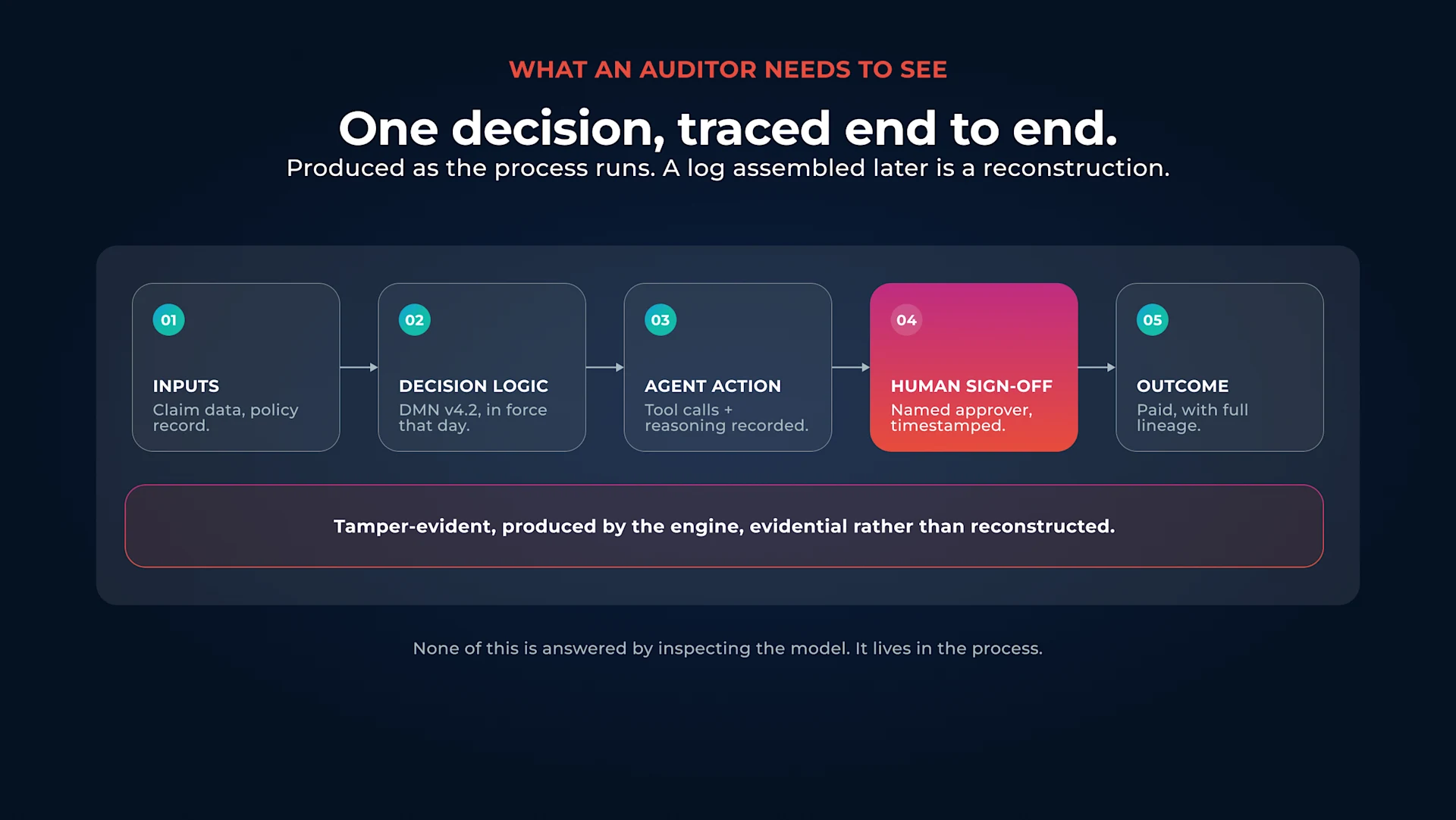
Consider an insurance claim above a defined risk threshold. The requirement is not that a person could have reviewed it. It is that a named person with the authority to decide did review it, at that point in the process, and that the record shows who, when, and on what basis. For insurance AI agents working on claims, that means the record shows which agent acted, which named person approved above the threshold and when.
This is human oversight as intentional design: the process specifies where judgment is required, and it stops until judgment arrives. Choosing those points deliberately is the subject of human-in-the-loop and human-on-the-loop oversight, and the choice belongs to each step rather than to the system as a whole.
The hardest of the three, and the one bolt-on governance handles least well. It is not enough to show that a control was configured. The question is whether a path existed through the process that avoided it.
If the escalation depended on an agent choosing to escalate, or the approval was a setting that a user with sufficient permissions could disable, the control is a convention. An enforceable control point is one the execution engine will not proceed past.
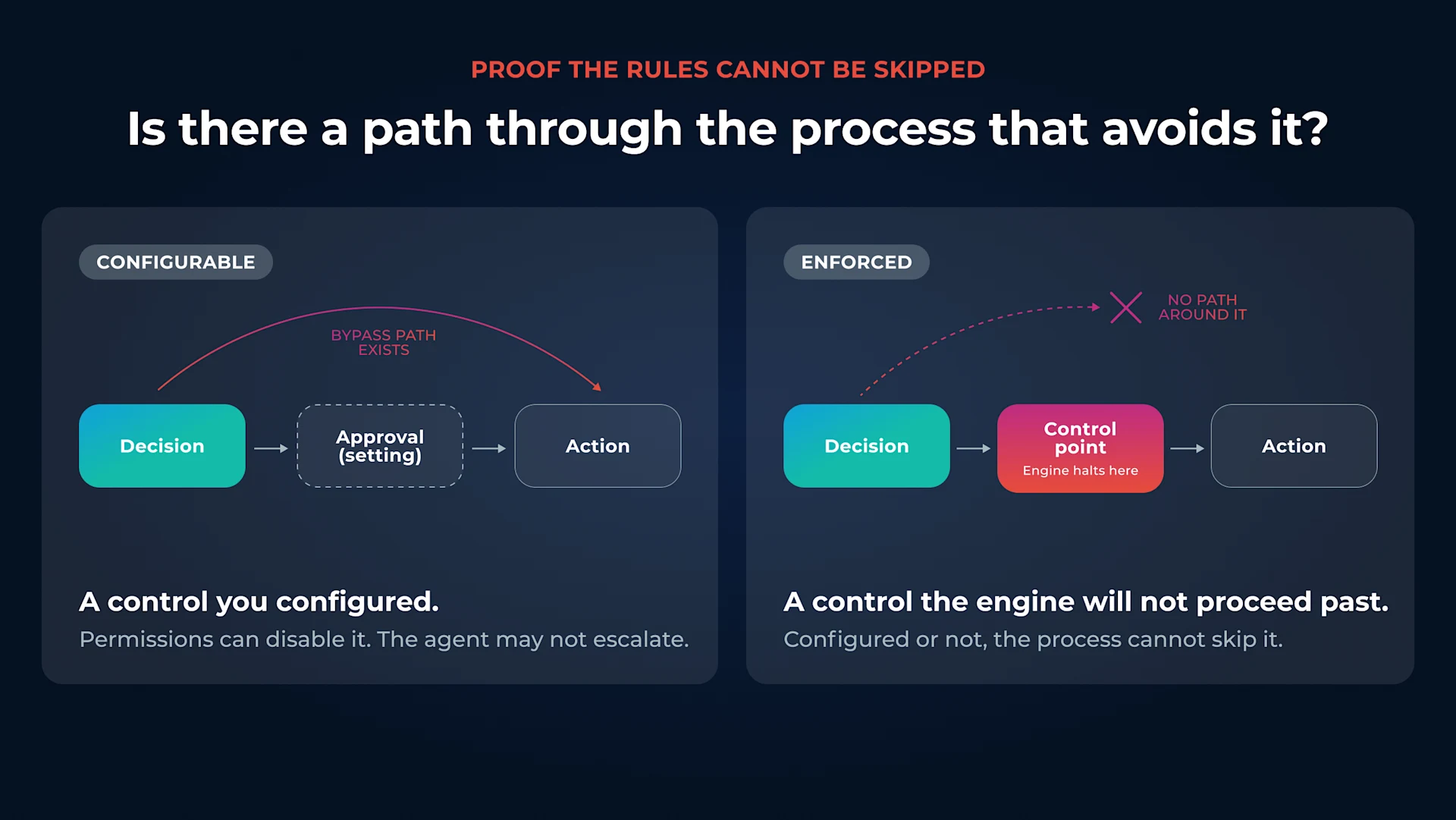
None of these three demands can be satisfied by inspecting the AI model. Accuracy, training data, and explainability all matter, and none of them tell an auditor who approved the claim, whether the approval could have been bypassed, or what the decision logic said on the day. Those answers exist only in the process, which is why an AI governance process that examines the model alone examines the wrong artifact.
If control must be intrinsic, its location is the next most important thing. And it should belong in the layer that runs the work.
That layer already holds everything governance needs. The steps are defined there. The decision logic is defined there. The points where a person is required are defined there.
The record of every execution is produced there as a matter of course. Governance built into the orchestration layer is the process itself, expressed in a way that makes its controls executable and its history evidential. There is no second system to reconcile against the first.
This is the argument the governance-platform vendors are structurally unable to make, because their product is the layer beside the process.
Monitoring has value. A control you can merely observe is still weaker than a control the engine enforces, and regulated institutions are accountable for the second kind. Our guide to AI agent governance sets out how that accountability applies once agents are acting inside enterprise processes.
Request a demo to see how Flowable makes governed AI automation a reliable, baked-in -art of your processes.
Portability follows from this, and it belongs in the buyer criteria early. If your control points, decision logic, and audit trail exist as one vendor's proprietary configuration and nowhere else, your ability to demonstrate control depends on that vendor's continued cooperation and continued existence. Open standards remove that dependency.
A process model expressed in BPMN, a case model in CMMN, and decision logic in DMN can be read and defended without the tooling that produced them.
Flowable is the platform for AI orchestration with human oversight built in, where governed AI automation is the default rather than an add-on. Control points, human checkpoints, and the audit trail are defined in the process model itself, in BPMN, CMMN, and DMN, and enforced by the engine on every run.
AI agents participate as modeled steps inside that process, subject to the same control points as any other participant, with every action and every piece of reasoning recorded. Governance becomes a property of how the work runs, produced by the process rather than assembled after it.
The governance problem gets harder with volume, and volume is the entire promise of AI automation.
A team can review a hundred automated decisions a month. It cannot review a hundred thousand. As AI takes on more of the work, the number of decisions requiring governance grows faster than the number of people available to govern them, and the manual, after-the-fact approach fails on arithmetic alone.
Sampling replaces coverage. Reports arrive later. Findings emerge months after the decisions they concern, at which point the exposure is already booked.
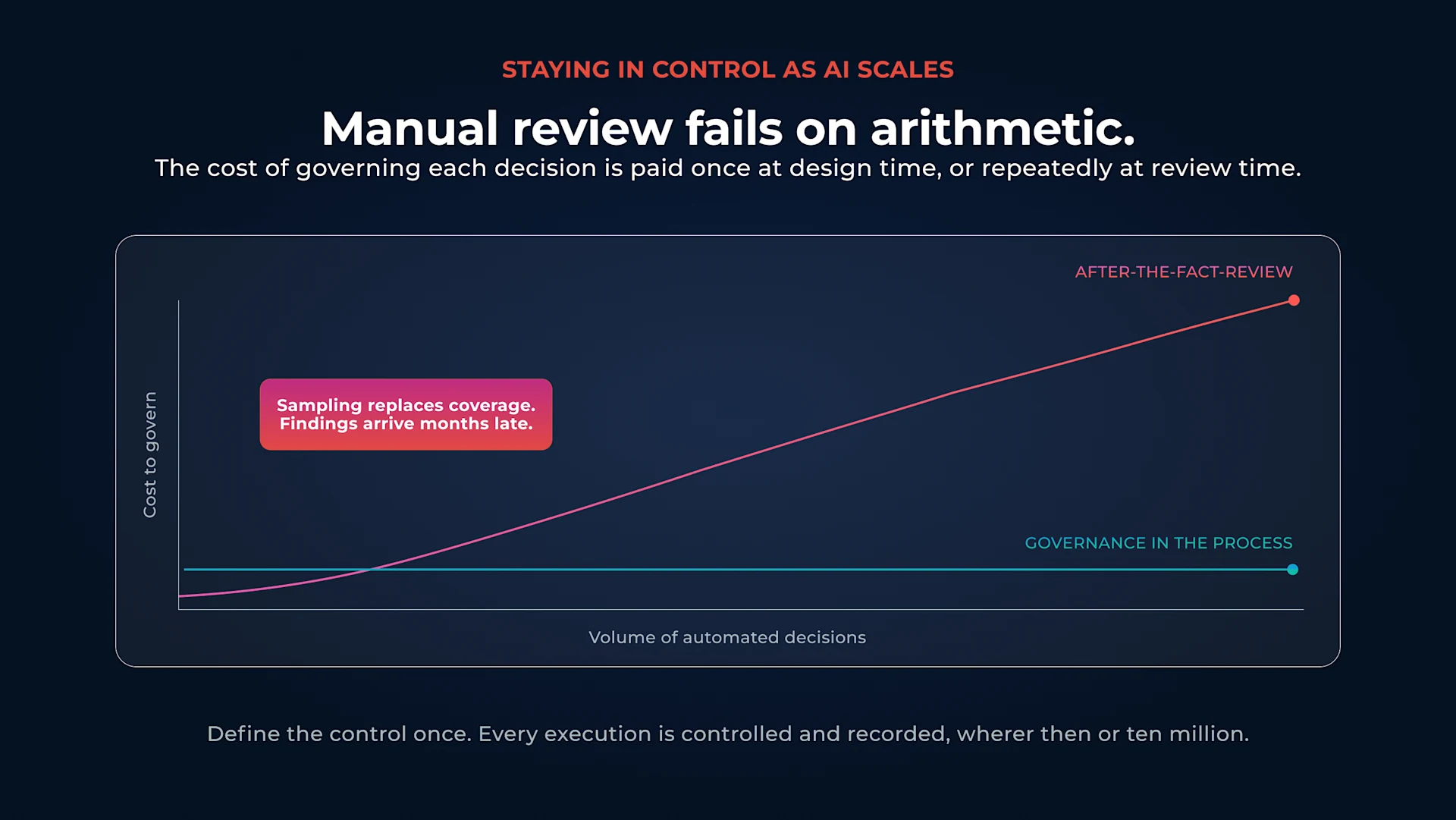
Governance built into the process scales differently, because the work of governing each decision is done once at design time rather than repeated at every review.
Define the control point in the process model, and every execution of that process is controlled and recorded, whether there are ten of them or ten million.
Human oversight concentrates where judgment is required, which is where the institution most needs it, and the remaining volume runs inside limits the engine enforces.
That is what allows a regulated enterprise to move quickly and stay in control at the same time. The guarantee comes from the process the AI runs inside, rather than from the AI's behavior. Process orchestration is the mechanism, open standards make it durable, and the audit trail is the proof.
What is governed AI automation?
Governed AI automation is automation in which the controls run as part of the process rather than sitting beside it. The rules about who can decide what, what gets recorded, and where a person must intervene are properties of the process itself, so they execute whenever the process runs and cannot be skipped.
How is governed AI automation different from AI governance?
AI governance is an organizational practice of policies, committees, and periodic review that describes what should happen. Governed AI automation enforces what does happen, because the controls are built into the layer that runs the work.
Why can't regulated industries add AI governance after the fact?
A layer that observes a process from outside can detect that something went wrong, but it cannot guarantee the thing could not have happened, because it holds no authority over execution. Meeting audit, oversight, and explainability obligations requires control that is intrinsic to the process, because in an audit, unprovable control and no control produce the same finding.
What do auditors need to see for an automated decision?
Three things: a complete record of what happened and why, produced as the process runs; evidence that a named, qualified person owned the high-stakes decisions; and proof the rules could not be skipped. None can be answered by inspecting the AI model alone, because the answers live in the process.
What is human-in-the-loop in AI automation?
Human-in-the-loop means the process specifies defined points where a person must decide, chosen deliberately and placed by design. It is intentional design, not a workaround: judgment-heavy steps require human judgment, and the process stops until that judgment arrives.
What is an enforceable control point?
An enforceable control point is a rule the execution engine will not proceed past until it is satisfied. It differs from a configurable control a user could disable, or an escalation that depends on an agent choosing to escalate. One is a convention; the other is a guarantee.
Why should orchestration be built on open standards?
If control points, decision logic, and audit trails exist only as one vendor's proprietary configuration, the ability to demonstrate control depends on that vendor's continued cooperation. Enterprises should ask whether their orchestration layer is built on open standards like BPMN, CMMN, and DMN, which can be read and defended independently of the tooling that produced them.
How does governed AI automation scale?
The work of governing each decision is done once at design time rather than repeated at every review. Define a control point in the process model, and every execution is controlled and recorded, whether there are ten or ten million.
Request a demo to see how Flowable makes governed AI automation a property of the process, with examples from banking and insurance.

Business process management software covers very different tools in 2026. See how the category shifted towards BOAT and what buyers should evaluate.

Client lifecycle management in banking goes beyond onboarding. See how case management keeps client context intact through KYC, reviews and offboarding.
n agentic workflow is more than a multi-agent diagram. See what the standard patterns omit once workflows meet exceptions, oversight, and audit requirements. Primary keyword: agentic workflow