If you are evaluating workflow orchestration tools, the bulk of what you find is a ranked list. Few of the lists show their reasoning. A ranking records what someone else preferred, and gives you no basis for judging a tool against the process you run.
In a Gartner survey of application leaders, 75% were piloting or deploying some form of AI agent, but only 13% strongly agreed they had the right governance structures in place for them. Whether a platform closes that gap for your organization depends on your process, not on where it sits in someone else's ranking, and that is what is worth figuring out before you buy.
This article sets out four criteria for judging whether a platform fits long-running, exception-heavy work, and a scorecard for rating any tool against them.
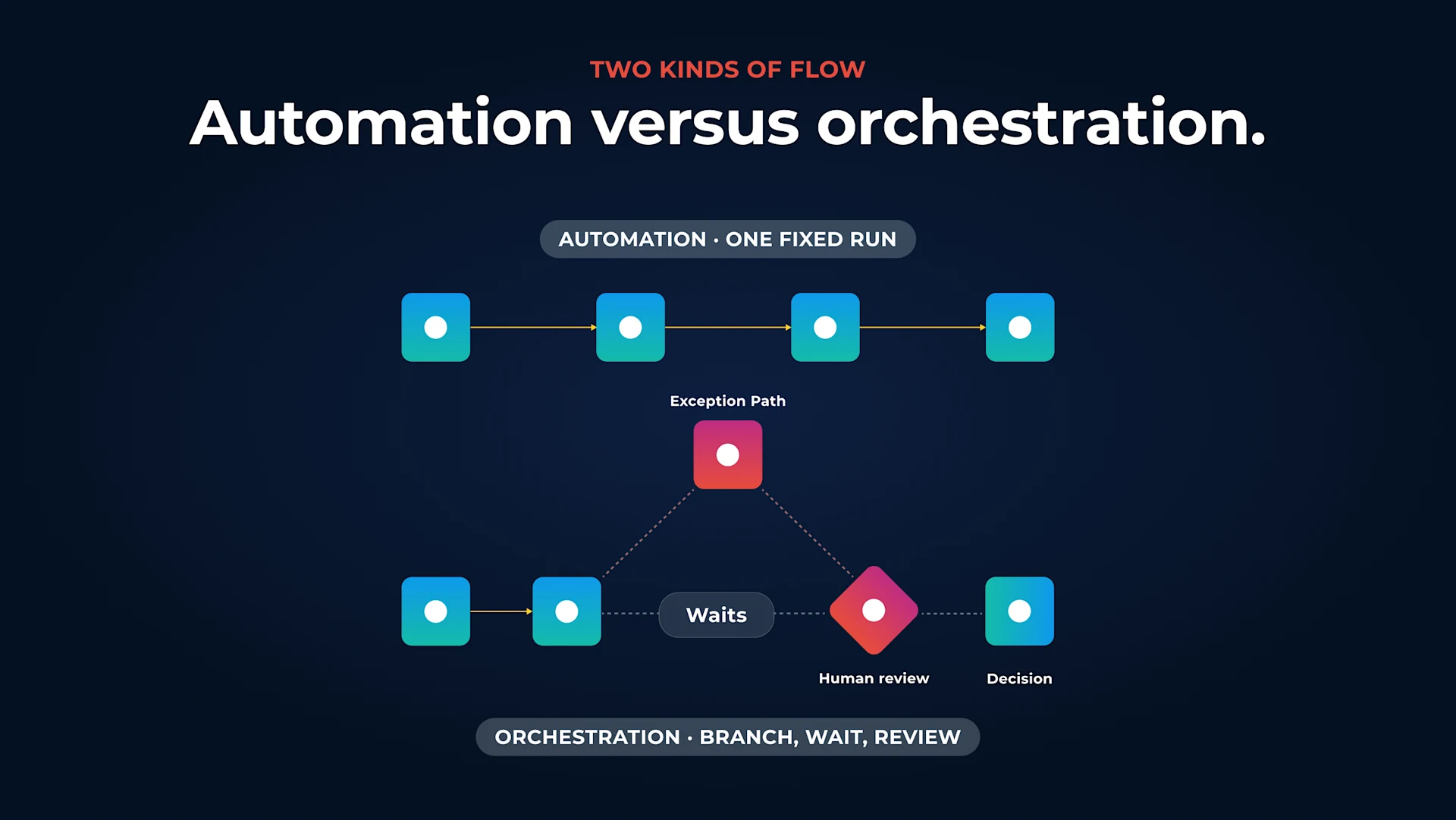
Automation repeats a fixed sequence of tasks, such as moving data between two systems when a record changes. Orchestration coordinates a process across several systems and several people, and routes each case according to its facts. Coordination on that scale is the job of process orchestration. A product built to automate linear tasks treats a branch or a wait as an exception to deal with later. One built to orchestrate treats them as the normal course of the process.
Enterprise processes such as a loan application or an insurance claim are orchestration problems. Each runs across intake, checks, review, and a decision, and any step can send the case back a stage or pause it until a person decides. These are long-running processes, with governance and audit obligations that automation does not carry. An automation benchmark leaves those requirements out of the comparison.
Analysts now group these capabilities under one category, business orchestration and automation technologies. Gartner projects spending on it as a consolidated platform to grow about 35% to nearly 7 billion dollars, and to pass 21 billion dollars by 2029, though this is a forecast rather than a measurement.

The criteria that decide fit are questions about the process rather than entries on a feature list. They will help you find the process orchestration tool that fits your processes, instead of giving you a list of features to try to tick off. If you already have process issues, a brand new tool may even make them worse.
Before you jump in, ask…
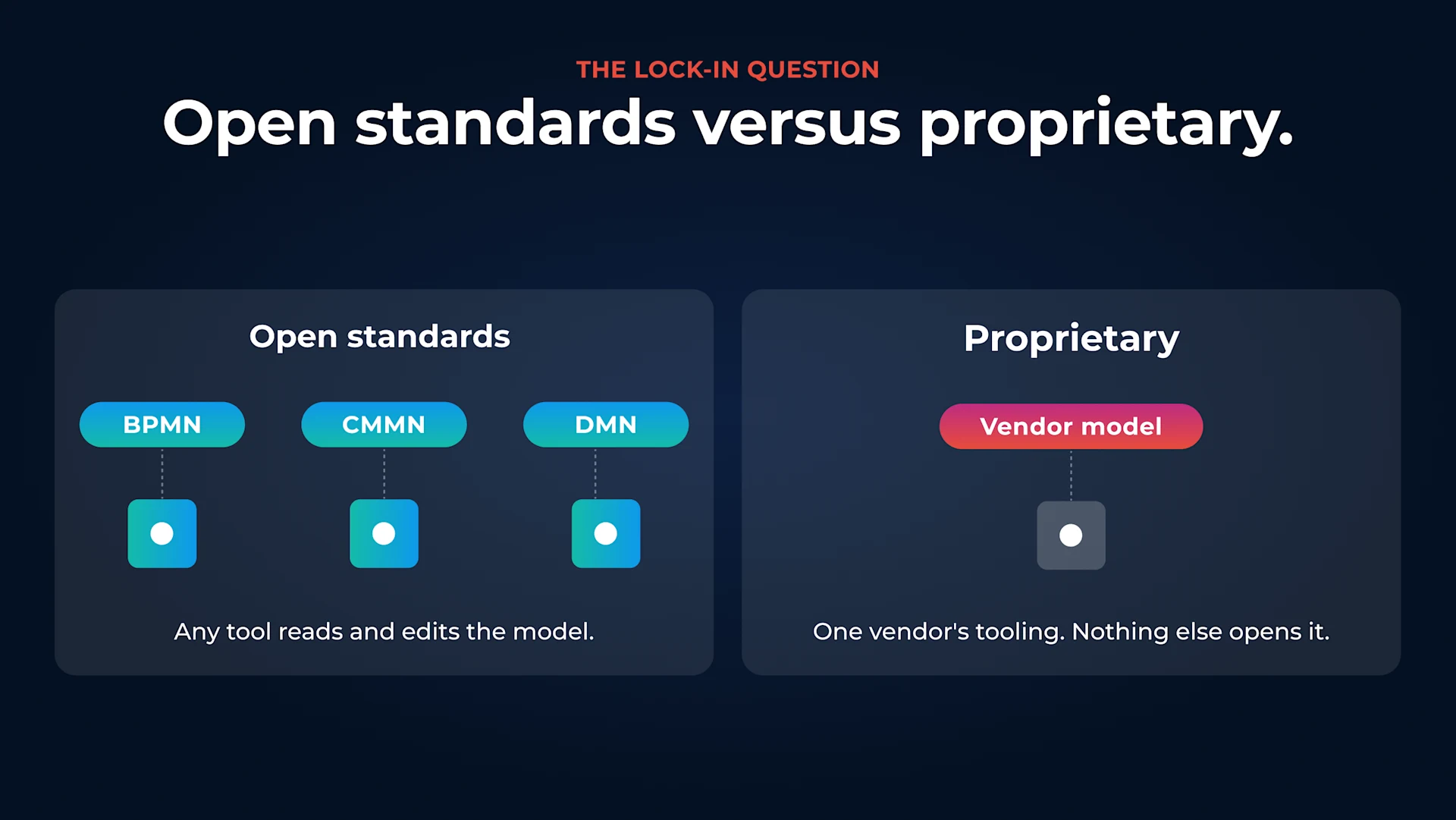
A process definition is the model that describes the steps, branches, decision rules, and waiting points of a process. No single vendor controls an open standard for process modelling. Business Process Model and Notation (BPMN) describes sequential and branching flows, Case Management Model and Notation (CMMN) describes case work that does not follow a fixed order, and Decision, Model and Notation (DMN) describes decision logic as rules.
All three belong to the Object Management Group, the international technology consortium responsible for upholding modelling standards, so anyone can read and change a process modeled in them without one vendor’s tooling.
Ask whether the platform is built on open standards. A tool built on a proprietary modelling language ties every process you model to that vendor, because no one can read, version, or move the models without its product. Vendor lock-in then sits inside the process definitions rather than in a contract you can renegotiate.
Open standards keep the models interoperable and extensible, and reduce the total cost of ownership over the life of a process. A business rules engine built on DMN offers a practical test, because the people who own the rules can edit them without the vendor’s tooling.
Native agent orchestration means the platform runs AI agents as steps in a modeled process, under the same control as every other step. A bolt-on treats the agent as a separate feature called from the side, with its own logic outside the process model. The gap shows when an agent has to hand a task to a person, or when a reviewer has to check its output before anything commits.
Ask whether the process orchestrates the agents or the agents run alongside it. When the process governs, an agent’s action becomes one modeled step. The platform records its inputs, routes its output through the same checks as any other step, and can place a human decision point in front of anything the agent commits.
When the agent runs on its own, teams have to rebuild that control around each integration. Process control rather than agent capability makes agentic automation governable. The same reasoning underlies agentic orchestration as an enterprise concern.
Governance here is the ability to show, after the fact, what each step received, which rule version applied, who approved what, and when. Auditability is that ability made routine, produced as the process runs rather than reconstructed later.
Built-in governance captures that record as a property of every process instance. Configuration-dependent governance depends on whoever assembles the logging, the approvals, and the retention for each process, one integration at a time.
Ask whether an audit trail and human oversight come from the platform or from how a given team configured a project. The obligation to reconstruct a decision does not scale if each process meets it differently. A platform that records every step in one place, across agents, automated systems, and people, gives one account of what happened.
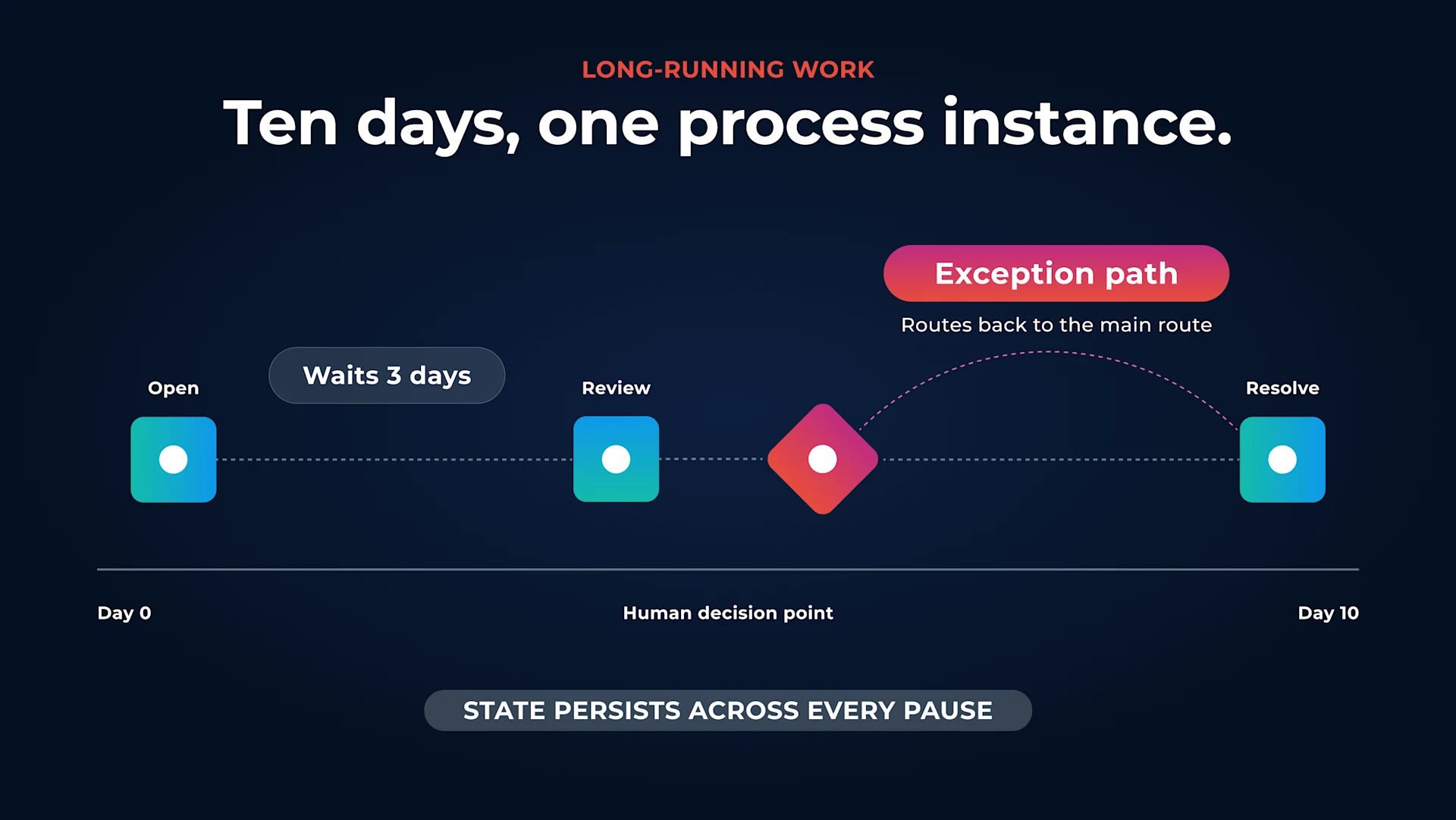
Long-running processes run for days or weeks and spend the bulk of that time waiting on a document, an approval, or an external system. In exception-heavy work, departures from the standard route are the norm rather than the edge, such as a claim missing a document or an application that needs a second review.
A tool for this has to persist the state of each running instance across restarts, resume the instance at the step it left off, and treat the exception as a modeled path rather than an error. Linear automation cannot do that once a case stops finishing in a single run.
Ask whether the platform models exceptions and waiting as part of the process, or leaves exception handling to retries and error states. Human-in-the-loop belongs here as intentional design.
A person owns a defined decision at a defined point, and the process waits for the answer rather than routing to a person after an agent fails. Work of this kind is what case management software handles. Routine cases are automated already, and the cases that remain depart from the standard route.
This scorecard can help you weigh up the capabilities of the workflow orchestration tools you’re currently looking at. Score each criterion from one to five against the process you run, then weight up which criterion is important to you and whether each tool is sufficient for your organization.
Criterion | What good looks like | Red flag | Score (1 to 5) |
Open standards | Built on BPMN, CMMN, and DMN; models read and move without the vendor | Proprietary modelling language; models locked to one product | ___ |
Native agent orchestration | Agents run as modeled steps under process control | AI called from the side, outside the process model | ___ |
Built-in governance | One audit trail across agents, systems, and people, produced by the platform | Logging and approvals assembled per project | ___ |
Long-running, exception-heavy work | Durable state, resumable runs, exceptions modeled as paths | Single-run assumption; exceptions handled as errors | ___ |
A framework replaces the ranking with your own score. Rate each tool on open standards, native agent orchestration, built-in governance, and support for long-running, exception-heavy work.
The open standards criterion carries more weight over time than the other three. Anyone can read, audit, and move a process modeled in an open standard without the vendor’s tooling, so the switching decision stays yours. A process modeled in a proprietary language leaves that definition, and every later change to it, with one vendor.
Take your shortlist through the four criteria, then see how a process orchestration platform built on open standards scores. Start a free trial to evaluate it against your own process, or book a demo to walk through a regulated use case.

Business process management software covers very different tools in 2026. See how the category shifted towards BOAT and what buyers should evaluate.

Client lifecycle management in banking goes beyond onboarding. See how case management keeps client context intact through KYC, reviews and offboarding.
n agentic workflow is more than a multi-agent diagram. See what the standard patterns omit once workflows meet exceptions, oversight, and audit requirements. Primary keyword: agentic workflow