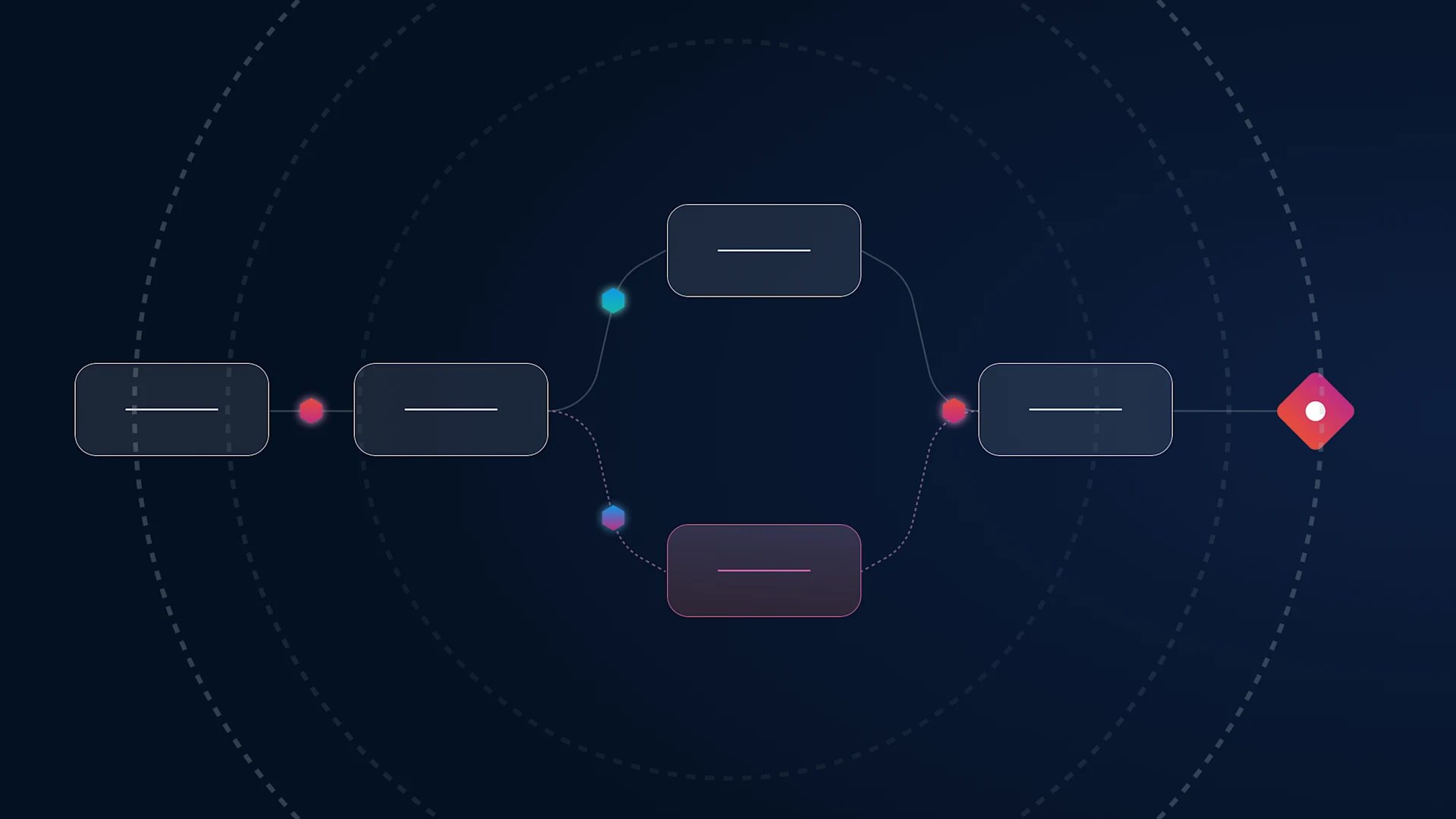
Ask a search engine or LLM what an agentic workflow is and you will see a diagram. Neat lines all showing out the orchestration layer works and passes onto the next layer. The nice clean diagram is reassuring: it makes coordinating a set of AI agents look like a problem solved.
But for many teams, that’s not the case. The work runs longer, crosses many more systems, involves more people that aren’t on the diagram. But before we make this right, before we show what really makes an agentic workflow work, we need to understand what one is.
An agentic workflow coordinates several AI agents across a process, giving each step to the agent suited to it. The standard drawing of one is a pattern diagram, with an orchestrator directing sub-agents and arrows for where control passes between them.
But that model is oversimplified. Deloitte's 2026 State of AI in the Enterprise survey found that 80% of organizations lack the mature model needed for governing agentic AI.
Patterns for agentic workflows come in several forms, each a variation on one structure.
The sequential pattern runs the agents in a fixed order, the hierarchical pattern puts one agent in charge of the others. The group-chat pattern lets several agents contribute to a shared exchange, and the handoff pattern passes control from one agent to the next as the task changes.
In each, an orchestrator directs the agents, and a handoff is the point where one agent’s output becomes the next agent’s input. The coordination these diagrams show is accurate. For a smaller organization, a coordination diagram can give a reasonable account of how the workflow operates.
Enterprises have a different set of requirements. Their workflows run more steps, span more systems, involve more people, last longer, and carry governance and audit obligations. None of those requirements appear in the diagram.
Coordination is the part the diagram gets right. It struggles with what happens when a run breaks, when a workflow has to stop to wait for a person, or how it can be accounted for in an audit.
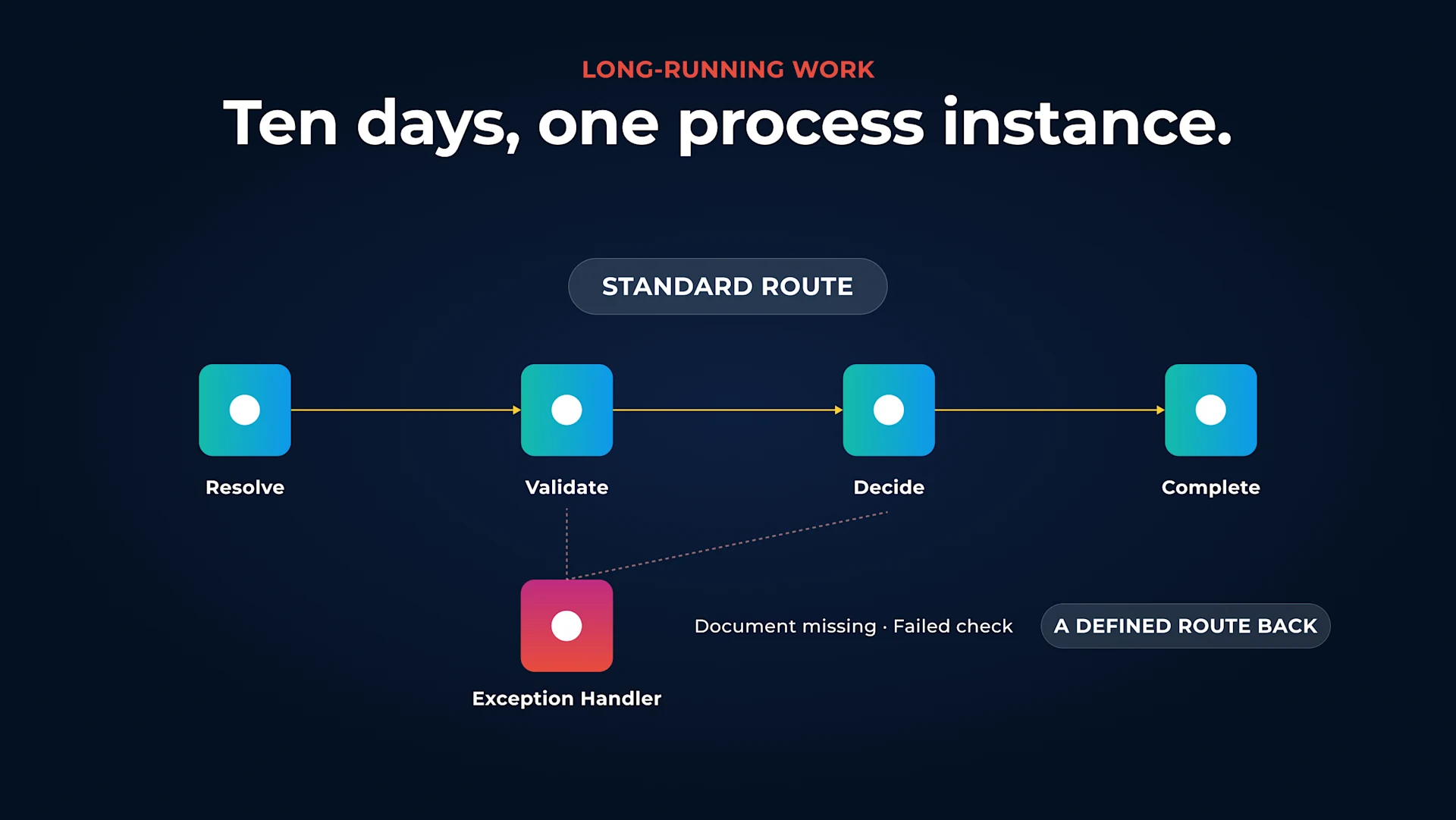
Let’s take a closer look at four of these diagrams. Three that surface inside a single run and one that only shows up across the days a process can run for. The first is the exception path.
An exception is anything that stops a process from following its standard route, such as a claim submitted with a document missing or a payment stopped for a fraud check. The exception path is how the process handles that, covering who receives the notification, what happens to the case while it waits, and how the case rejoins a normal route once the missing document arrives.
A pattern diagram shows the run that completes. Exception handling, where it appears, is a retry or an error state. In judgment-heavy work that is the wrong emphasis. Insurance claims, loan applications, and compliance reviews are exception-driven by nature, because the routine cases run automated already and the cases left over leave the standard route.
Without a modeled exception path, people handle those cases outside the system. The exception path belongs in the process model, tested and with a defined route back into the main route.

A human decision point is a step where a person, rather than an agent, owns the decision. The design states, in advance, the condition that routes a case to a person, the information they receive, and the point at which the process waits for their answer before it continues.
Diagrams that treat human review as a fallback place it after an agent fails or reports low confidence, which puts the person at the end of the case, once the agent has acted. A designed decision point sits where the process needs the judgment, which in regulated work tends to be before an action commits rather than after.
An autonomous agent acting under a threshold can commit the organization before anyone has looked. Human oversight built into the process runs on stated criteria every time, rather than on the agent’s own report of uncertainty.
Auditability is the ability to reconstruct, after the fact, what an agent did, on what information, and under which rules. An audit trail makes this possible by recording the inputs the agent received, the policy version in force at the time, the output it produced, and any human action taken alongside it.
A model’s own account of its reasoning is not that record. Asked to explain a past decision, an agent produces a plausible reconstruction rather than a verified one, and once the underlying data has changed the reconstruction cannot be checked.
The platform has to capture the trail as each step runs and store it as structured records outside the model, so the trail stays fixed regardless of what the model would say later. Regulated firms carry an obligation to show what happened, and meeting that obligation is the practical core of AI agent governance.
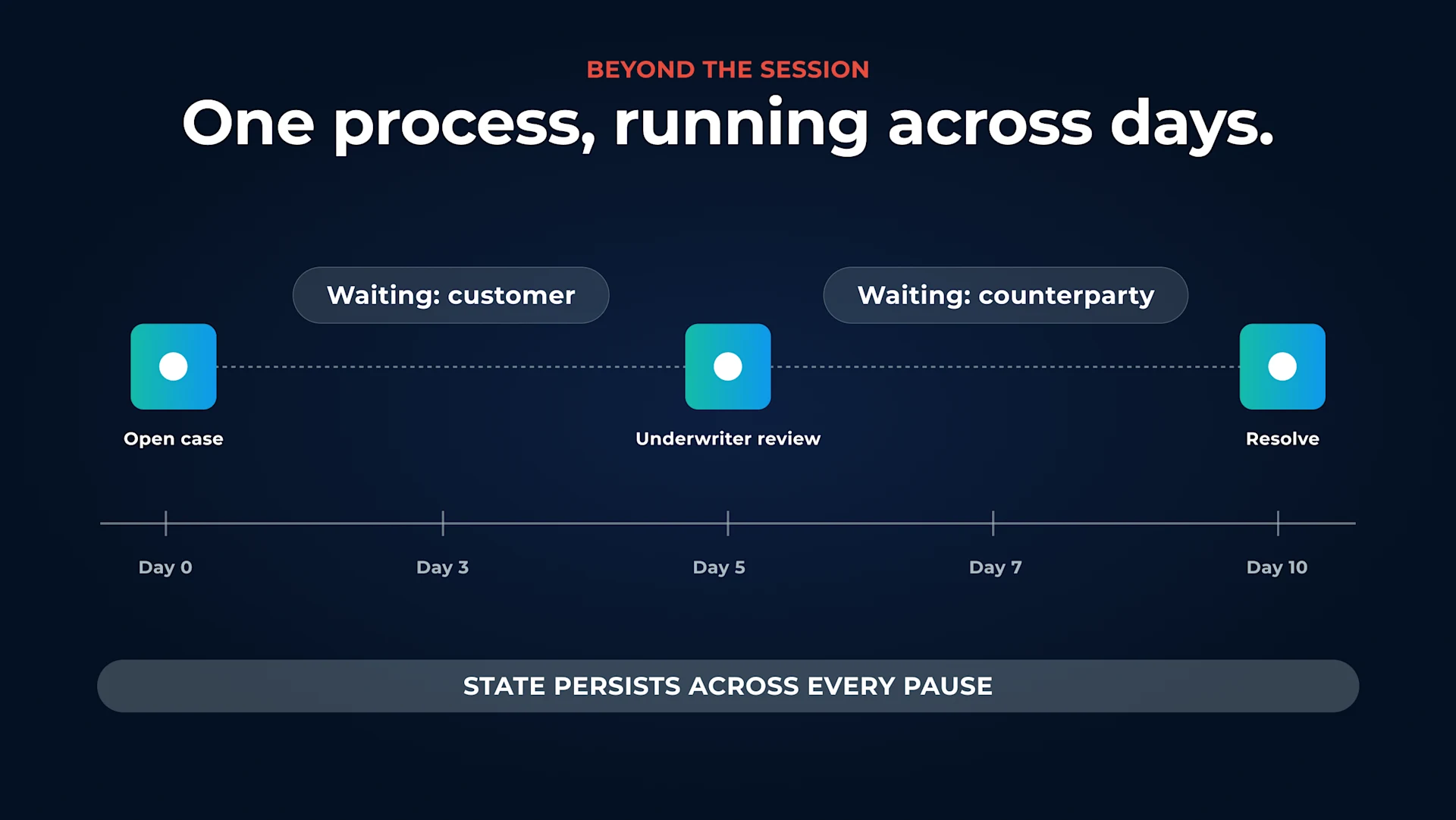
A session is a single continuous run, in which the workflow starts, the agents work, and the process finishes without stopping. Many enterprise agentic AI workflows do not run as sessions. A case can open on Monday, wait for a customer to upload a document, move to an underwriter two days later, then pause again while a counterparty confirms.
A process like this runs for days or weeks, and waiting takes up more of that time than execution. The process has to survive restarts, deployments, and handovers between shifts without losing its place.
Durable execution keeps the state of each running instance, where the instance has reached, what it waits on, and what to do when a wait runs longer than expected. An agent that returns an answer in 200 milliseconds does not raise this. Durable execution becomes a requirement once a process runs long enough to face interruption.
A pattern diagram treats the agent as the unit of work, so anything outside a single agent's run sits outside the diagram. In an enterprise, the process is the unit that needs governing, and agents are participants in it.
That's visible in how agentic AI is actually scaling. McKinsey's 2025 survey found 23% of organizations scaling an agentic system somewhere in the enterprise, but no more than 10% in any single function. Most of that 23% has scaled an agent, not the process it sits inside.
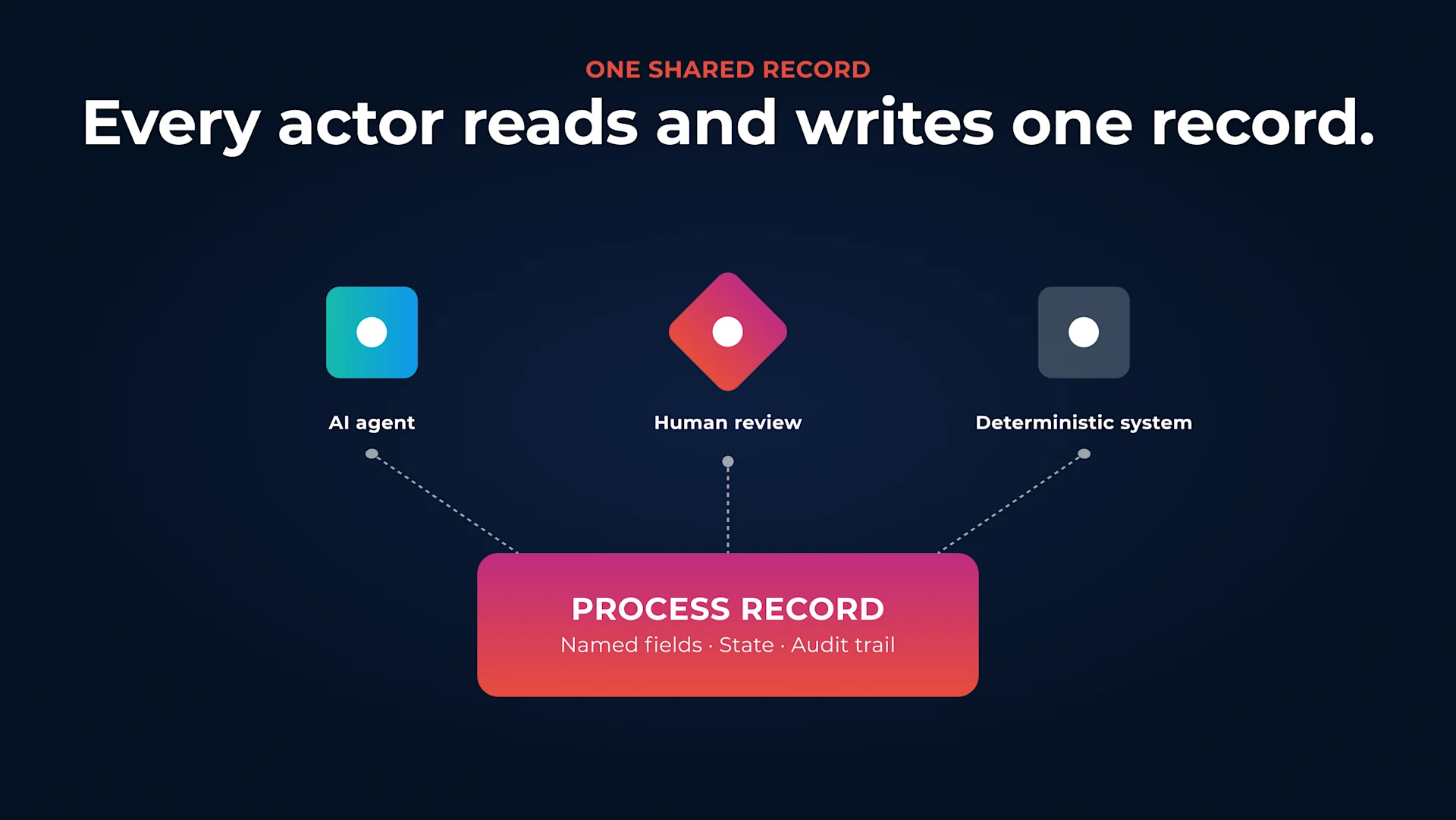
Process orchestration governs the process, defining the sequence of steps, the branches a case can take, the points where the process waits, and the actor responsible at each step. The actors are of three kinds, an agent that reasons, a deterministic system that executes a fixed rule, and a person who owns a decision.
Each reads from and writes to a shared process record instead of passing results to the next agent in a prompt. This is what "agentic workflow management" means in practice: governing the record the agents share, not just the agents themselves.
The shared record is what makes a given agent action auditable and resumable. A fraud flag set by one agent becomes a named field that every later step must read, rather than free text in a prompt a downstream agent can summarize away. A process that paused for two days resumes at the step it left, because its state sits in the orchestration record rather than in an agent’s memory.
In this model, enterprise AI agents supply the reasoning; the process determines where the output goes, who checks it, and what the record keeps. A study of multi-agent systems traced their failures to fourteen recurring modes, the bulk of them in how agents coordinate and hand off rather than in any single agent’s reasoning.
The useful questions concern agentic workflow architecture rather than feature lists.
Exceptions that aren’t part of the diagram leave the judgment-heavy cases manual no matter how capable the agents are.
A designed point is visible in the model before you commit, while a fallback appears once something has gone wrong.
A record limited to agent actions cannot account for a process that also ran through automated systems and people.
Business Process Model and Notation (BPMN), Case Management Model and Notation (CMMN) and Decision Model and Notation (DMN), all belong to the Object Management Group, so anyone can read and move a process modeled in them without a single vendor’s tooling. A proprietary language ties every future change to the vendor that defined it. Open standards are one criterion among several here.
The process, rather than the agent, is the unit an enterprise governs. The exception path, the human decision point, the audit trail, and the case that runs for days all sit outside a pattern diagram, and all belong to the process rather than to any agent inside it.
The distinction becomes a build decision. Anyone can read, move, and defend a process modeled in open standards without the vendor’s tooling. A process modeled in a proprietary language leaves the definition of a governed process, and every later change to it, with that vendor. The same reasoning applies to agentic orchestration as an enterprise concern.
See how Flowable runs governed agentic processes in regulated environments. Book a demo, or read the platform overview.

Business process management software covers very different tools in 2026. See how the category shifted towards BOAT and what buyers should evaluate.

Client lifecycle management in banking goes beyond onboarding. See how case management keeps client context intact through KYC, reviews and offboarding.
Automating single functions leaves the process broken at the handoffs. See why end-to-end orchestration beats function-by-function financial process automation.