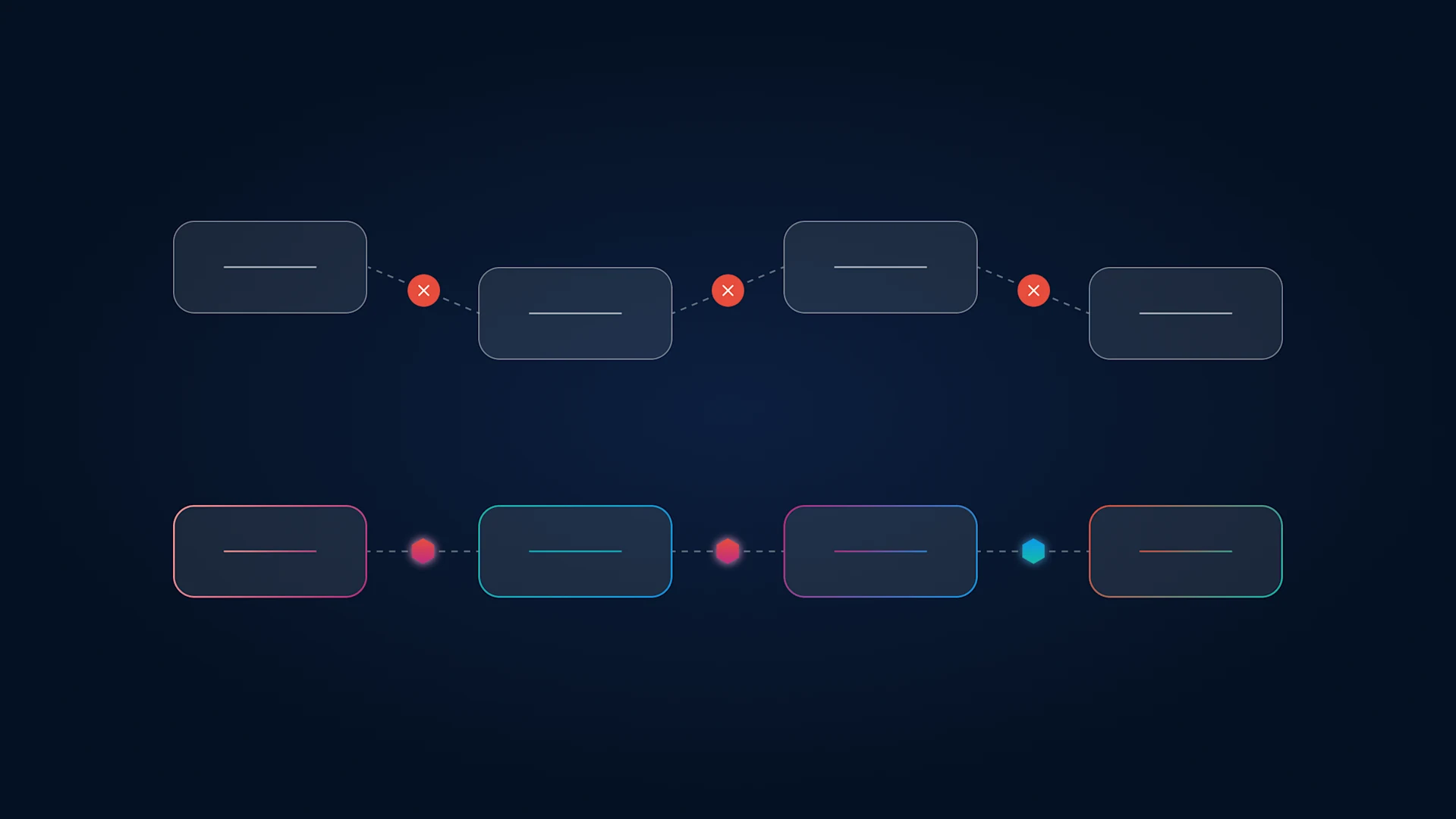
Banks and insurers have spent years automating individual functions. Accounts payable runs on one tool, invoice processing on another, reconciliation on a third, and onboarding on a fourth. Each function is faster than it was, yet the process running through them still stalls, and no one can show it end to end. That's the gap in financial process automation: automating one function at a time has not produced an automated process.
Gartner found that 54% of chief executives said their automation was still limited to specific tasks, and 13% expected to remain there through 2028. The shift they describe is from automated functions to an automated process, and that shift breaks wherever a case still passes between functions by hand.
A financial process is the full route a case takes from arrival to close. A new customer moves from application through Know-Your-Customer (KYC) and screening to account opening. Automating a function optimizes one stage of that route, and leaves the rest unchanged.
The result is a set of automated functions with no connection between them. Each function runs its own tool and stores its own data, so cases move onward by export, email, or manual rekeying.
The process breaks at these handoffs. Work stalls with no owner, exceptions collect at a boundary neither function handles, and the audit trail splits across separate systems. The operational risk of the process sits in the handoffs rather than inside the automated functions.
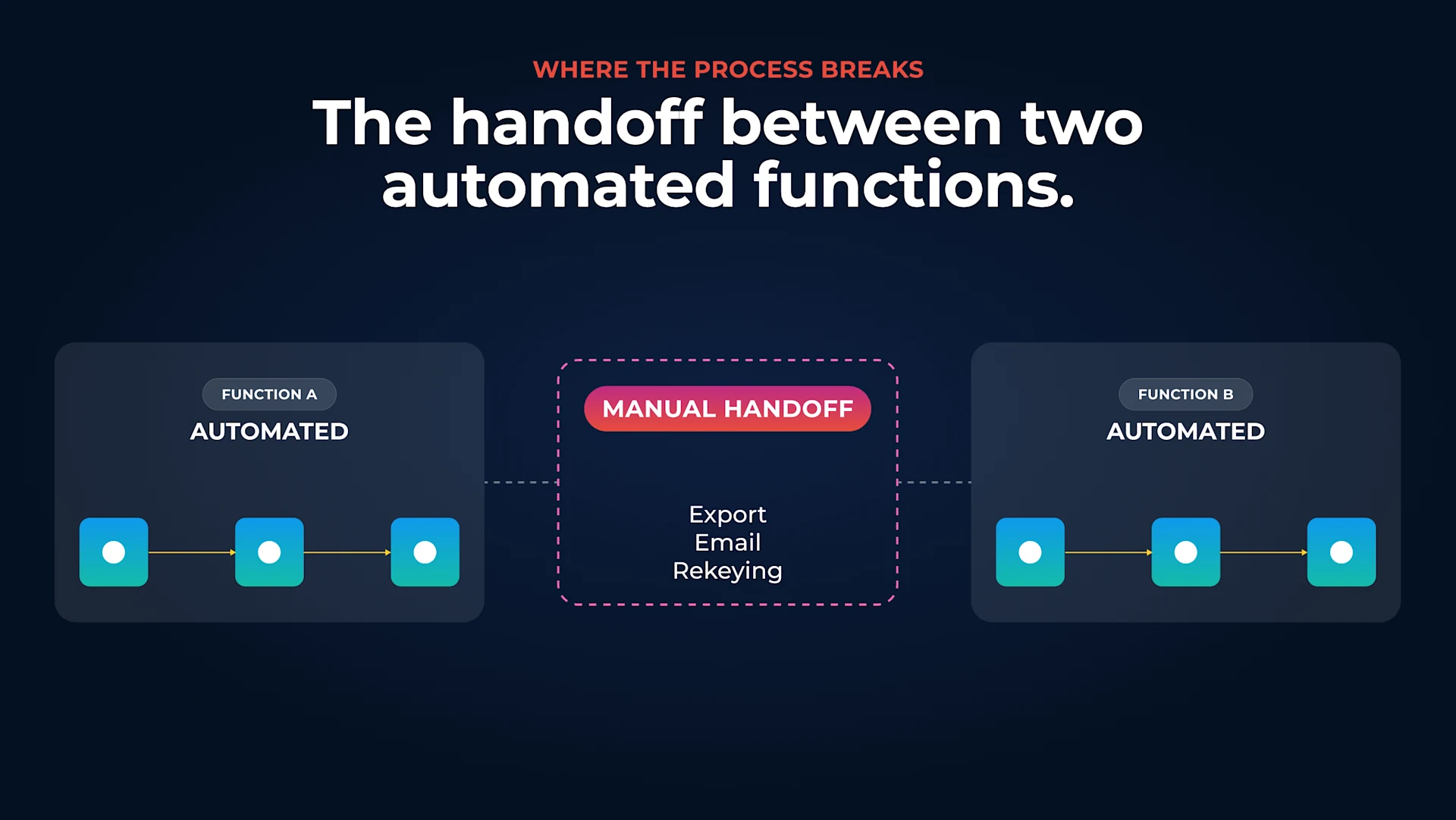

This pattern shows up clearly in banking process automation. Reconciliation automation hands a file to the next system, and a case that fails to reconcile simply waits for a person to pick it up.
An exception is any case that cannot follow the standard route without a decision. No two claims, onboarding cases, underwriting decisions, or loan originations run the same way, because each carries facts the standard route did not anticipate.
A claim might arrive with an estimate that doesn’t match the policy, or an onboarding check might return a near-match to a sanctions entry. Automation already covers the routine cases; what's left are the ones that leave the standard route entirely, and in regulated financial work, exception handling accounts for a large share of daily volume rather than a rare edge case.
The Coalition Against Insurance Fraud puts the cost of insurance fraud in the US at $308.6bn a year, with roughly 10% of property-casualty claims estimated to be fraudulent. Each is an exception a fixed automated flow cannot resolve: it needs an investigation, judgment, and a route the standard path does not contain. Function-by-function automation cannot absorb that, because a tool built for the routine case treats everything else as an error.
The right platform treats adaptive work as normal rather than forcing it into a fixed flow. Effective insurance workflow automation models the exception path alongside the standard one, with a defined route back. Claims automation that runs the clean claim alone leaves the investigator working outside the system. The same pattern repeats with agentic AI in insurance. The agent handles the routine case, and the exception still needs a modelled route.
End-to-end orchestration treats the whole process as the unit of control rather than any single function. One model describes the full route, including the steps, the branches, the points where the process waits, and the actor responsible for each. Straight-through processing runs wherever the case allows, and a human decision point sits wherever the case requires judgment, by design rather than as a fallback.
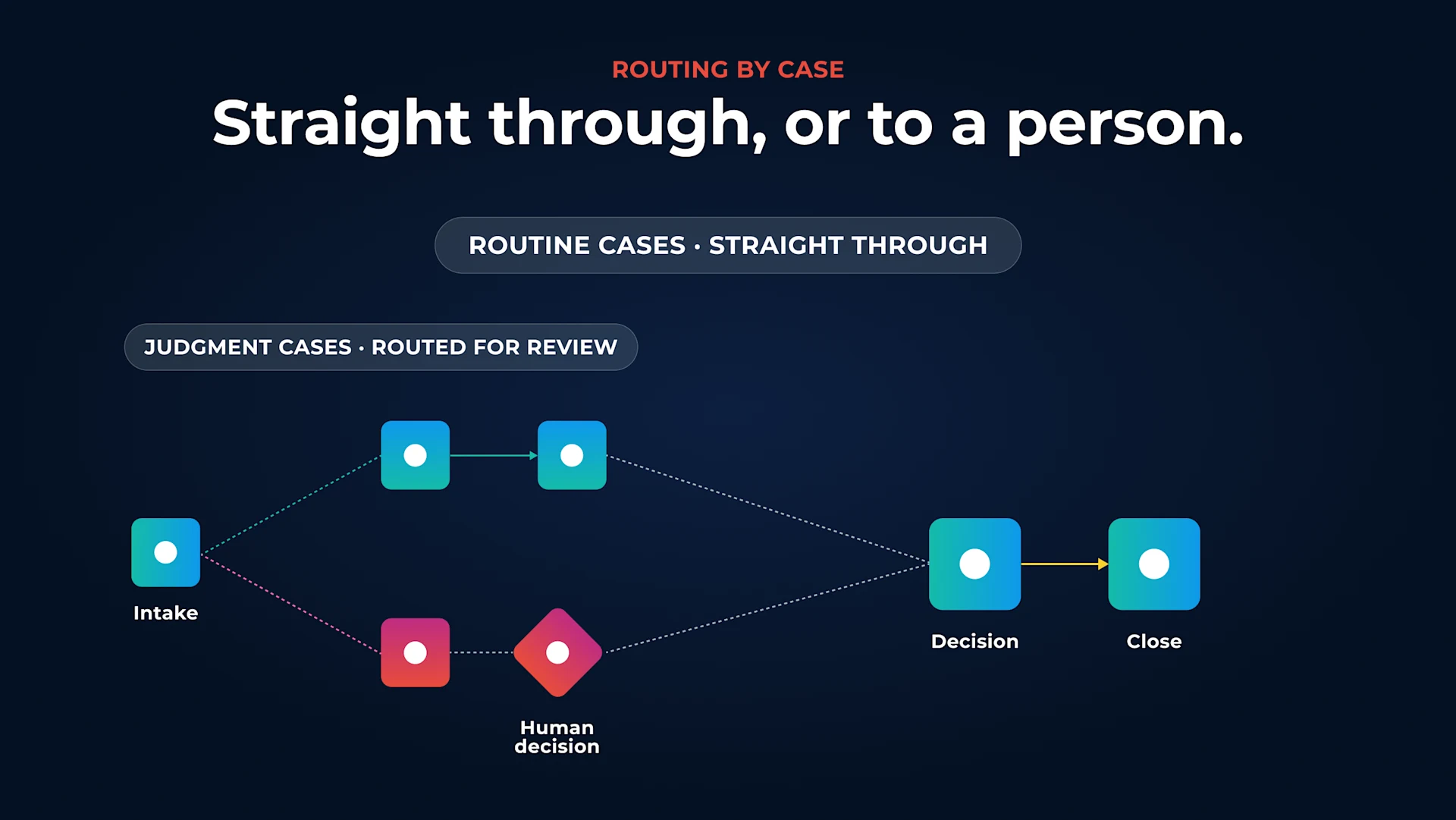
AI capability enters the process as a participant rather than as the starting point. An agent reasons over a case, a deterministic system applies a fixed rule, and a person owns a decision. The orchestration engine decides which acts when, and records what each did.
For the same reason, AI agents for banking stay useful. The agent’s output enters a governed process rather than moving downstream unchecked. Effective banking workflow orchestration provides that control. An agent bolted onto a function with manual handoffs sits outside it.
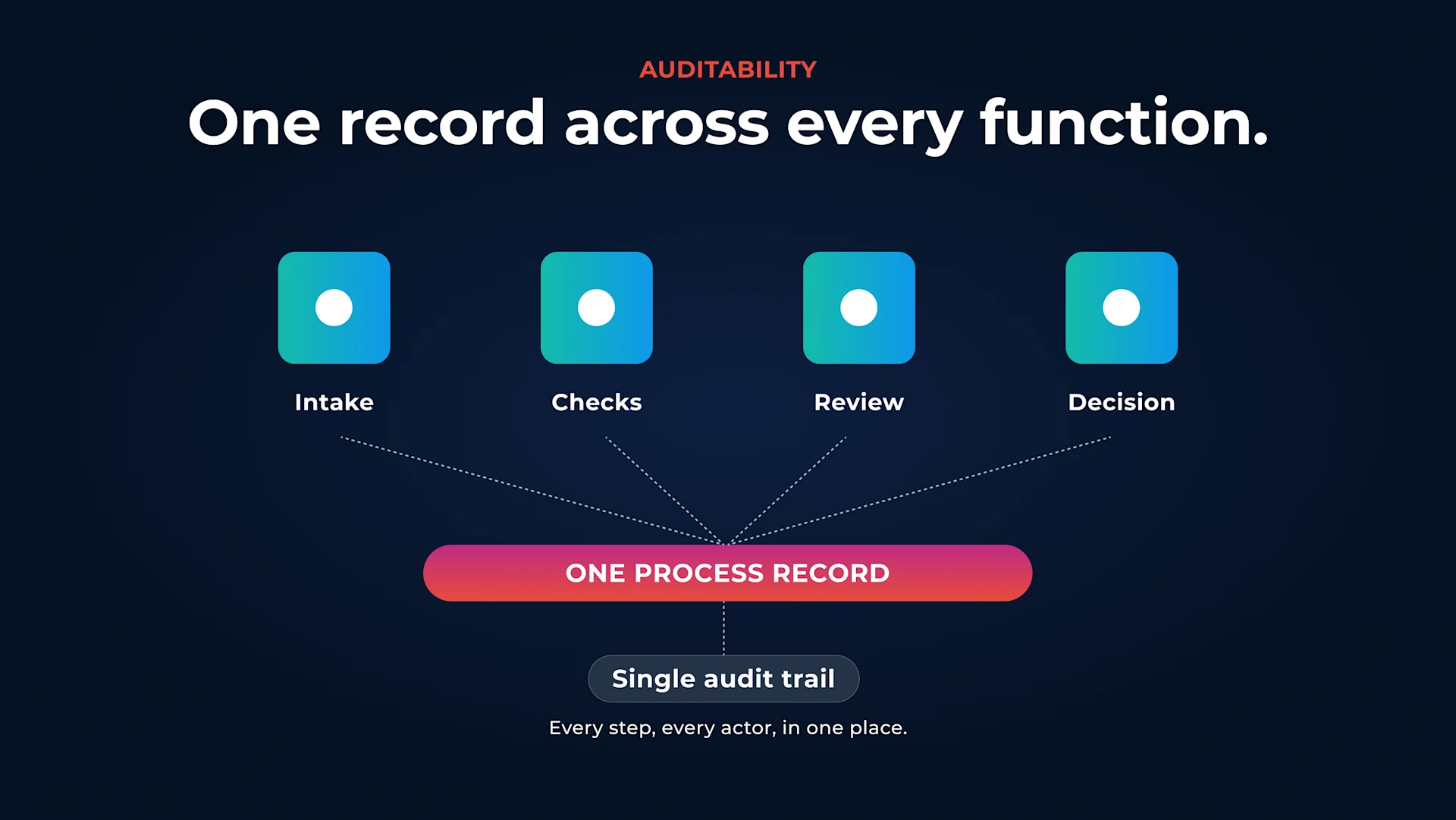
An audit trail records what arrived, what each step did, which rules were in force, and which decisions a person made. When each function keeps its own trail, reconstructing one case means joining records across systems with different identifiers and timestamps.
One orchestrated record spans every function, so a reviewer can read the full history of a claim or onboarding case in one place. Showing what happened, on demand and in full, is a standing obligation in financial services, and a trail that stops at each function’s boundary cannot meet it.
A human decision point is a step where a person, rather than a system, owns the decision. It is defined in advance by the condition that routes a case there and the information the reviewer receives.
When human oversight is built into the process, it runs on stated criteria at the step that requires judgment. In regulated work that step tends to come before an action commits. Human review added as a workaround appears after an automated step has already failed, once the system has acted. A reviewer in the first design can still change the outcome, and a reviewer in the second cannot.
Linear automation runs a fixed sequence of steps, which fits a process with a path set before it starts. Much financial work has no fixed path in advance, because the next step depends on what the last one found.
Adaptive handling models several possible activities and enables each as the case requires. Case Management Model and Notation (CMMN), the case management notation from the Object Management Group, exists for this kind of work. A platform limited to linear flows treats adaptive work as a run of exceptions and returns the process to manual handling.
The useful questions concern the whole process rather than one function. Here’s what to ask their product teams before you make a decision…
A tool that automates one function leaves the handoffs to the next tool and to people, exactly where the process already breaks.
A trail per function cannot show one case from arrival to close without manual reconciliation.
A decision point sitting in someone’s inbox is outside both the control and the record, so exception handling stays invisible.
Financial processes run across core systems that will stay in place for years, so legacy system integration decides whether orchestration covers the real process or only part of it.
BPMN, DMN, and CMMN belong to the Object Management Group, so anyone can read and move a process modelled in them without one vendor’s tooling.
A proprietary language ties every function it automates, and every later change, to the vendor that defined it. Piecemeal tools lock each function into a separate vendor’s definition, while an orchestration platform on open standards keeps the whole process portable.
An automated function is a part of the process. The process itself runs through every function and includes the handoffs, the exceptions, and the audit trail. End-to-end orchestration governs the full route. Finance automation bought function by function optimizes each part and leaves the process without an owner.
Portability is the practical form of the argument. Teams can read, move, and change a process modelled on open standards without depending on the vendor that wrote the tooling.
The choice between end-to-end and function-by-function also decides who controls the definition of your process. A process definition is the authoritative model of how the work runs: its steps, branches, rules, and the points where it waits. Buy function by function and that definition never exists in one place.
Each vendor writes the part covering its own function, in its own format, so the definition of the whole process lives nowhere except in the gaps between the tools and in the people who work around them. Changing how the process runs then means changing several systems at once, each on its owner's terms. End-to-end orchestration holds the whole route in one model, and on open standards that model is yours to read, audit, and change. Owning the process means owning its definition, not renting the pieces back from the vendors who automated each function.
See how Flowable delivers financial services workflow orchestration across banking and insurance, with straight-through processing where the case allows and human decision points where it does not. Book a demo, or read how Direct Insurance consolidated fourteen systems into one platform and cut claims registration time by 25%.

Business process management software covers very different tools in 2026. See how the category shifted towards BOAT and what buyers should evaluate.

Client lifecycle management in banking goes beyond onboarding. See how case management keeps client context intact through KYC, reviews and offboarding.
n agentic workflow is more than a multi-agent diagram. See what the standard patterns omit once workflows meet exceptions, oversight, and audit requirements. Primary keyword: agentic workflow