
AI agents are changing how banks operate by combining autonomy with judgment. Unlike traditional AI, which mostly analyzes data or generates content and then waits for a person to act, AI agents take action themselves, based on context, objectives, and changing conditions. That makes AI agents for banking especially valuable, where dynamic processes demand both precision and adaptability.
Banks face pressure to sharpen decision-making, personalize customer engagement, and streamline compliance. AI agents help by automating demanding, multi-step workflows and enabling stronger human-AI collaboration.
Adding AI agents into automated business workflows with Flowable supports fast, data-driven decisions while keeping humans strategically in the loop. The result is a more agile, efficient operation that responds to changing customer needs and regulatory demands faster, with better support for your teams.
AI agents autonomously take action based on context and objectives rather than just analyzing data, letting them carry out demanding tasks without human intervention at each step.
Successful AI implementation needs governance infrastructure from day one, including explainability, audit trails, and orchestration platforms that coordinate multiple AI models into governed processes.
Multi-agent AI systems deliver productivity gains of up to 60% for credit analysts and accelerate decision-making by around 30%, by keeping humans in the loop for exceptions and high-stakes judgments.
AI pilots are everywhere in banking. Whether it is document extraction models or fraud detection algorithms, most pilots work well in testing. Moving from proof of concept to production is what reveals what AI actually needs to deliver business value.
If any of the use cases below are of interest, it is worth making sure your organization is ready for AI first, by following these practices:
Governance from day one. Any AI system touching customer data, credit decisions, or compliance processes needs explainability, audit trails, and the ability to show that decisions were not biased or discriminatory. Without governance built into AI workflows, scaling becomes a compliance liability.
Integration across systems. AI does not create value in isolation. If each AI tool operates independently, humans become the integration layer, manually moving data between systems and introducing delays and errors.
Human-AI collaboration, not replacement. The highest-value AI use cases in banking keep humans strategically in the loop. AI handles data gathering, preliminary analysis, and routine decisions. Humans focus on exceptions, high-stakes judgments, and customer relationships. This requires workflows that hand off cleanly between AI and human tasks.
Orchestration platforms that scale. A platform like Flowable lets you coordinate multiple AI models, tools, and workflows into governed processes. It is what allows a mortgage application to move from document processing to credit scoring to compliance checks automatically, with each AI component triggering the next, sharing data securely, and maintaining complete audit trails.
Visibility and control. As banks deploy more AI agents, they need centralized monitoring: which models are running, what decisions they are making, where failures occur, and how much they cost. Without that visibility, AI sprawl creates the same problems banks face with legacy systems, only faster and harder to debug.
The difference between AI pilots that stay in testing and AI that transforms operations comes down to infrastructure. Banks that build with governance, integration, and orchestration from the start gain the foundation to scale AI across their most important processes.
The distinction that matters most in banking is between traditional automation and AI agents. Traditional automation, including RPA and rule-based workflows, follows a fixed script. AI agents work toward an objective and adapt as the case changes. The difference shows up across every dimension that matters for a regulated process.
| Traditional automation (RPA) | AI agents |
What starts it | A fixed rule, a schedule, or a person clicking go | Context, objectives, and changing conditions |
Scope of action | One predefined task at a time | Multi-step work that adapts as the case evolves |
Unexpected inputs | Stops and waits for a human | Reasons through, re-plans, and escalates by design |
Working across systems | Stays inside one application; people move data between tools | Acts across systems as part of one orchestrated process |
The human role | Fills the gaps between disconnected bots | Sets the objective and owns exceptions and judgment calls |
Governance and audit | Added afterwards, if at all | Built into the orchestration, with a complete audit trail |
The following use cases show how AI agents change banking operations when they run with proper orchestration and governance.
Investment analysis often requires time-consuming manual due diligence. Financial institutions spend significant resources evaluating market conditions, assessing risks, and compiling reports. Running these processes manually at scale limits capacity for in-depth decision-making and raises the risk of human error.
Building AI agents into automated business processes with Flowable speeds this up by integrating real-time market analysis, credit risk assessment, and report generation into your teams’ workflows. It accelerates decision-making, cuts costs, and improves transparency, while human experts interpret AI-generated data and make the final decisions instead of performing routine manual tasks.
An analysis by McKinsey found that multi-agent AI systems in credit memo preparation deliver productivity gains of up to 60% for credit analysts while accelerating decision-making by around 30%.
Banks using manual processes often struggle with inconsistent customer interactions that hurt efficiency and service quality. Those challenges grow as customer expectations for personalized, responsive service rise. Without a systematic approach, maintaining consistent quality is a huge task.
Integrating AI agents into workflows improves customer relationship management by automating personalized communications and recommendations. Customized AI agents can analyze customer data and proactively suggest relevant products or services.
When a customer’s spending patterns change, for example, the responsible agent can suggest tailored financial products, such as savings plans or investment opportunities. This reduces the workload for employees handling customer lifecycles and delivers a consistent, tailored, scalable experience. People still handle the interactions, now supported by AI agent-driven insights that make for deeper, more meaningful engagements.
Traditional onboarding tends to be slow and fragmented, often relying on manual know-your-customer (KYC) checks. With customers opening accounts in-branch, on mobile, and online, speed is hard to align, and the disconnect frustrates customers and raises operational costs. Delays in ID verification and compliance checks slow things further and hurt satisfaction.
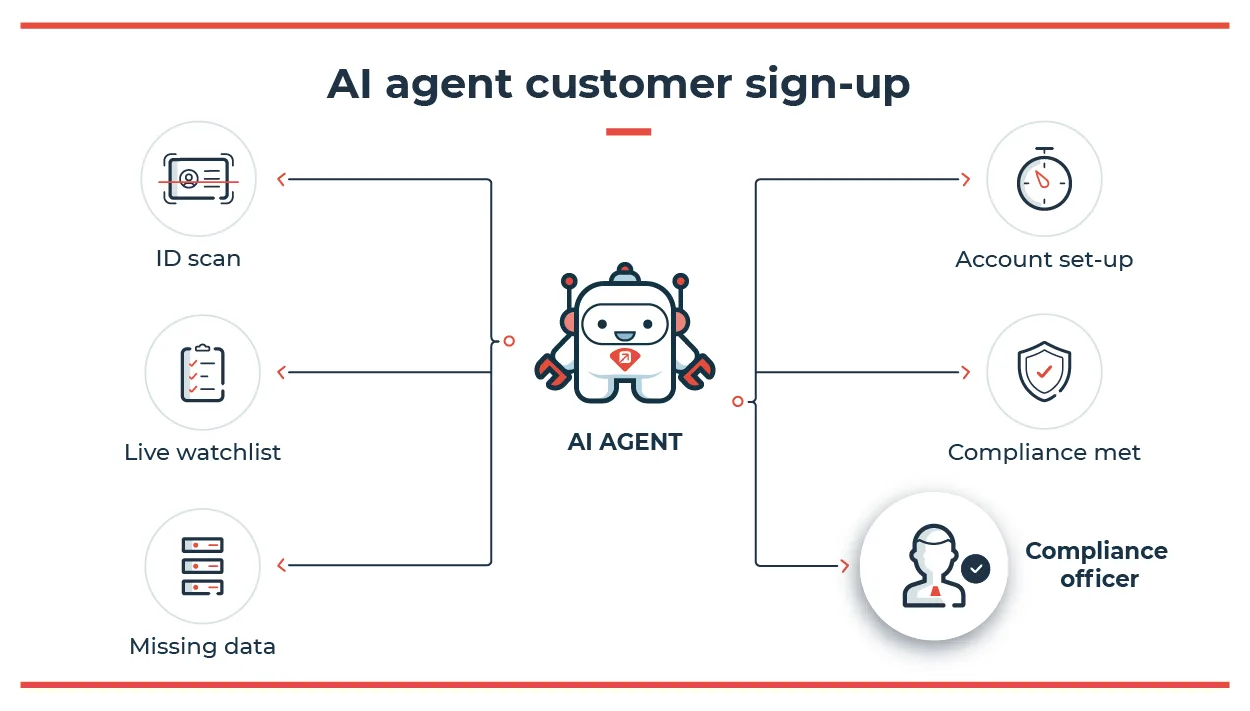

Using AI agents, Flowable streamlines this by automating tasks like ID verification, cross-referencing against live watchlists, and flagging risks for human review. A unified onboarding workflow using Business Process Model and Notation (BPMN) and Case Management Model and Notation (CMMN) lets AI agents verify ID documents with optical character recognition and compare them against watchlists in real time.
By building anti-money laundering (AML) verification directly into the workflow, AI agent integration makes compliance faster and more accurate. Compliance officers only step in on exceptions, cutting onboarding times while keeping consistency across branches, mobile apps, and websites.
Loan processing often involves manual data collection and risk evaluation, which makes it slow and cumbersome. Delays in approvals lead to customer dissatisfaction and missed business, and human error during risk evaluation can cause financial losses.
AI agents can automate these steps by gathering applicant information, performing preliminary risk scoring, communicating across channels to request missing information, generating forms, and handling intelligent document storage.
Flowable’s document workflow software uses AI agents to gather customer financials, credit scores, and collateral details at speed. If the data meets core criteria, the agent moves the application to approval; if not, it routes it to an underwriter for review. This decision runs under Flowable's AI agent governance, with every step logged for audit and compliance review.
This reduces processing time and improves accuracy, leading to better customer experiences. Automated credit scoring keeps decisions consistent, while human oversight makes sure high-stakes cases get the attention they need.
Banks face real challenges in fraud detection and dispute handling. Manual investigation of suspicious activity can overwhelm call centers, causing long response times and compliance risk. As fraudsters grow more sophisticated, traditional monitoring often fails to keep pace.
AI agents can continuously monitor transactions, identify anomalies, and trigger workflows to investigate potential fraud. BPMN orchestrations let organizations pull transaction data from multiple systems and use real-time pattern recognition to detect suspicious activity.
The system can automatically flag unusual credit card transactions and send immediate customer notifications. If a dispute cannot be resolved automatically, it escalates to a specialized resolution officer. Orchestrating AI agents within Flowable’s dynamic case management builds proactive workflows that cut resolution time and improve satisfaction through faster, more transparent dispute handling.
Some tasks are a natural match for integrated AI. As the Bank of England notes, AI’s ability to detect financial crime and fraud in real time is one of the key drivers of its transformative impact on the financial system.
The growing focus on environmental, social, and governance (ESG) frameworks brings a need for efficient ways to screen ethical investment opportunities. Traditionally, this means gathering data from many sources, which is time-consuming and error-prone.
By setting up AI agents within Flowable’s business process automation, agents can collect information from ESG databases and run an initial impact analysis, flagging risks for human validation.
This shortens screening times and aligns investment choices with sustainability goals, supporting compliance and ethical standards, so investment managers make quicker decisions without compromising the quality of due diligence.
AI agents are reshaping banking by aligning human expertise with automated core processes, and an AI agent platform helps keep you ahead today. The ability to analyze data, predict outcomes, and execute decisions makes agentic workflow design a core tool for modern financial institutions. By adopting AI, banks gain greater efficiency, better customer experiences, and a more proactive approach to compliance.Okay,
Embracing agentic AI improves operational efficiency and positions banks to stay ahead in a competitive market. As technology advances, banks that integrate AI agents into their core processes will gain a real edge, offering faster, more personalized, and more secure financial services.
Bank of America predicts that agentic AI will reshape bank operations that rely on human capital and spark a corporate efficiency revolution across the global economy. That shift, and the pairing of human expertise with AI-driven automation, is ushering in a new age of digital banking. Are you ready for it?
Try out Flowable’s AI agent governance, and orchestration for free. Try out Flowable AI agents free.
Or, if you prefer, meet with a Flowable expert for a demonstration tailored to your business. Schedule a business-tailored demo.
McKinsey research shows that multi-agent AI systems in credit memo preparation deliver productivity gains of up to 60% for credit analysts while accelerating decision-making by around 30%. AI agents handle time-consuming tasks like gathering market data, assessing risks, and compiling reports, so analysts focus on interpretation and final decisions rather than manual data collection.
AI agents continuously monitor transactions, identify anomalies using pattern recognition, and trigger workflows the moment suspicious activity appears. The system automatically flags unusual transactions and starts customer notifications. If disputes cannot be resolved automatically, they escalate to specialized resolution officers, with a complete audit trail maintained throughout. The Bank of England identifies AI’s real-time fraud detection as a key driver of its transformative impact on the financial system.
Traditional AI mostly analyzes data or generates content and then waits for a human to act on it. Agentic AI takes action autonomously based on context, objectives, and changing conditions.
Instead of just flagging a loan application for review, an AI agent gathers financials, performs risk scoring, generates the required forms, and routes the application to approval or an underwriter, without human intervention at each step.

Head of Customer Success
Flowable

Business process management software covers very different tools in 2026. See how the category shifted towards BOAT and what buyers should evaluate.
Client lifecycle management in banking goes beyond onboarding. See how case management keeps client context intact through KYC, reviews and offboarding.
n agentic workflow is more than a multi-agent diagram. See what the standard patterns omit once workflows meet exceptions, oversight, and audit requirements. Primary keyword: agentic workflow