Picture the scene; you buy a workflow tool to automate client onboarding. It works for the standard path applications just fine, but when a case arrives with an ownership structure that isn’t properly mapped, the tool has no route through it.
Within a year the process is back to running on spreadsheets and email alongside the system that was supposed to replace them. The mistake runs the other way too. Work that follows the same steps every time, run through a case management system, loses the consistency and speed that made it worth automating in the first place.
Case management and business process management are two different assumptions about the work itself, yet the terms are often compared as though the choice were a matter of preference. BPM assumes the path can be drawn before the work starts.
Case management assumes it cannot, and gives the person handling the case the authority to decide what happens next. Choosing the wrong model for a process produces either a tool people route around, or a process that loses the consistency automation was meant to deliver. Most comparisons of case management vs BPM stop once the definitions are clear. Knowing the difference is not the same as knowing which one your process needs, and the comparison of case management vs business process management is only useful if it ends in a decision.
Business process management is the discipline of modeling, executing, and improving processes whose path can be drawn before the work begins. The sequence is known. Each step has a defined next step, and the conditions that route work between them can be specified in advance.
A mortgage application moves from submission to validation to credit check to decision to disbursement. BPM is expressed in BPMN, the Business Process Model and Notation standard, which exists precisely to capture that kind of predictable sequence.
Case management handles work where the path emerges as the work proceeds. A fraud investigation begins with a signal and no fixed route.
What the investigator does next depends on what the previous step revealed. The work has a goal rather than a sequence, and the person handling it decides which activities are relevant and in what order.
This is what CMMN, the Case Management Model and Notation standard, was built to model: work organized around a case file and a set of available activities rather than a predetermined flow.
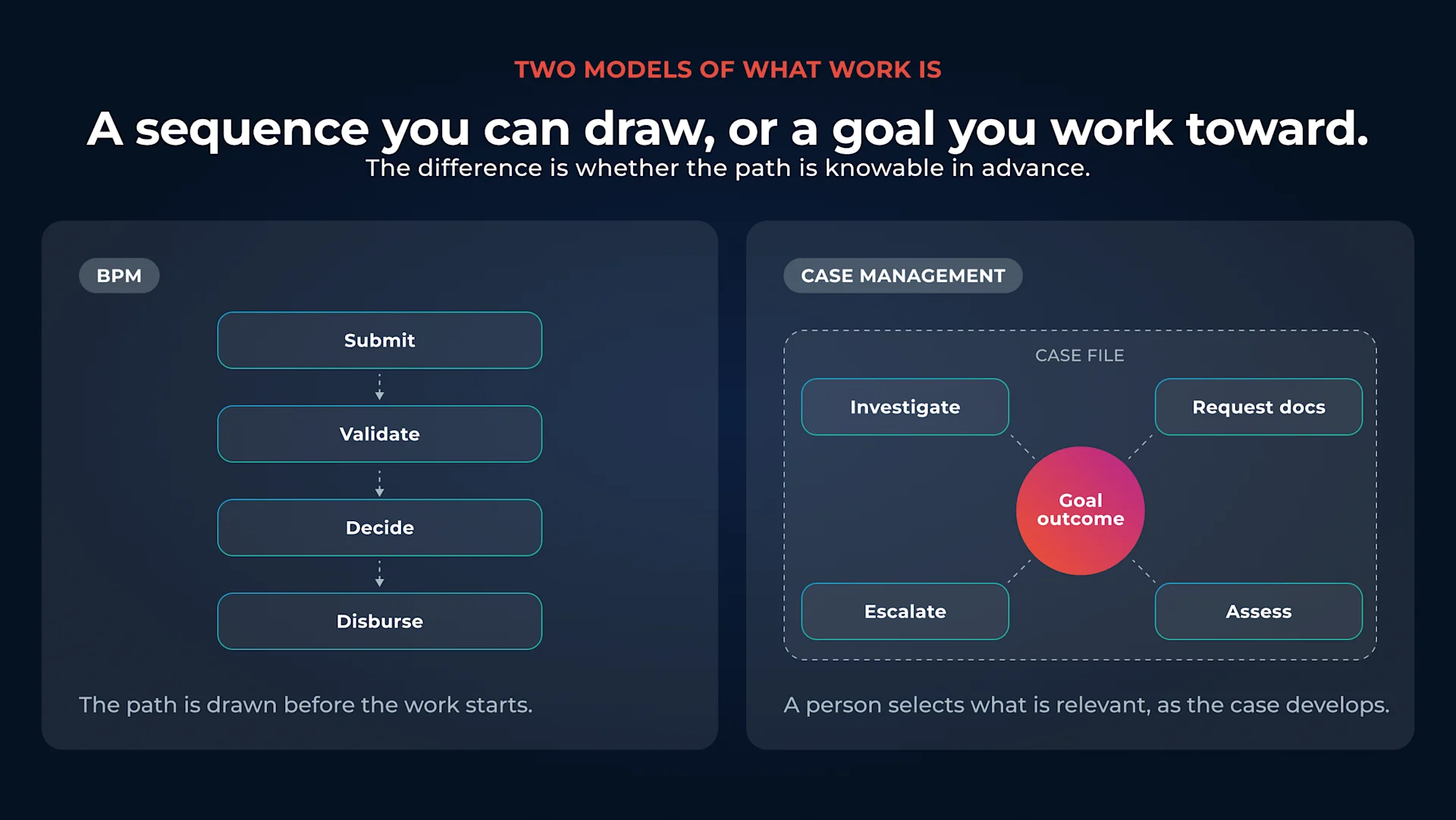
The distinction between BPM case management approaches is not about difficulty. Both handle high-stakes, high-value work, and both are found in the most regulated corners of financial services. The distinction is about whether the path is knowable in advance.
This matters because the two models fail differently when misapplied. Structured work forced into a case management system loses the consistency that made it worth automating: two people handle the same situation two ways, and the variance shows up in the audit.
Exception-driven work forced into a structured process produces the opposite failure. The path does not fit, so people route around it, and the record of what actually happened lives outside the system that was supposed to hold it.
BPM | Case management | |
Process shape | A defined sequence, drawn before work starts. | A goal, with activities selected as the case develops. |
Who decides the next step | The model. Routing rules determine what happens next. | A person, informed by what has just happened. |
What good looks like | Consistency, throughput, and low variance. | Sound judgment and a defensible outcome. |
Typical work | Payments, standard onboarding, claims within policy. | Investigations, escalated claims, exception handling. |
Standard | BPMN | CMMN |
Definitions rarely settle a purchase. These four questions do, and they work better on a specific process than on a department.
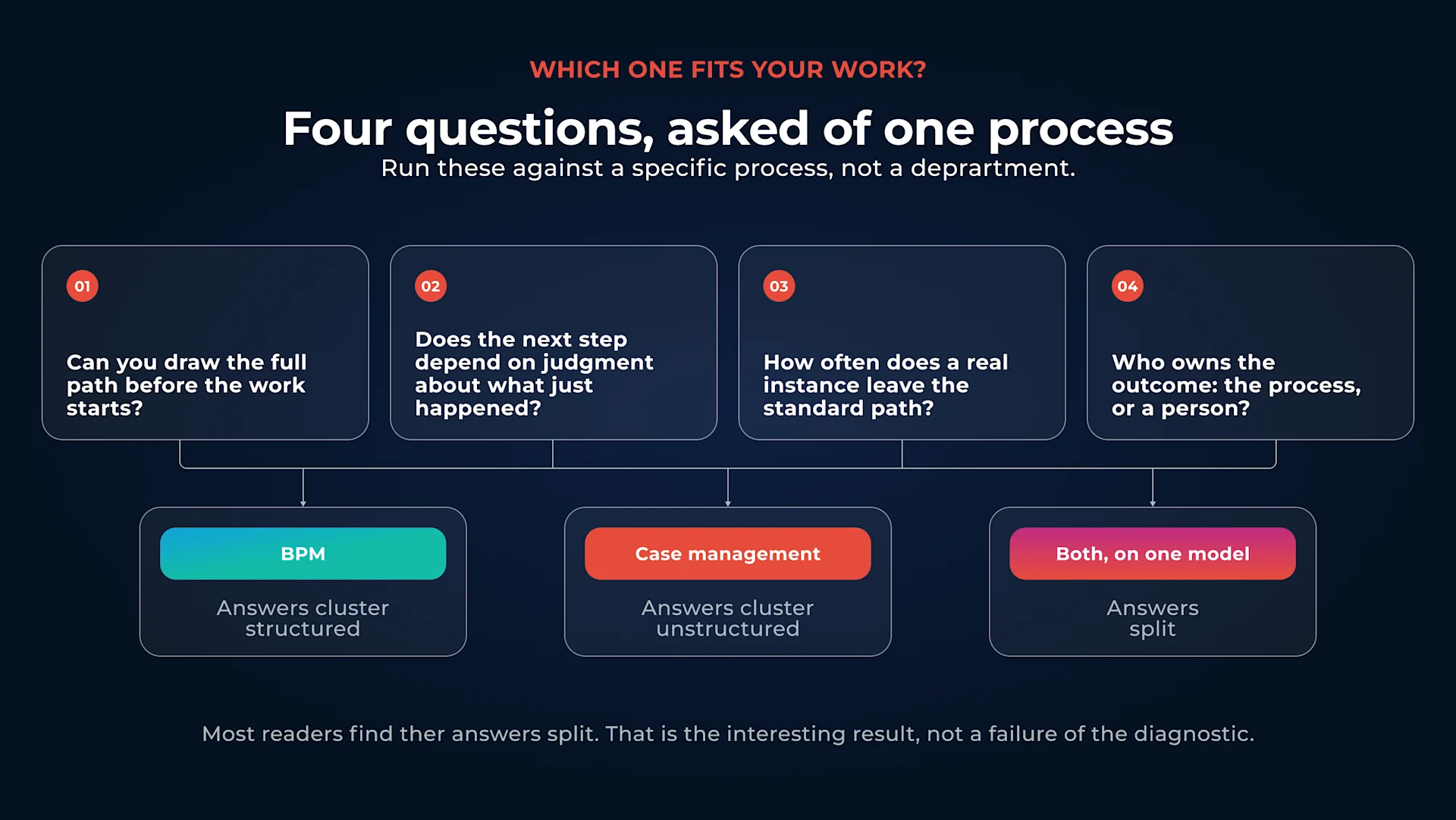
Take a real instance of the process and try to map it end to end without knowing anything about the particular case. If the map holds for most instances, the work is structured, and BPM fits. If mapping requires knowing what the case turns out to contain, the work is not structured, regardless of how organized the team is.
In a structured process, a rule chooses the next step: if the amount exceeds a threshold, route to review. In case work, a person reads the situation and decides what is worth doing next. If you cannot express the routing as a rule without losing something important, you are looking at case management.
Every process has exceptions. The question is proportion. Where exceptions are rare and handled by a defined escalation, BPM holds. Where a substantial share of instances go off the standard path, the standard path is a fiction, and the exception is the work.
In structured work, the process owns the outcome and the people execute it. In case work, a named person owns the outcome and uses the system to support and record their decisions. That difference shows up in accountability, and it shows up in how a regulator reads your audit trail.
Most BPM case management decisions resolve on these four questions alone. Four structured answers point to BPM. Four unstructured answers point to case management. You might find your answers split, and that is the interesting result rather than a failure of the diagnostic.
Need a platform that can handle both? Get a free trial of Flowable to see its capabilities in action.
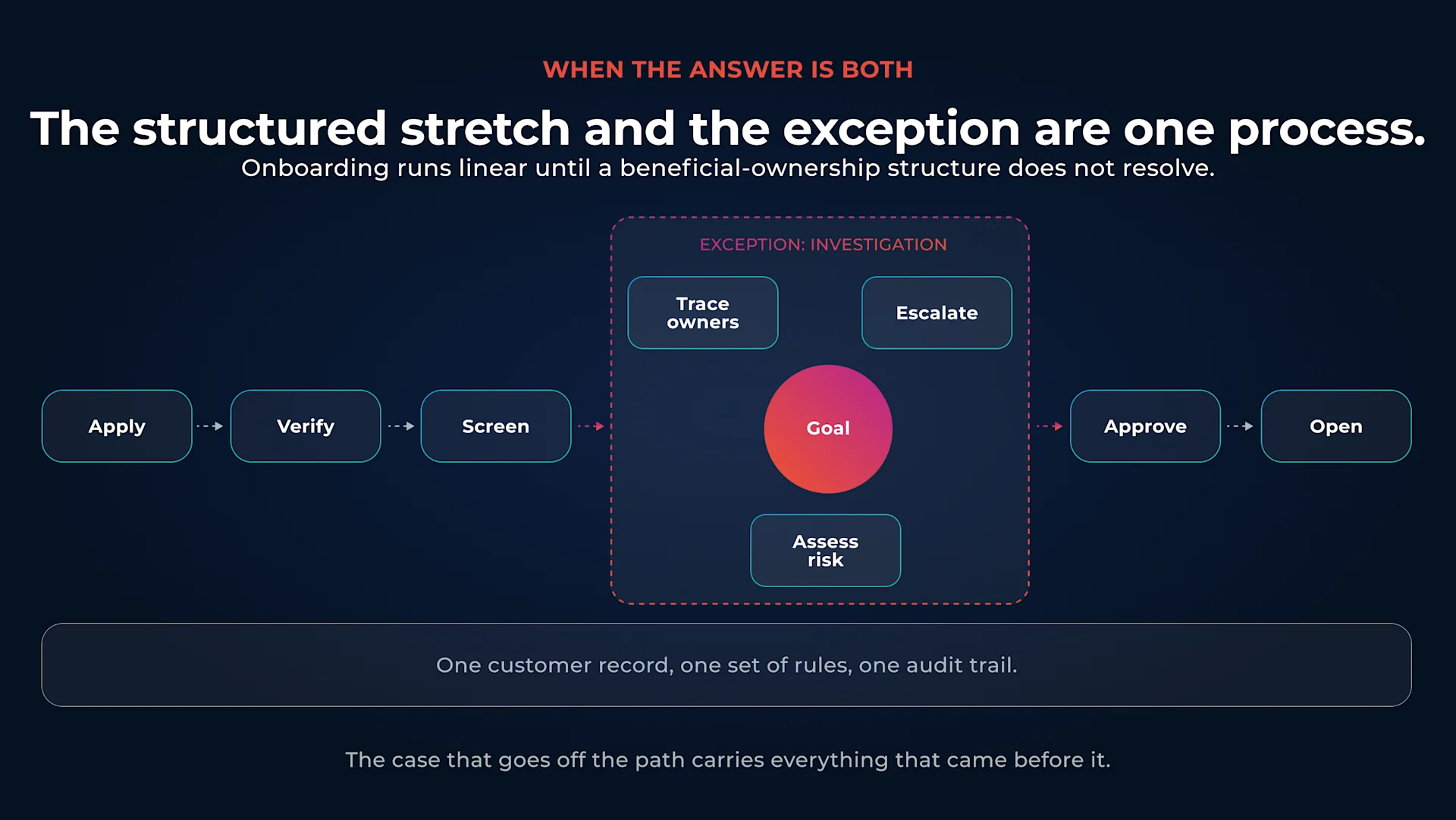
Almost every comparison of these two models arrives at the same conclusion: you need both. Real operations do not divide into structured processes and unstructured processes.
They contain both inside the same end-to-end flow. Customer onboarding is a defined sequence for the majority of applicants, and it is a judgment-heavy investigation when a beneficial-ownership structure does not resolve.
An insurance claim runs a fixed path until an assessor finds something that needs a decision no rule anticipated. The structured and the exception-driven work belong to one process. Everything recorded before the claim left the standard path still applies to it afterwards.
Buying two tools, one for each kind of work, creates several problems. Structured work runs in one system, exception-driven work in another, so the point where a case moves between them becomes an integration to build and maintain.
Customer data sits in two places. The rules applied during the structured part of the process stop at the system boundary. The audit trail splits in half, so answering a question about one customer means pulling records from two systems and lining them up by hand.
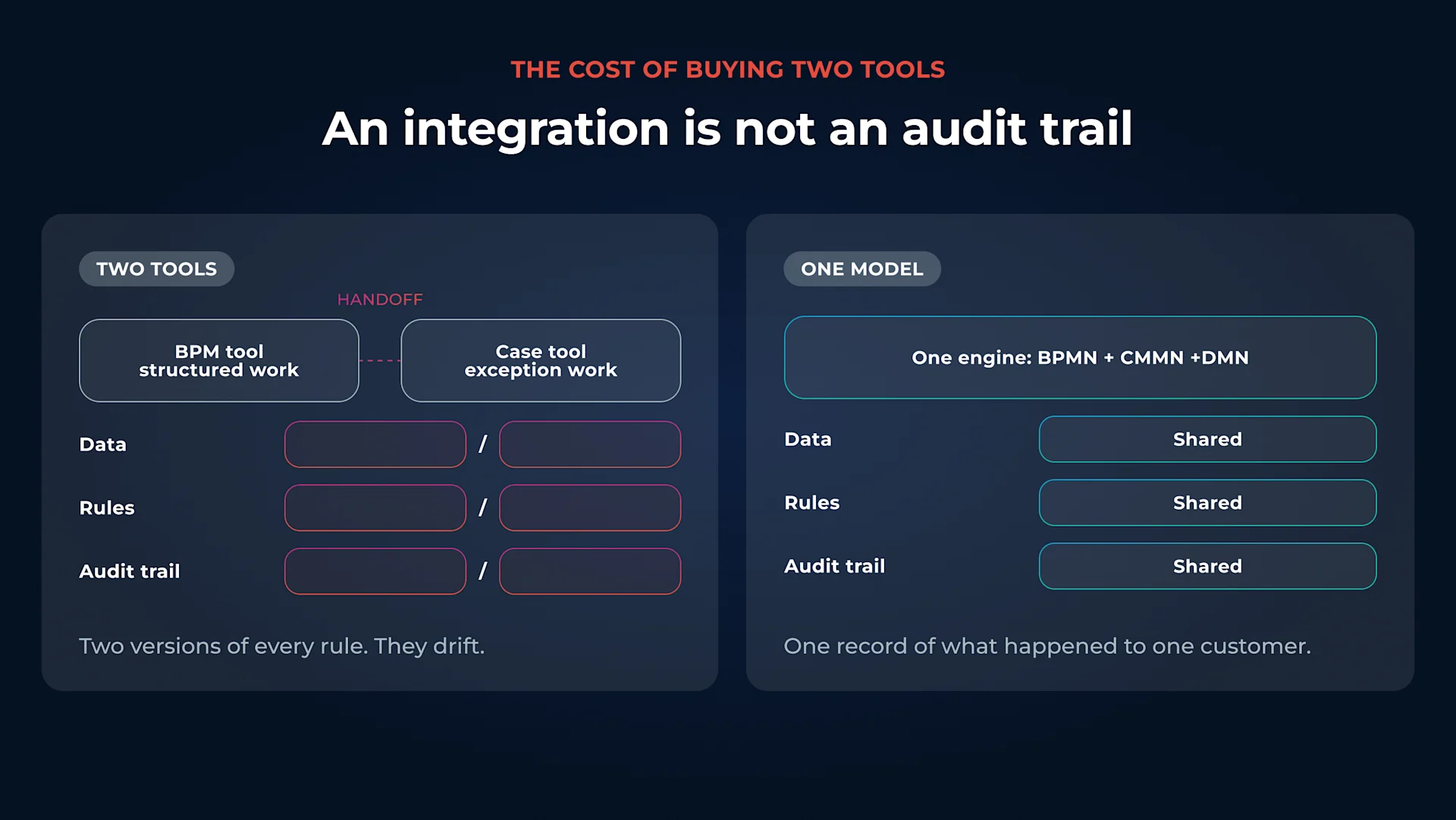
There's a second kind of cost, and it's harder to see at purchase because it doesn't show up on day one. Two systems mean two models of the same customer, two definitions of the same rule, and two teams maintaining them.
When a policy changes, it changes twice, and the two versions drift apart. The exception-driven system, being the one handling the unusual cases, is usually the one that drifts furthest from the policy it was meant to implement.
The useful question is not which tool to buy. It is whether one platform can run both kinds of work on one model, with shared data, shared rules, and a single record of what happened.
Structured work is modeled in BPMN. Exception-driven work is modeled in CMMN, and getting exception handling automation right depends on the model, not just the intent to handle exceptions well. BPMN and CMMN are both open standards, maintained by the Object Management Group, and a model expressed in either one is readable and portable without the vendor's tooling. Decision logic has a third standard, DMN, which separates the rules from the flow so they can be changed and audited on their own.
Many platforms that market case management support BPMN and treat case work as a feature layered on top: a flexible task list, an ad hoc subprocess, a set of configuration options.
That approach works until the case work becomes the point rather than the exception. A goal-driven case with a case file, discretionary activities, and stage-based lifecycles is a different execution model, not a relaxed version of a sequential one.
So the question to put to a vendor is direct. Is your platform built on open standards that cover both predictable and exception-driven work, or does it support one properly and approximate the other? And if the model is proprietary, what happens to your process definitions, your rules, and your audit trail when you want to move?
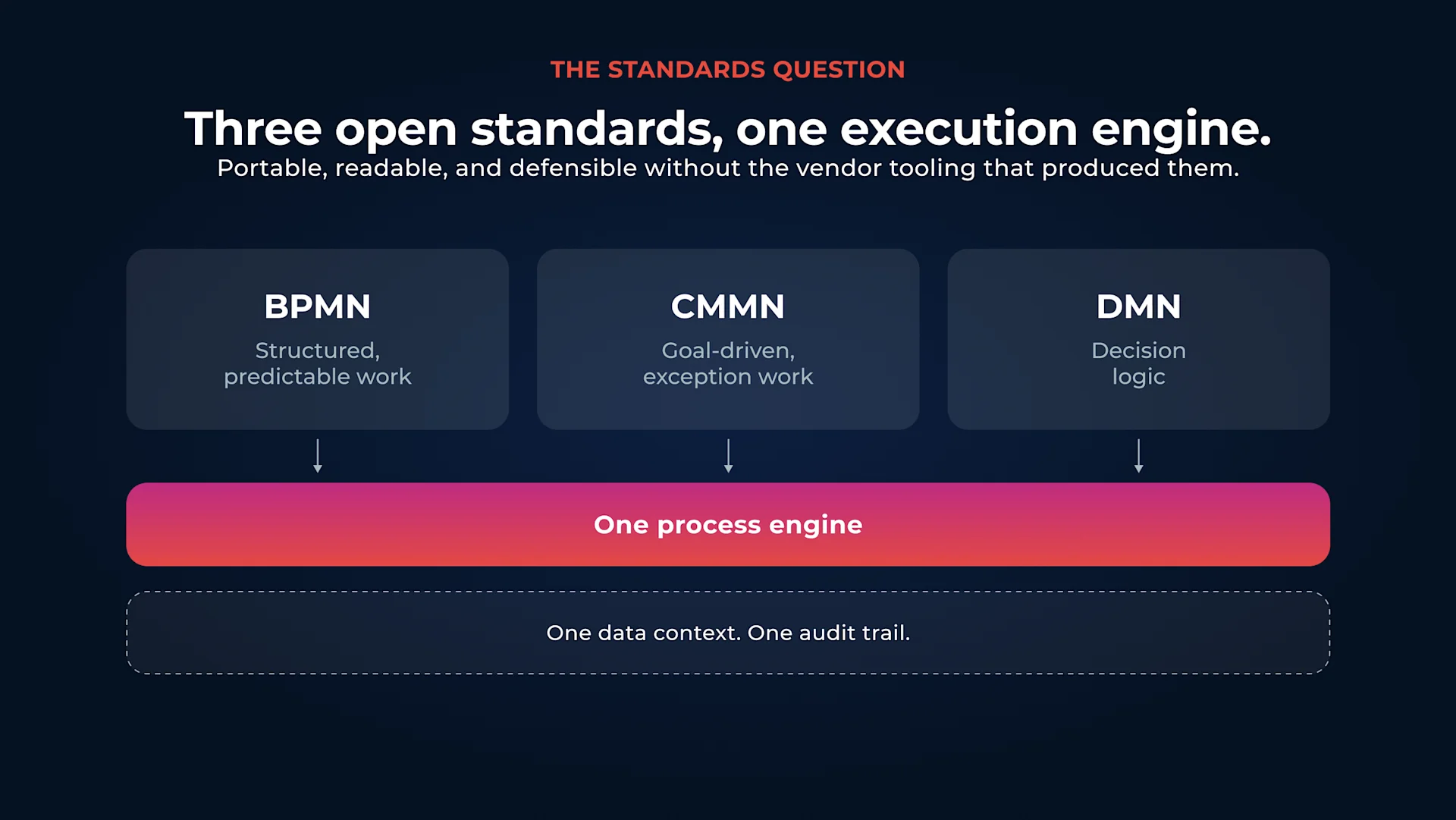
Flowable runs BPMN, CMMN, and DMN on a single engine. Structured work, adaptive case management, and decision logic share one process model, one data context, and one audit trail.
An onboarding that runs a defined sequence and then opens an investigation does not cross a system boundary to do it, because both are expressed in the same model and executed by the same agentic orchestration layer.
The decision you make now has to adapt for the work as it changes, and AI is changing the shape of it.
As AI takes on the predictable parts of a process, the proportion of human effort spent on the remainder rises. The routine claim gets decided by a rule and a model. What is left for a person is the claim that does not fit, the case with an unusual pattern, the decision that needs judgment and will need to be explained later.
The structured share of the work is being automated, and the residue is exception-driven, judgment-heavy work. That is precisely the work case management was designed to hold.
This does not make BPM less relevant. The structured elements still need to run consistently, and they still need to connect to the exception-driven ones.
What it does mean is that a platform which handles predictable work well and treats adaptive work as an afterthought is a platform aimed at a shrinking share of the problem. The requirement is one model that governs both, keeps them auditable, and lets AI agents participate in either under the same controls.
Flowable is the process orchestration layer for that requirement. Predictable work and exception-driven work run on open standards in one engine, with the data, the decision logic, and the audit trail shared between them, and with human judgment placed where the work needs it.
Request a demo to see how Flowable runs structured and exception-driven work on one model, with examples from financial services and insurance.
Sign up today to get your free Flowable trial and see the platform in action.
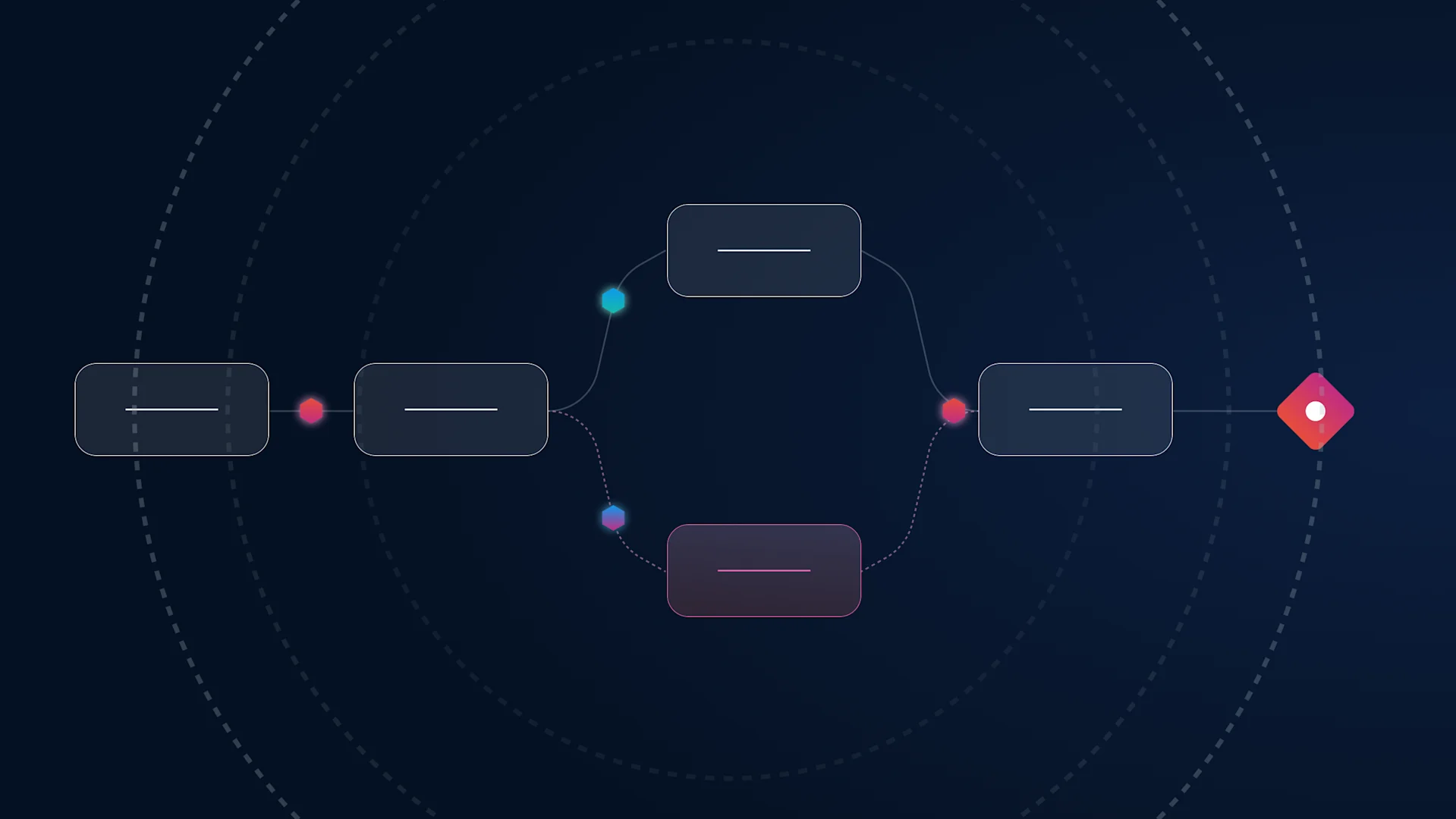
n agentic workflow is more than a multi-agent diagram. See what the standard patterns omit once workflows meet exceptions, oversight, and audit requirements. Primary keyword: agentic workflow

Automating single functions leaves the process broken at the handoffs. See why end-to-end orchestration beats function-by-function financial process automation.
A criteria-led framework for evaluating workflow orchestration tools, covering open standards, governance, exceptions, and lock-in, not another ranked listicle. Keywords: workflow orchestration tools