Imagine two automated payment systems: in one, an irreversible payment proceeds automatically because a person was only expected to monitor the process, rather than approve the decision. In the other, every routine, low-risk action is held for human approval at every stage, turning automation into even more of a bottleneck than manual work.
Both of these problems stem from the same mistake: treating human oversight as a single concept. Human-in-the-loop and human-on-the-loop are two distinct ways of assigning responsibility between people and automation, yet the terms are often used interchangeably. In a human-in-the-loop process, a person must make a decision before the workflow can continue. In a human-on-the-loop process, the system acts autonomously while a person supervises and intervenes only when necessary. Choosing the wrong model for the wrong step can create either unacceptable risk or unnecessary friction.
The distinction is also more granular than many organizations realize. It is not a choice you make once when deploying an AI system. It is a decision that should be made for every meaningful step in a workflow. Once those points have been defined, they need to be enforced consistently every time the process runs, with a clear record of when a person decided and when the system acted on its own. Most enterprises already run a human-in-the-loop workflow somewhere in their process landscape. The question this article answers is which steps actually need one, and which need supervision instead.
Both models keep a person accountable for automated work. They differ in where the person sits relative to the decision, and getting that placement right for each step is what separates safe automation from a bottleneck.
Human-in-the-loop means a person must make a decision before the workflow can continue. The process reaches a defined point, stops, and waits for human judgment before it proceeds.
This model fits high-stakes, irreversible, or judgment-heavy steps, where the cost of an unreviewed decision is high enough that automation should not act alone. The person is inside the flow of execution, and their decision is a required part of it.
Human-on-the-loop means the system acts autonomously while a person supervises and intervenes only when necessary. The process runs on its own, and the person monitors it, stepping in to correct or halt it when something warrants attention.
This model fits routine, low-risk, high-volume steps, where holding every action for approval would create friction without reducing meaningful risk. The person is above the flow of execution rather than inside it.
Both models place a person above an autonomous system. The difference is where that person sits relative to the action.
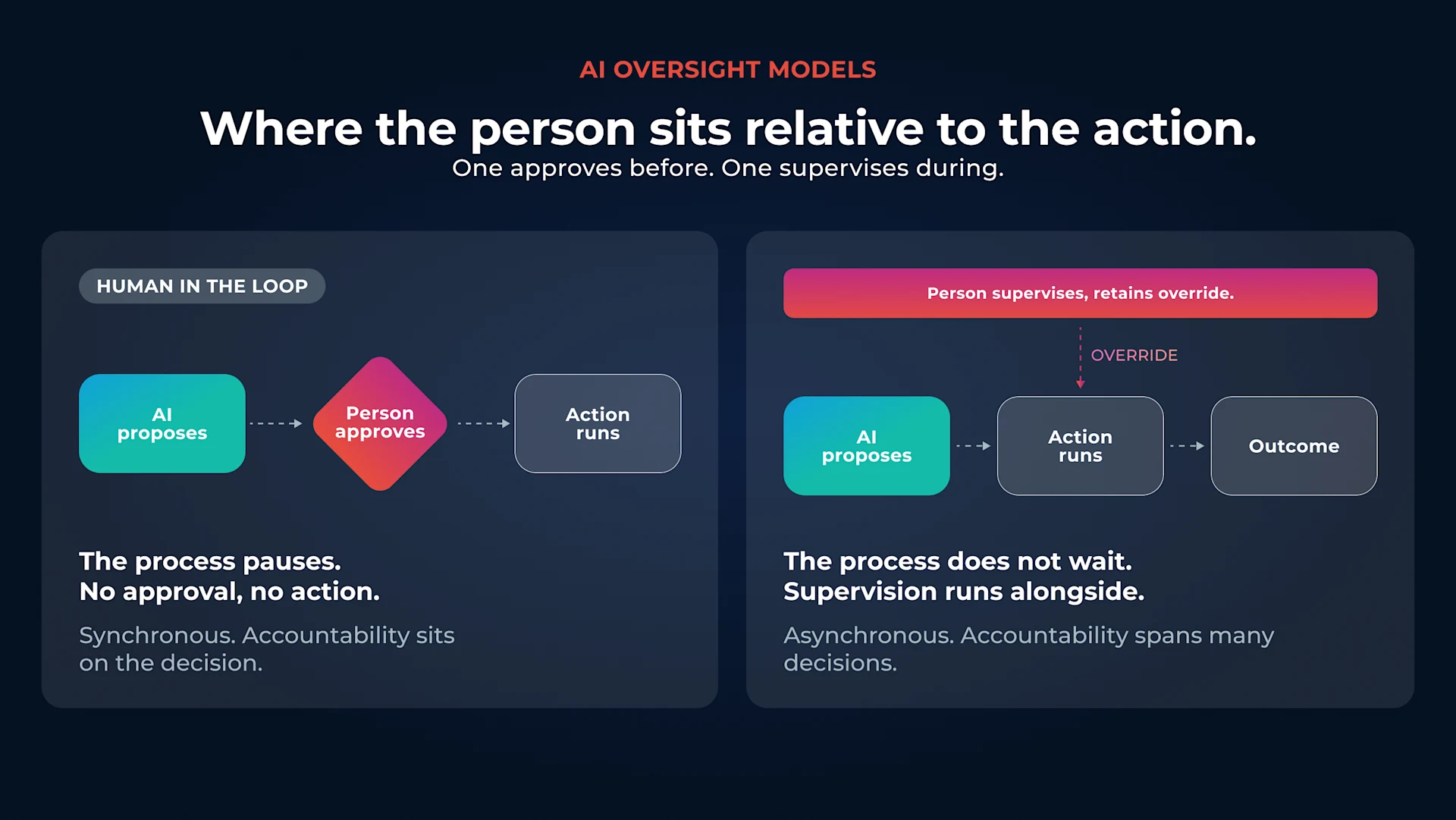
In a Human-in-the-loop process, a person makes a decision before the system can proceed. The system prepares an action and presents it, the person approves, rejects, or amends it, and only an approved action runs.
Execution is synchronous, because the process pauses at that point and waits for the decision. Accountability sits with the person who approved, on the specific decision they made.
In a human-on-the-loop process, the system acts on its own and a person supervises. The person monitors the decisions the system makes, keeps the ability to intervene, and steps in when something is wrong.
Execution is asynchronous, because the process continues while supervision runs alongside it. Accountability sits with the supervisor, across the whole set of decisions rather than any single one.
| Human-in-the-loop | Human-on-the-loop |
Control point | Before the action. The system proposes, the person approves. | Alongside or after the action. The system acts, the person can override or halt. |
Execution model | Synchronous. The process pauses for a decision. | Asynchronous. The process runs; supervision happens in parallel. |
Latency | High by design. Speed is bounded by human availability. | Low. The system moves at machine speed. |
Accountability | With the approver, per decision. | With the supervisor, across a population of decisions. |
On paper the distinction is simple. It matters only when the actions a system takes have real consequences, and that is what has changed.
For most of AI's short history the oversight model made little practical difference, because the systems only produced text. A model that drafts a summary or answers a question makes a suggestion. A person reads the output, keeps it or discards it, and nothing happens without them.
Agentic systems change this, because they can act. They call tools, query systems, update records, trigger payments, and open and close cases. Each of those steps changes something, and its effect lands whether or not a person is watching.
When the system is wrong, the error is already in effect, and someone has to find it and reverse it. The oversight model determines whether a failure is caught before it happens or corrected after it has.
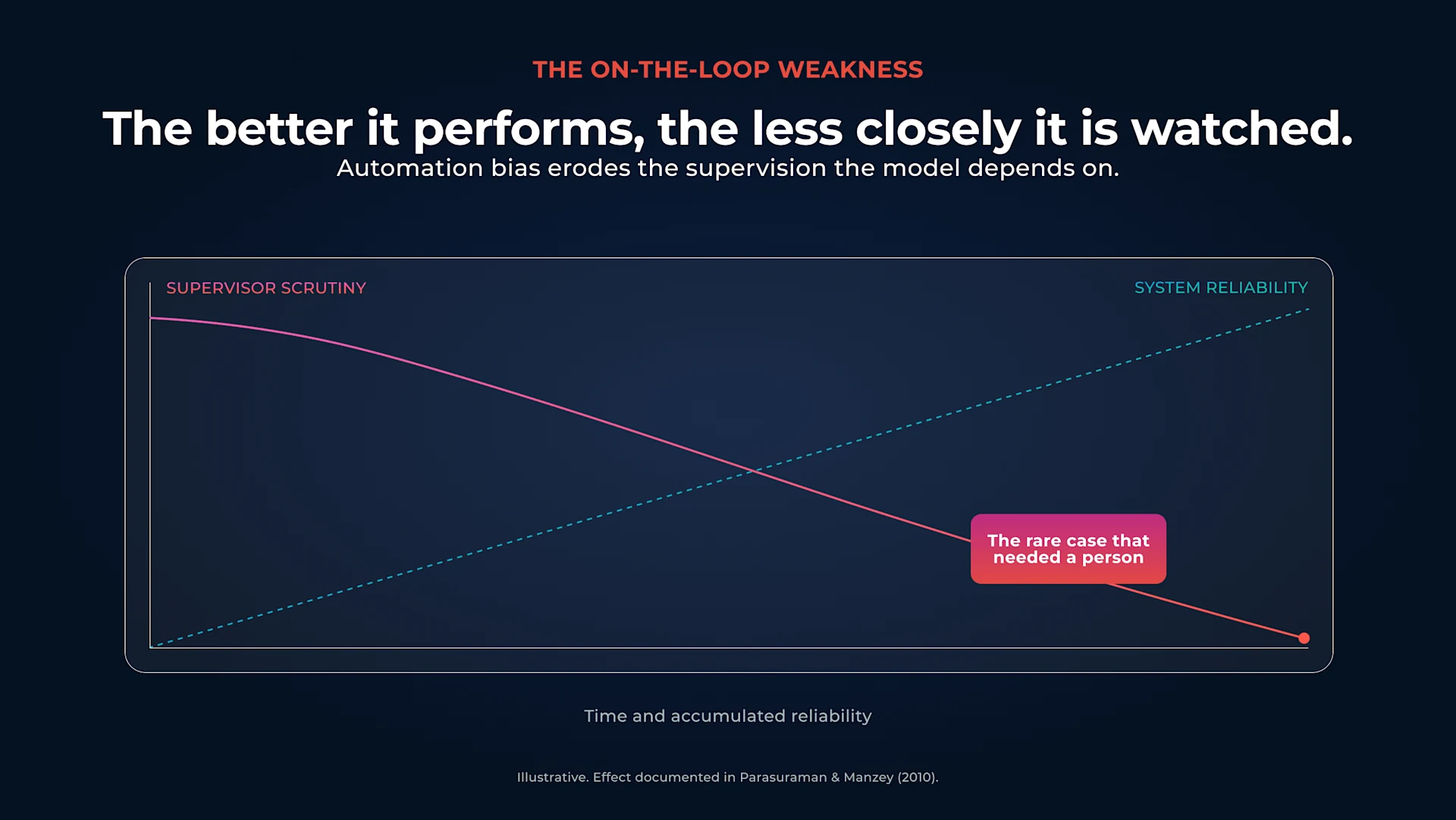
Human-on-the-loop oversight carries a specific weakness. In principle the system handles the volume and a person handles the exceptions, but that depends on the person noticing them.
A supervisor who watches a system perform reliably for long enough stops examining its output closely, because checking a machine that is almost always right comes to feel unnecessary.
This tendency has a name, automation bias: people defer to a system's output over their own judgment, and the effect grows the more the system has proved itself. The better it performs, the less closely it is watched, and the rare case that needed a person is the one most likely to pass unchecked.
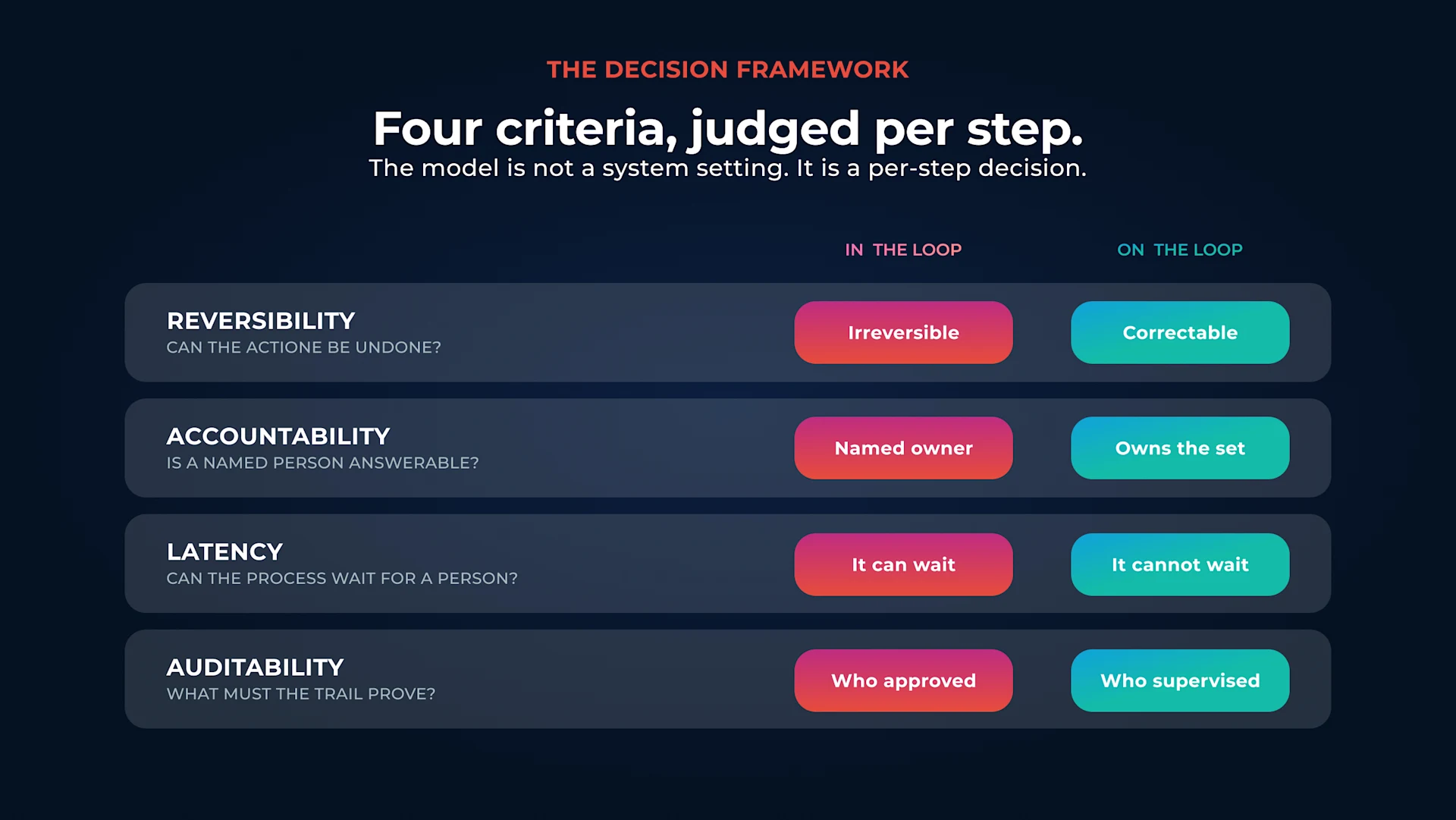
The choice is made per step, so the criteria apply per step. Four of them settle most cases: reversibility, accountability, latency, and auditability.
Start with whether the action can be undone. A record flagged for review can be unflagged at no cost. A payment sent to an external account may be unrecoverable.
The less reversible an action, the stronger the case for requiring human approval before it runs. Actions that can be corrected afterwards are safe to leave under supervision, because a late catch still fixes them.
Some decisions carry a named owner by law or internal policy: a person who must be able to say they made the call and explain it.
Where a regulation or control framework assigns that accountability to a named individual, supervision does not satisfy it, because being responsible for a set of outcomes is different from making a specific decision.
Human-in-the-loop places the accountable person on the decision itself, at the moment it is made.
Latency tolerance is whether the process can wait for a person. A claims decision above a set threshold can hold for an hour while an adjuster reviews it. Monitoring a high volume of transactions for anomalies cannot wait, because no person can stand in the path of every transaction without stopping the business. Where the work cannot wait, human-on-the-loop is the only workable model, and the task becomes making that supervision effective rather than nominal.
Auditability is the ability to show, after the fact, who decided what and why. Both models produce an audit trail, and the two trails record different things.
Human-in-the-loop logs a decision and the person who approved it at a point in time.
Human-on-the-loop logs an action, the person supervising, and any intervention they made.
A claims decision above a monetary threshold routes to a person for sign-off before payment. That is Human-in-the-loop, because the action resists reversal and carries personal accountability.
Monitoring a high volume of transactions for anomalies runs autonomously and surfaces outliers for a person to review. That is human-on-the-loop, because no one can gate that volume and a flag costs nothing to reverse.
A single organization runs both, on different steps of different processes. Neither model is the right answer for a whole system.
Choosing the model is the easy part. Enforcing it is where systems fail.
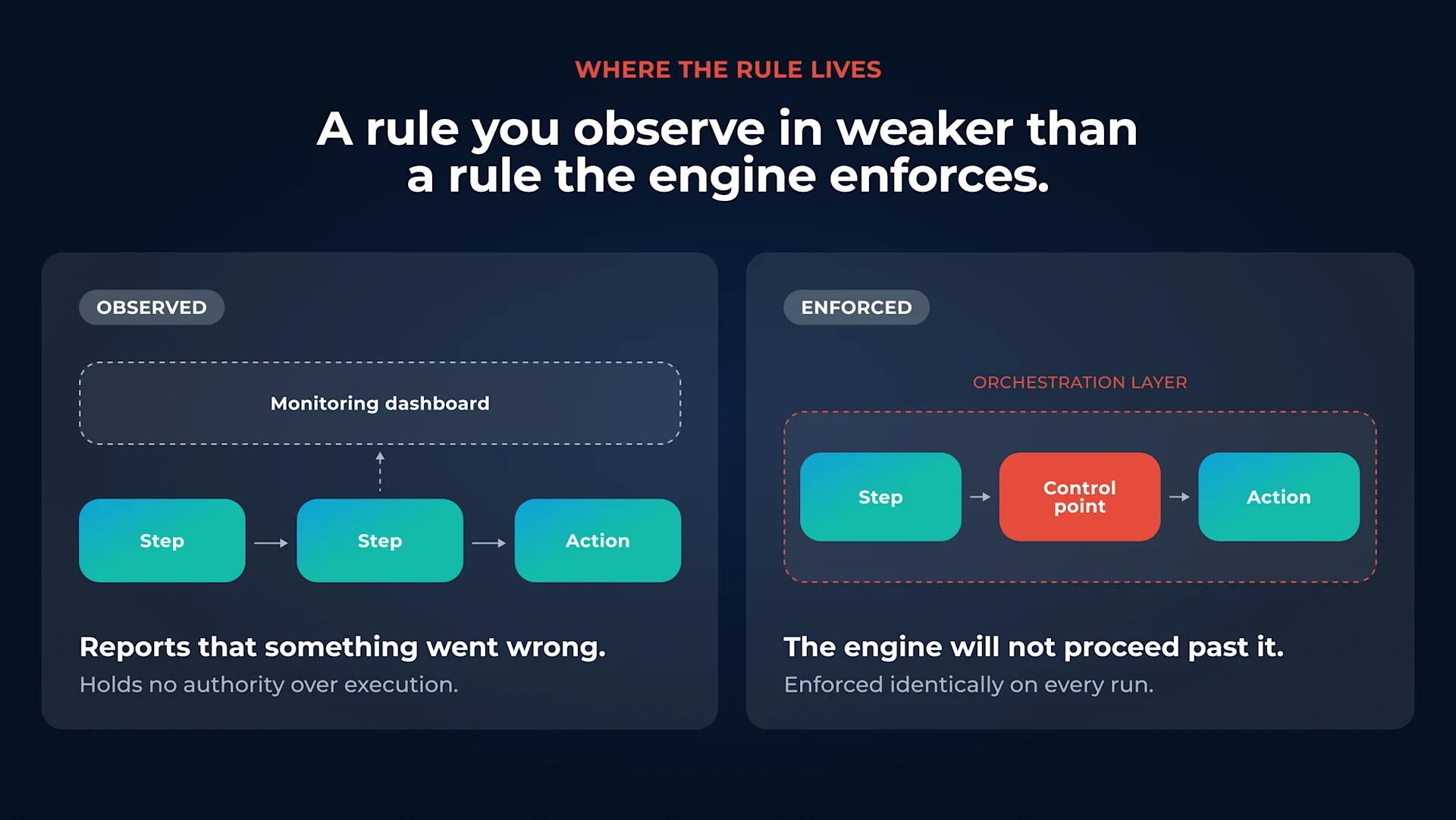
A Human-in-the-loop rule is worth only as much as the guarantee that the system cannot act without the sign-off. If the rule lives in a prompt, a wiring diagram, or one developer's memory, it holds until someone edits the prompt, reroutes the flow, or leaves the team.
A prompt can be talked around. A model can be steered past an instruction it was merely told to follow, and a person under deadline pressure can quietly reroute a flow without anyone reviewing the change.
A process definition is different in kind, not just in degree: it is a versioned artifact the engine executes directly, so the control point is not advice the system tries to honor, it is a step the engine will not skip. Removing it means shipping a new version of the process, not editing a line of application code or rewording a prompt.
The oversight model has to hold identically every time the process runs, on every path through it, with a record of who decided what and when. A rule that holds only most of the time controls nothing, because the system follows it when convenient and drops it when not.
That guarantee comes from the layer that runs the process, rather than from the AI model inside it. The model generates and acts. The orchestration around it decides where an action needs a person to approve it and where it needs only a person watching, and it enforces that placement at runtime. Governing enterprise AI agents sets out the wider control problem this creates; the oversight choice is one control point within it, defined at design time and enforced on every run.
Where the rule lives matters for a second reason. Oversight defined in proprietary configuration is portable only as far as one vendor permits. A buyer evaluating an orchestration layer should ask whether its control points are expressed in open standards or locked to a single product, because auditability that depends on proprietary configuration is not something the enterprise fully controls.
As agentic systems take on more of the work, the human role moves. Fewer operational decisions pass through a person, and more of a person's time goes to the calls that carry the most risk and the exceptions that fall outside the model's competence. Oversight shifts from making the routine decision toward assuring the quality of decisions made at machine speed. A reviewer who once approved every claim comes to own the claims above a threshold and audit the rest.
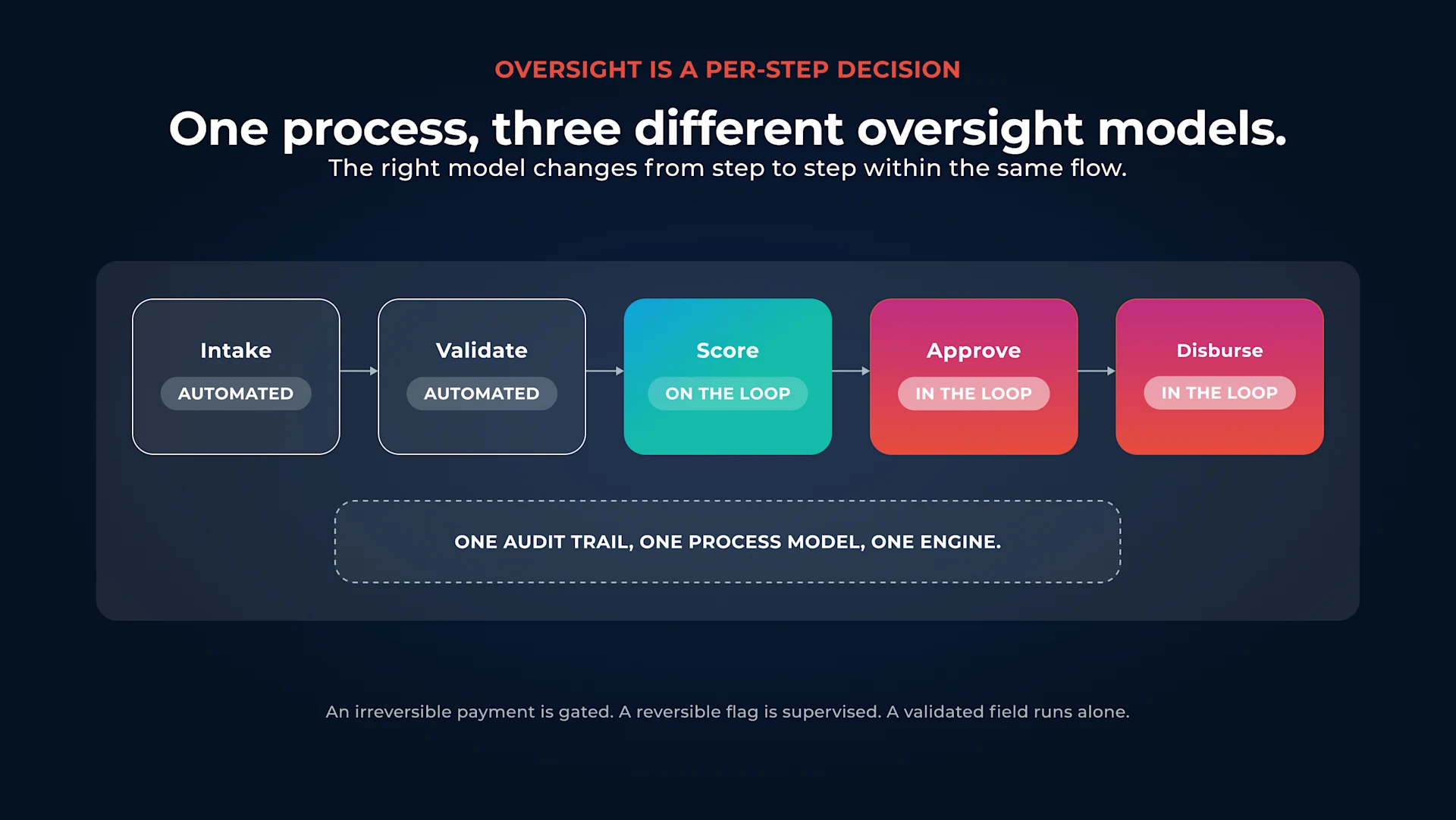
That shift holds only if the placement of the person is a defined, enforced part of the process rather than a habit that erodes under load. Human judgment at specific points is a design choice.
The process states where a person must decide, where a person supervises, and where the system runs alone, and it enforces those states on every run with a full record of each. Left to convention, automation bias erodes the on-the-loop model, and a poorly placed approval step turns the in-the-loop model into the bottleneck described at the start.
Flowable provides AI orchestration with human oversight built into the process itself, not layered on top of it, so a Human-in-the-loop step is enforced rather than optional, and a human-on-the-loop step logs every action and every intervention for review.
The oversight rule you define at design time is the rule that runs in production, on every path, every time. That is what lets a regulated bank or insurer show a risk committee that the control it described is the control that operates.
Request a demo to see how Flowable enforces Human-in-the-loop and human-on-the-loop oversight across regulated banking and insurance processes.
Learn what a decision engine is, how DMN separates rules from process logic, and how Flowable governs decisions across every case.
See a real decision table example for business rules automation, plus how Flowable models it using the open DMN standard.

Business process management software covers very different tools in 2026. See how the category shifted towards BOAT and what buyers should evaluate.