
AI orchestration is the governing and coordination of diverse AI models, the AI actions of specialized tools, and workflows into complete automation-assisted processes that support complex task solutions. AI orchestration is achieved with advanced software modeled business processes — by automation developer teams — that provide an enterprise-wide orchestration layer for AI-assisted work.
On a technical level it involves connecting and managing various AI components, like machine learning models, natural language processing (NLP) engines, and external applications, ensuring they collaborate efficiently and intelligently to achieve cohesive business outcomes. And AI orchestration can also be driven by an AI model or agent itself, by way of an orchestrator agent.
The expectations of enterprise AI, for example; from automated loan approvals and personalized customer service to real-time claims processing, often remain stuck in isolated proof-of-concepts, or are even limited to ad-hoc use of large language models (LLMs) for support. While individual AI models demonstrate powerful capabilities, the challenge for businesses is integrating and scaling multiple AI components into high-volume, regulated processes. And AI orchestration is what clears this barrier.
AI orchestration covers AI’s end-to-end integration, coordination, automation, and its management and governance.
AI orchestration starts with integrating siloed models as operational assets that can be used and centrally connected across your core systems and work. That means securely connecting disparate AI models, whether internal, vendor-supplied, or LLMs, databases, and business applications through APIs so they can share information in real-time, be onboarded to the work with internal procedures, and the right tool and use can be actioned when needed directly within a work process.
For example, this might involve calling a computer vision model that is connected and on stand-by to process an image and instantly send the extracted text data to an integrated NLP model for summarization to determine what process should be actioned, while an AI agent can then begin the right workflow and present the necessary information for the right colleague to collaborate on its completion.
AI orchestration delivers immediate benefits in three key areas: scalability, efficiency, and enhanced outcomes, allowing organizations to expand their AI capabilities while also optimizing resource allocation.
Orchestration allows the coordination of when and which different AI components are triggered and interact to achieve a larger goal, like setting orchestration rules in ecommerce resulting in a retail system using a recommendation engine result as the input for an inventory check to suggest only in-stock products.
Automating the execution of multi-step AI tasks and workflows to reduce manual intervention and increase efficiency. Think automating the entire lifecycle of an AI application, including handoffs with the required level of human-in-the-loop collaboration to accelerate processes.
Automation modeled processes mean AI tools and services don’t need to be manually prompted or actioned outside of a workflow, and the results of AI powered SaaS tools don’t need to be carried over into another system manually: the desired action is already performed for an employee to then complete a process or step with AI’s input already actioned, while data is carried across systems and tools.
With orchestration comes governance, by providing a centralized framework for managing, monitoring, and ensuring the reliable performance of AI, including cost optimization and the security of the whole AI system. It enables setting guardrails, access permissions, tracking model accuracy, managing resource usage, keeping full audit trails, and ensuring data compliance with policies and regulations.
AI orchestration is fundamental in un-siloing AI adoption and transforming AI solutions into scalable, value-driven systems. AI orchestration delivers immediate benefits in three main areas: scalability, efficiency, and enhanced outcomes, allowing organizations to expand their AI capabilities by making AI actionable across enterprise work processes.
By chaining specialized models, orchestration enables more complex problem-solving that no single AI system could manage alone, leading to business outcomes that can meet the expectations of AI adoption. It also delivers consistency and reliability by providing necessary guardrails for AI workflows, ensuring tasks benefit from the AI capabilities available across systems and tools. And it reduces the risk of costly errors and inconsistencies, leading to more trustworthy and consistent results in critical, regulated processes.
Today’s enterprises are moving beyond passive applications — where apps wait for users — toward autonomous, adaptive AI actions — where AI acts and collaborates with decision making and decision support. Orchestration software is what makes enterprise AI agent use possible, controlled, customized, safe, manageable.
This level of AI execution is bringing a new level of adaptive orchestration, where the orchestration layer coordinates dynamic, context-aware entities that reason and act. AI orchestration is the framework that supports an AI agent's ability to plan and execute a multi-step task based on evolving context and the integration with internal and external data sources and policies.
Its capability also enhances workflow management by overseeing cognitive load by structuring complex outputs, understanding document repositories and large data sets at speed, and managing exceptions that otherwise create a high cognitive load for human analysts.
Orchestration elevates automation beyond simple path decisions by providing a managed process structure around complex AI outputs, managing the judgment-based workflows and exceptions that previously relied heavily on highly skilled human analysts and extensive work hours consulting process guidance and resources.
For every AI action, from simple data categorization to complex planning, the governance that comes with AI agent orchestration: mandates that control, security, and compliant data filtering become non-negotiable architectural requirements. AI orchestration enables guardrails that customize AI agent actions and enforces these standards at scale.
Leading industry analysts like Forrester recognize that multi-AI orchestration has become a key cog in enterprise automation. The orchestration provided by an automation platform and its developed processes are the unified control tower that manages the planning, memory, governance, and human-in-the-loop oversight across all AI interactions.
Adaptive process orchestration is designed to handle the dynamic, context-aware decision-making inherent to complex AI workflows. The focus is now on safely governing the non-deterministic nature of AI outputs, ensuring compliance, security, and auditability at scale, increasingly more than automating fixed tasks.
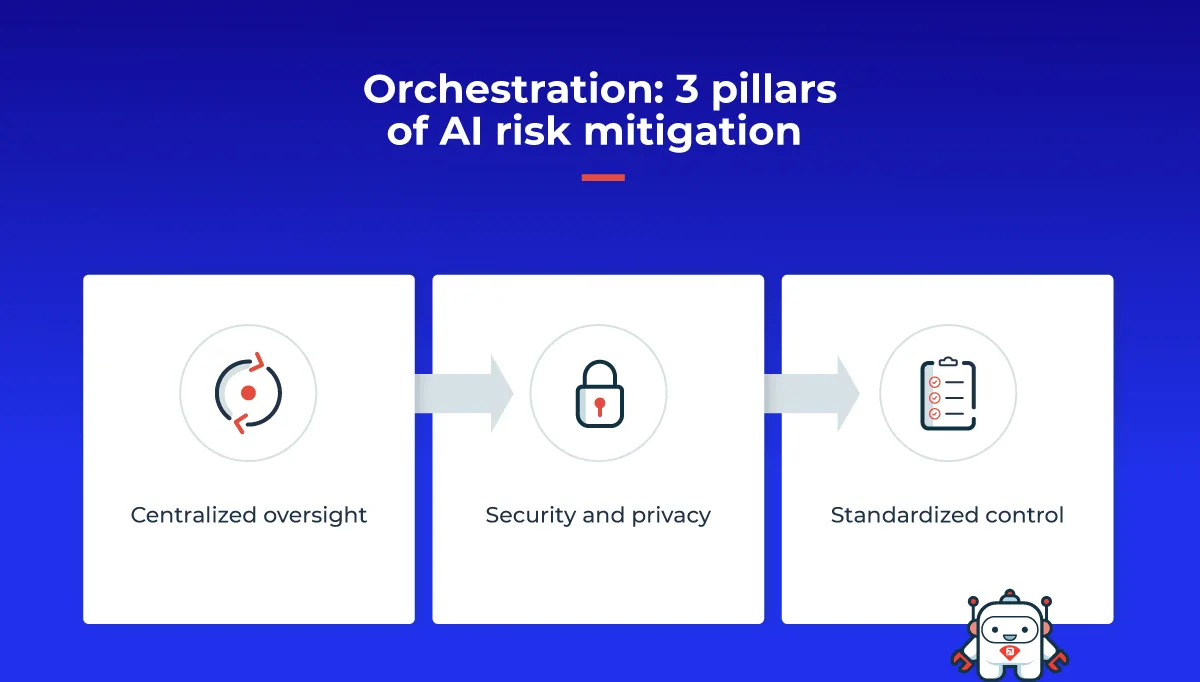

Orchestration serves as the risk mitigation tool for scaling AI, delivering:
Centralized oversight: Mandating centralized management, monitoring, including latency and cost tracking, and clear traceability for every decision and action taken by an AI service.
Security and privacy: Orchestration enforces security and compliance by acting as a filter, controlling and protecting sensitive data before it is passed to external AI services like an LLM.
Standardized control: Providing declarative, code-centric mechanisms to govern complex data and ML pipelines, ensuring all steps are versioned, reproducible, and auditable for regulatory compliance.
Flowable’s unique approach addresses the challenge of integrating non-deterministic AI outputs into auditable business outcomes by leveraging strategic automation engineering to model every aspect of a governed AI workflow. This methodology utilizes a combination of three key open automation standards.
BPMN (business process model and notation) is used for linear aspects and well-defined processes, handling tasks like standard data validation, sending a final AI output for human approval, or managing failure recovery logic — by way of providing a predetermined pathway for the system to follow when an error or failure occurs during an automated process.
For managing the non-deterministic side of AI, Flowable uses CMMN (case management model and notation). CMMN is essential for adaptive workflows, handling the case or context of a complex problem, allowing the workflow to dynamically add, remove, or complete tasks based on real-time AI reasoning and outcomes. And providing necessary state management, which is the process of tracking, recording, and controlling the transition of a process — or "case" — from one state to the next in complex, non-linear workflows. For example, a customer complaint's state might be "Pending Review," "Awaiting External Data," or "Completed."
And DMN (decision model and notation) is used to centralize and govern decision logic. This is ideal for defining the explicit rules for AI governance, such as: "If the AI confidence score is below 75%, or if the extracted sentiment score is negative, then route the task to a senior analyst for human-in-the-loop review."
Flowable’s multi-standard approach is suited to govern the complexity of advanced AI patterns like retrieval-augmented generation (RAG), connecting the multi-step RAG process using BPMN sequences for control.
DMN controls which vector database to query or which LLM to call based on the user's request context. Traceability is inherent: every step, including the specific DMN rule used, is logged within the process history, standardizing the pattern.
For general complex AI workflow governance and human-in-the-loop, CMMN provides the workflow state management necessary to control the long-running, non-linear lifecycle of a dynamic AI process, tracking its context, memory references, and planning. Instead of rigid pipelines, the CMMN case tracks the workflow's progress toward a goal.
Human-in-the-loop oversight is smoothly integrated. BPMN user tasks are inserted whenever an AI service's output is high-risk, non-compliant, or falls outside predetermined confidence thresholds set by DMN.
This provides a clear, managed handoff between AI execution and human judgment, which is logged as part of the overall process audit trail. Tool and resource control is managed by modeling external services, like code execution or proprietary APIs, used in AI workflows as service tasks within BPMN, centralizing their inputs, outputs, and failure handling to ensure robust and auditable interaction with the external world.
AI orchestration is the crucial link to transform isolated AI models and services into scalable, secure, and value-driving enterprise capabilities. And a robust orchestration platform is the most effective way to deliver the three pillars of successful enterprise AI implementation:
Reliability: Ensuring durable workflows, high resiliency, and built-in failure recovery to maintain 24/7 business operations.
Compliance: Providing centralized management, data filtering, and adherence to auditable, versioned execution for regulatory peace of mind.
Scale: Facilitating growth from a single pilot to high-volume production across a distributed, secure architecture.
By adopting adaptive process orchestration, organizations can move beyond experimentation and unlock the potential of AI within their most crucial business operations with confindence and impact.
Business process management software covers very different tools in 2026. See how the category shifted towards BOAT and what buyers should evaluate.
Client lifecycle management in banking goes beyond onboarding. See how case management keeps client context intact through KYC, reviews and offboarding.
n agentic workflow is more than a multi-agent diagram. See what the standard patterns omit once workflows meet exceptions, oversight, and audit requirements. Primary keyword: agentic workflow