
Faced by global clinician shortages and the ever-increasing demand for care, the healthcare industry finds itself at a critical crossroads. But amidst these growing concerns, there’s an answer on the digital horizon: Embracing a fundamental shift toward optimizing and automating clinical workflows.
This is about more than streamlining administrative tasks; this transformation is necessary to sustain high-quality patient care, improve the well-being of medical professionals, and ensure the long-term viability of healthcare systems. And at the heart of this shift is clinical workflow automation, which uses technology to standardize, accelerate, and improve the series of tasks and decisions that define a patient's journey.
By replacing manual, paper-based, or disjointed digital processes with automated structures, healthcare providers can reclaim valuable time, reduce human error, and redirect their focus to what really matters: Patient care and treatment. At present, physicians spend just 66.5% of office time on direct patient care.
The Flowable Platform, a robust business process management (BPM) and case management solution, provides a powerful foundation for this crucial change.
The call to automate clinical workflows has never been more urgent, and the benefits of a new-found strategy will drive both better outcomes and more resilient organizations. Automated workflows standardize processes, ensuring every step is completed accurately, and in the correct order.
Such an approach reduces the cognitive load on staff, and minimizes the risk of errors in key tasks such as medication administration, lab order processing, and managing patient information. By building compliance checks directly into the workflow, automation helps healthcare providers adhere to complex regulations, like the HIPAA and the EU AI Act. Adopting such a proactive approach ensures data integrity and security, in turn leading to more reliable data for clinical decision-making and better patient outcomes.
Automated clinical workflow software can also integrate with innovations like ambient scribes that automatically document patient encounters, AI agents that assist with scheduling and administrative tasks, and robotic logistics systems that manage supply chains. The even better news? Flowable's architecture is specifically designed to incorporate these modern tools, making it a forward-thinking choice for healthcare organizations to adapt.
It should also be highlighted that the journey toward digital workflow automation is not without its challenges. The highly regulated and sensitive nature of healthcare data demands careful planning and robust solutions.
New risks like AI hallucination, automation bias, and ethical responsibility emerge, and a reliable automated clinical workflow must include guardrails to prevent such risks. Flowable addresses these concerns by ensuring human-in-the-loop validation steps are integral to any process involving AI
Regulatory compliance and data privacy are paramount: Any system that handles Protected Health Information (PHI) must have strict controls in place. Flowable provides full traceability and audit trails for every action within a workflow, ensuring that organizations can easily demonstrate compliance.
Another potential barrier is clinician trust. Technology adoption can be a slow process if medical professionals feel that a new system is overly complex, or detracts from their patient interactions. Flowable's low-code design encourages rapid adoption by non-IT staff, including nurses and administrators, empowering them to participate in the design and refinement of their own workflows.
As AI agents become more prevalent, new risks like AI hallucination, automation bias, and ethical responsibility emerge, and a reliable automated clinical workflow must include guardrails to prevent such risks. Flowable addresses these concerns by ensuring human-in-the-loop validation steps are integral to any process involving AI. For example, an AI agent might suggest a course of action, but the final decision is always routed to a qualified clinician for review and approval.
The Flowable Platform is designed to meet the unique demands of this sector. Its core capabilities provide a powerful toolkit for healthcare workflow management, enabling organizations to tackle a wide range of processes and cases.
Dynamic BPMN / CMMN for complex workflows: Healthcare processes are often non-linear and unpredictable, and a patient's journey might involve multiple escalations and detours. Flowable's support for both Business Process Model and Notation (BPMN) and Case Management Model and Notation (CMMN) allows organizations to model structured, repeatable processes and dynamic, ad-hoc cases. This flexibility is essential for automating clinical workflow examples that do not follow a rigid path.
Democratized process design: Flowable’s intuitive design interface puts the power of workflow creation into the hands of the people who know them best — your clinical and operational teams. By empowering these two groups to design and create their own processes, organizations can ensure they’re built by those who’ll be using them day in, day out.
Flowable also offers full traceability and compliance readiness. Every action, decision, and data change within a Flowable workflow is recorded and timestamped, creating an immutable audit trail, a crucial feature for healthcare providers who must demonstrate compliance for regulatory purposes, as well as for internal quality assurance.
The applications of the Flowable Platform across healthcare are vast. Automating the patient admissions process reduces both wait times and administrative burden by automatically routing forms, verifying insurance, and notifying relevant departments.
For discharge planning, an automated process ensures all necessary follow-up appointments, prescriptions, and post-care instructions are scheduled and communicated to the patient before they leave the hospital.
In lab-result workflows, a system can be created to automatically route normal results to a patient's chart, while escalating abnormal or critical results to the appropriate physician for immediate review and action. This improves response times and reduces the risk of critical information being missed.
For first-class clinical trial administration, a digital workflow guarantees that all consent forms are properly completed and routed, and study-related activities are performed in the correct sequence, enhancing both data integrity and compliance.
The platform can also be used to integrate modern tools like ambient scribes. An automated workflow takes the output from the scribe and routes it to a physician for review and sign-off, ensuring the documentation is accurate and validated before it is added to the patient's record.
Successfully implementing a healthcare workflow automation strategy requires a structured approach. Rather than attempting a massive overhaul, a solid starting point is to pilot high-impact, well-defined workflows: A simple, repeatable process like documentation routing or scheduling requests would be a great place to kick things off.
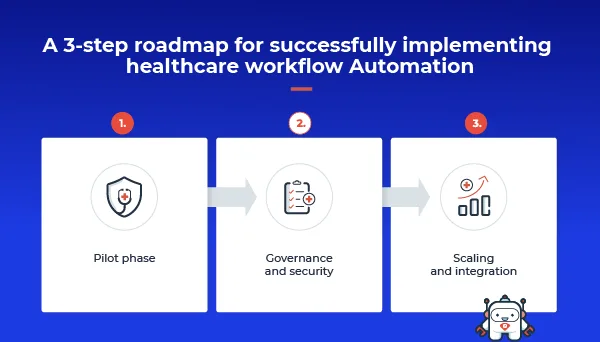

It’s also important to establish a governance framework that prioritizes data privacy, security, and ethical considerations. The structure should define clear human-in-the-loop validation steps, especially when AI is involved, and establish a process for auditing and monitoring workflows.
Let’s break down the roadmap into bite-size pieces:
Pilot phase: Begin by automating a simple, high-impact workflow to demonstrate value and build internal expertise.
Governance and security: Create a clear governance model to manage data privacy and security, as well as ensuring ethical use of automation and AI.
Scaling and integration: Once the pilot is successful, scale the solution to integrate with other systems, such as Electronic Health Records (EHRs), to create a comprehensive, connected patient workflow.
To see these principles in action, the Flowable healthcare industry demo video provides a practical blueprint. The demo showcases how the platform can be used to manage everything from a simple patient intake process to a more complex care escalation scenario, offering a step-by-step guide on how a healthcare organization can modernize its operations and enhance the patient experience.
The future of the healthcare sector depends on its ability to modernize operations and adapt to an increasingly complex environment. By embracing clinical workflow automation, healthcare organizations can create systems that are more efficient, safer, more compliant, and more supportive of their staff.
The Flowable Platform offers all the essential tools for this journey, providing a flexible, powerful, and compliant way to automate clinical workflows. By starting with small pilots, establishing clear governance, and scaling strategically, healthcare providers can begin to transform their operations, leading to enhanced patient care and a stronger, more sustainable healthcare system for all.

Business process management software covers very different tools in 2026. See how the category shifted towards BOAT and what buyers should evaluate.

Client lifecycle management in banking goes beyond onboarding. See how case management keeps client context intact through KYC, reviews and offboarding.
n agentic workflow is more than a multi-agent diagram. See what the standard patterns omit once workflows meet exceptions, oversight, and audit requirements. Primary keyword: agentic workflow