
A business analyst walks into a meeting with IT developers armed with a 20-page requirements document. The developers express their understanding and nod in agreement, ask clarifying questions, and walk away confident they understand exactly what needs building. Months later, a solution that technically meets every requirement is delivered, but somehow misses the mark entirely. Sound familiar?
Research from Forrester reveals that only 29% of business and technology decision-makers believe their digital initiatives align highly with other internal functions.
These statistics represent a misalignment that can cost millions of dollars in wasted effort, hours of rework, and frustration that comes when talented people work hard but somehow move in different directions. The root cause isn't a lack of skill or dedication. But it can be a communication gap that impairs collaboration when everyone isn’t on the same page.
What if business stakeholders and IT teams could literally see the same picture when discussing process automation? This is exactly what business process model and notation (BPMN) delivers: a universal visual language that enables true collaboration between business and IT teams working on process automation initiatives.
The alignment challenge runs deeper than simple miscommunication. In most organizations, business and IT teams operate in fundamentally different worlds, each with its own vocabulary, priorities, and ways of thinking about problems.
Business stakeholders focus on outcomes, customer experience, and operational efficiency. They think in terms of workflows, approvals, and business rules.
IT teams, meanwhile, concentrate on system architecture, data flows, and technical implementation. They speak in APIs, databases, and integration patterns.
This divide is particularly costly when organizations embark on business process automation (BPA) initiatives, which require close collaboration between business and IT teams, yet often lack a common framework for discussion. As a result, business requirements can get lost in multiple layers of interpretation. By the time technical specs reach the development team, the original business intent may lie buried under layers of technical jargon and assumptions.
MIT Sloan Management Review identifies this as the "technology walled garden" problem, where technologists become comfortable in their silo while business leaders feel like outsiders in technology discussions.
And the financial impact of this communication barrier is real; failed automation projects don't just waste the initial investment; they create ongoing operational inefficiencies, damage stakeholder confidence in future initiatives, and often require expensive remediation efforts. More subtly, they can erode trust between business and IT teams, making future collaboration more challenging.
Business process model and notation offers a different approach to this challenge. Rather than relying on textual descriptions, BPMN provides a visual language that both business and technical stakeholders can understand and contribute to.
BPMN emerged from the recognition that business processes are inherently visual. When people describe how work gets done, they naturally think in terms of flows, decisions, and handoffs. They draw boxes and arrows on whiteboards, sketch out approval chains, and map exception handling. BPMN formalizes this into a rigorous standard that maintains business readability while providing the precision needed for technical implementation.
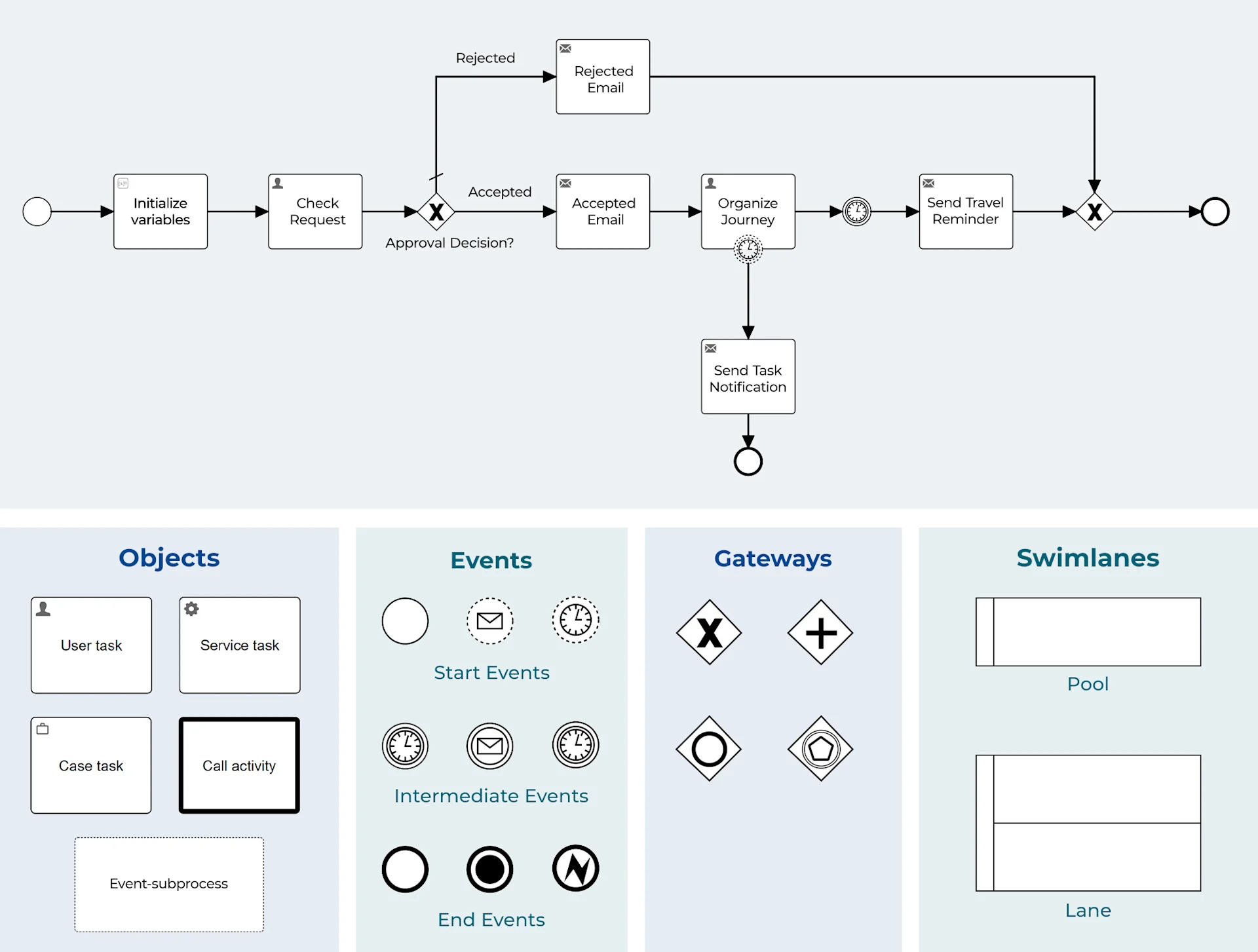
Travel request process example modeled in BPMN.
The notation itself is deceptively simple. Events are circles, activities are rounded rectangles, and gateways are diamonds. Sequence flows connect these elements with arrows, showing how work moves through the process. But this simplicity is powerful: a business analyst can create a process model that a developer can directly implement without requiring translation or interpretation.
When organizations adopt BPMN for cross-functional collaboration, it fundamentally changes how teams work together on process automation initiatives. It enables collaborative design where perspectives from both business and IT inform the solution from the start.
This approach starts with process discovery sessions where business stakeholders and IT teams work together to map current state processes. The visual nature of BPMN makes these sessions more productive because participants can immediately see how their contributions fit into the larger process flow. Business experts can focus on describing the logic and rules that govern each step, while IT team members can identify integration points, data requirements, and technical constraints.
The shared visual model becomes a living document that evolves throughout the project lifecycle. As teams uncover edge cases, identify optimization opportunities, or encounter technical limitations, they can update the BPMN model to reflect these discoveries. This shared view keeps everyone aligned on the current understanding of the process and prevents the drift that often occurs with requirements captured in static documents.
BPMN also enables more effective stakeholder participation throughout the automation project. Business users who might struggle to review deeply technical specifications can easily understand and validate BPMN process models. They can spot missing steps, incorrect sequences, or overlooked exceptions. This early validation prevents costly rework later in the development cycle and ensures that the final solution truly meets business needs.
The power of BPMN becomes apparent when organizations move from process modeling to business process automation (BPA). Unlike traditional requirements documents that need interpretation and translation, BPMN models can serve as direct input to process automation platforms. This alignment eliminates a significant source of errors and misunderstandings in automation projects.
And modern process orchestration platforms like Flowable execute BPMN models directly. This capability allows the same diagram used for business analysis and stakeholder communication to be the blueprint for the automated process. There's no separate development phase where requirements get translated into code; the BPMN model is what gets implemented.
A differentiator of the the Flowable Platform, which takes no-code drag and drop automation to the next level is its additional use of case management model and notation (CMMN). While BPMN creates a shared language for defining and handling tasks that follow a set sequence, CMMN addresses scenarios where ad-hoc processes typically occur, such as during a customer service request. Known as cases or case management, these business scenarios often do not follow a regular pattern but are event driven and need human input for complex decision-making at some point.
Combining BPMN and CMMN offers a dual approach for business analysis and stakeholder communication to become the blueprint for the automated process, effectively supporting both automation planning and practice in real-time. There's no separate development phase where requirements get translated into code; the BPMN and CMMN models are what get implemented.
Instead of lengthy development cycles followed by extensive testing and refinement, teams can rapidly prototype processes, test them with real data, and iterate based on feedback. Business stakeholders can see their processes in action quickly, providing feedback while the details are clear.
The alignment between business models and technical implementation also improves governance and compliance. Audit trails become more meaningful because they reference the same process elements that business stakeholders understand. Compliance requirements can be built directly into the process models, making them visible and valuable to both business and IT teams.
Organizations that will thrive in an increasingly automated world are those that master the art of collaboration between business and IT teams. BPMN provides the foundation for this collaboration by creating a shared language that both sides can speak fluently. However, the benefits extend far beyond individual automation projects:
Organizations become more agile when business and IT teams can communicate effectively using visual process models.
They can respond quickly to market changes with collaborative teams able to rapidly design, validate, and implement process modifications.
They can take advantage of new technologies because the business context for automation is clearly understood.
They can scale successful processes across the organization because the models capture what happens and why it happens that way.
BPMN is an enabler of organizational transformation. It breaks down the silos that prevent effective collaboration, creates shared understanding across functional boundaries, and provides the foundation for process automation that serves business needs with agility. In our modern, digital world, the ability to adapt quickly determines competitive success, and organizations that master this collaborative approach will be the ones that shape the future of their industries.
Business process management software covers very different tools in 2026. See how the category shifted towards BOAT and what buyers should evaluate.
Client lifecycle management in banking goes beyond onboarding. See how case management keeps client context intact through KYC, reviews and offboarding.
n agentic workflow is more than a multi-agent diagram. See what the standard patterns omit once workflows meet exceptions, oversight, and audit requirements. Primary keyword: agentic workflow