
For many insurers, existing claims process models and systems are outdated, and struggling to meet modern customer expectations.
Why? They often include too many manual, paper-based, or email-heavy disjointed steps, resulting in slow processing workflows that don’t handle scale. Others rely on poorly converted legacy, or internally developed and non-specialized systems without enough software or AI orchestration power, ultimately resulting in high operational costs, inconsistent outcomes, and a frustrating experience for policyholders.
A customer trying to file a home insurance claim after a storm may have to chat with a bot, call a claims agent, email photos and repair estimates — often while repeating their information several times, and then wait days or even weeks for a response, with follow up seemingly becoming their own responsibility. A frustration that strongly encourages dissatisfaction and churn.
Inefficient claims processing is a major pain point for both insurers and customers, that leads to a loss of business and an endangered reputation.
Luckily, there is a solution: automating insurance claims processing leverages advanced technologies to streamline the entire claims journey, from the first notice of loss (FNOL) — the initial report of a claim by a policy holder — to final payment.
By bringing legacy systems up to speed and embracing insurance claims process automation, companies can reduce costs while also freeing up their workforce to focus on high-value task aspects that require greater empathy and critical thinking.
Companies that integrate an enterprise process automation platform lock in continuous advantage over their competitors, as the underlying software continually evolves to power their workflows with developing technology as soon as it's available: the latest being AI agent led claims processes.
Insurance claims process automation is powered by a sophisticated suite of interconnected technologies — each of which play a role in creating a smooth-running, efficient digital workflow.
Robotic process automation (RPA) is still a foundational element, used to automate repetitive, rule-based tasks with high accuracy and speed. In the context of insurance claims, RPA can be used for data entry from forms like policy numbers, cross-verifying information across different systems, and transferring data between legacy platforms and modern digital solutions.
While RPA is great for automating repetitive tasks based on rigid rules, artificial intelligence (AI) and machine learning (ML) go beyond simple rule-based automation. These models can analyze vast amounts of structured and unstructured data to make informed decisions — and Flowable’s AI Studio enables easy building, managing, and integration of AI agents that, acting as digital assistants, can analyze vast amounts of data to make informed decisions with independent input that utilizes all of this and more.
IDP eliminates the need for manual data entry, ensuring that information is captured accurately and efficiently from the very beginning of the claims process
ML algorithms can be leveraged to detect patterns indicative of fraud, like a suspiciously high number of claims from the same address or inconsistent information, flag suspicious claims for review by your team, and even analyze photos of damage to provide preliminary cost estimates. Intelligent document processing (IDP) is a specialized field of AI that is critical for insurance claims process automation. It uses optical character recognition (OCR) and natural language processing (NLP) to automatically ingest and extract relevant data from various documents like medical bills, police reports, and repair invoices.
IDP eliminates high amounts of manual data entry, ensuring that information is captured accurately and efficiently from the very beginning of the claims process. In addition, it can handle both structured and unstructured data, instantly collecting information such as the date of incident, location, or names of parties involved, making it a key differentiator in this area of workflow automation.
Within automated claims processing embedded generative AI and large language models (LLMs) add another, deeper layer of intelligence. Within automation chosen and guardrailed models are used to read and understand complex policy documents, compare the terms of that policy against the details of a claim, and assist with generating a summary of a case for a claims adjuster directly within a workflow. This capability speeds up the initial review and analysis phase, enabling quicker decisions and greatly reducing the workload on your people.
At the highest level, an AI agent can act as a digital claim orchestrator, using RPA to handle repetitive data tasks, leveraging IDP to process documents, and applying machine learning models to analyze data for fraud or damage. This integrated approach allows a single agent to support a complete workflow, from initial data intake to communication for missing information, all the way up to final decision-making.
The journey of an automated claims processing insurance system is a well-orchestrated sequence of events, beginning with the customer, and moving through a number of instant and human-in-the-loop stages. Powered by AI and agentic case management the claims processes become standardized yet dynamic. The process kicks off when a customer submits a claim through a digital channel, like a mobile app, a self-service web portal, or comms channel.
The system acknowledges receipt and IDP begins extracting key information from the submitted documents. This initial step of FNOL insurance claim process automation is crucial for setting a positive tone and gathering all necessary data efficiently.
Once the data is ingested, AI agents instantly cross-verify the claim info against the policyholder's information, policy details, and historical data. The system uses ML to analyze for suspicious patterns and flags any potentially fraudulent claims for human review.
This proactive approach helps in mitigating fraud early on, while gathering all relevant data for the claim’s resolution into one case file for your adjusters to action. Simple, low-value claims that pass all verification checks can be auto-adjudicated and approved for payment immediately.
More complex cases are intelligently routed to the right adjuster for a detailed review: A low-damage claim could go to a junior adjuster, and a more complex case to one with greater experience. This ensures that your people's expertise is used where it's most needed, reducing time spent on straightforward cases while optimizing the more complex.
When a claim is approved, the system can automatically trigger a payment and send real-time status updates to the customer via their preferred communication channel: affording the transparency and speed that are key to enhancing customer satisfaction and retention.
To illustrate how a process might look more clearly, let’s follow an example through from start to finish. A customer files an auto claim via a mobile app after a minor accident. The system could then use:
IDP to extract data from uploaded photos and a police report (including scanned documents);
AI to assess the damage and identify it as a low-value claim;
RPA to auto-adjudicate and trigger payment
Implementing automated claims processing delivers tangible and measurable benefits across the entire organization. By empowering employees with on-demand data organization and decision support, insurers can achieve significant gains in efficiency, accuracy, and customer satisfaction.

Take our work with Direct Insurance, who used Flowable to consolidate 14 isolated systems into a single, unified view. Direct Insurance accelerated its claims registration by 25%, and reduced troubleshooting time by a whopping 75%.
Flowable's platform takes insurance claims process automation to the next level by combining agentic AI with dynamic case management using the case management model and notation (CMMN) standard. This approach is designed to handle the unpredictable and non-linear nature of complex claims, which can potentially involve unexpected events and require a flexible, human-centric workflow.
In this way, multiple agents can work together instead of on independent tasks. The business benefits of automation when you make the most of the Flowable Platform include:
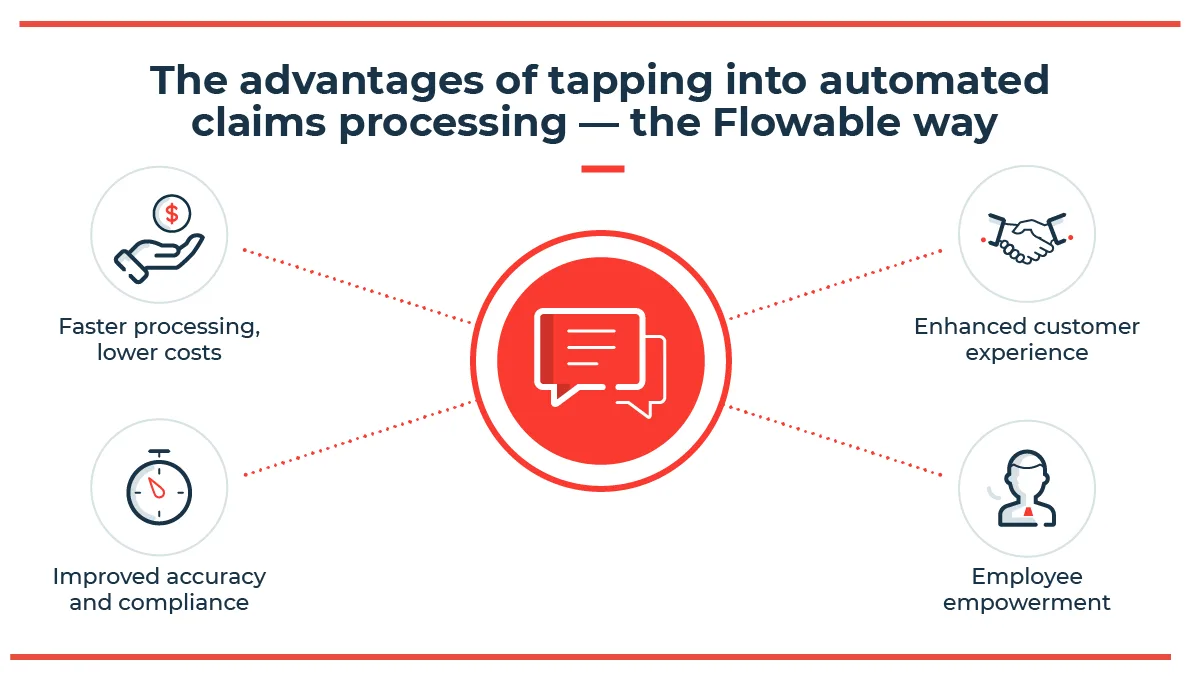
Faster processing and lower costs: Automation reduces the time it takes to process a claim, from days or weeks to just a matter of minutes. This efficiency leads to a significant decrease in operational costs associated with manual labor and physical document handling.
ures consistent handling of claims and creates a clear, unalterable audit trail. This is essential for regulatory compliance and quality assurance, providing a solid record of every step undertaken throughout the entire process.
Enhanced customer experience: A digital-first experience with rapid payouts and proactive communication leads to higher customer satisfaction and retention. In a competitive market, a modern claims process is a powerful differentiator, and a key driver of positive word-of-mouth.
Employee empowerment: Intelligent insurance claims systems free adjusters from mundane, repetitive tasks. This allows them to focus on complex, high-value cases that require critical thinking, and negotiation skills, transforming their role from data entry clerks to strategic problem-solvers.
While many routine tasks can be modeled with a traditional business process model and notation (BPMN) workflow, CMMN is perfectly suited for processes that require human judgment and an adaptable path. It allows for event-driven flexibility, where new information or unexpected events can trigger new tasks or change the course of a case.
This is particularly crucial in an industry like insurance, where each case is unique. For example, if a fraud alert is triggered on a simple claim, the CMMN model can reroute it to a fraud investigator, without disrupting the overall flow.
Flowable's agentic AI agents can be embedded within the CMMN framework, acting as digital assistants and automating critical steps like classifying a claim by severity, cross-referencing policy data, and estimating damages. For complex or high-value claims, the system ensures human-in-the-loop oversight, while the CMMN model provides a complete audit trail by recording every action, whether by a human or an AI agent, which is crucial for compliance and quality assurance.
Flowable's platform orchestrates this interaction between people and AI agents, allowing insurers to build comprehensive claims management solutions that handle everything from the FNOL to fraud management and third-party orchestration, all within a single, transparent system. By embracing its adaptable and flexible structure, insurers can create a more agile and resilient claims operation that is ready for the future, and puts the customer front and center.

Business process management software covers very different tools in 2026. See how the category shifted towards BOAT and what buyers should evaluate.
Client lifecycle management in banking goes beyond onboarding. See how case management keeps client context intact through KYC, reviews and offboarding.
n agentic workflow is more than a multi-agent diagram. See what the standard patterns omit once workflows meet exceptions, oversight, and audit requirements. Primary keyword: agentic workflow