
Today, intelligent business automation has evolved. Automated workflows are now even more responsive, able to adjust themselves in real-time, and automation can be applied to work instances previously considered too unpredictable to be automated.
Agentic process automation (APA) combines foundational technologies like task automation bots, artificial intelligence (AI), and machine learning (ML) with the ability to reason, formulate a plan, and take autonomous actions. Workflow integrated AI agents plan and carry out resolutions while leveraging this tech and connecting to other tools, data, comms, and knowledge bases via APIs. APA provides a system where AI agents can adapt to a dynamic environment while optimally supporting your workforce with proactive workflows and intelligent support.
Agentic process automation systems can make independent decisions and handle processes that were previously considered too complex for automation.
What lies at the heart of agentic process automation? AI agents.
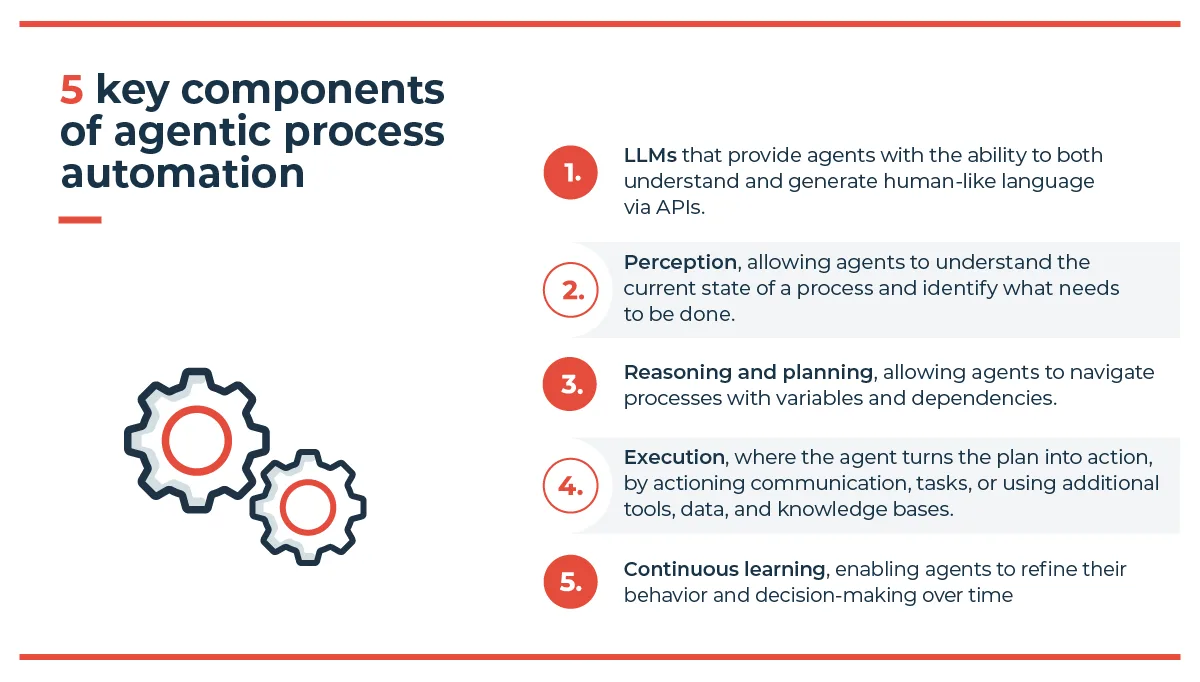

A sophisticated agentic process automation system goes beyond following a script; it uses a combination of ability to perceive, reason, and act in a way that mimics human-like intelligence:
Large language models (LLMs): LLMs provide agents with the ability to both understand and generate human-like language. This is crucial for interpreting unstructured data and instructions, like emails, customer chat logs, and complex legal documents. While traditional deterministic automation works with structured inputs, LLMs allow agents to grasp nuance, intent, and context, paving the way for more profound interactions than traditional automation would allow. Consider the following example: An agent can read an email from a customer, understand their frustration, and initiate a refund process in collaboration with the right team member and company process without being explicitly told the exact keywords.
Perception: An agent’s ability to collect and analyze data from its environment, covering everything from text documents to sensor data to real-time market feed, is its perception. This allows it to understand the current state of a process and identify what needs to be done. For instance, a financial agent might perceive a sudden drop in a stock price and initiate a series of trades based on a pre-defined strategy. Or lead entire customer onboarding workflow with adjacent processes like know your customer checks.
Reasoning and planning: Agents can take a high-level goal and break it down into a series of actionable steps. This ability to reason and plan allows them to navigate processes with many variables and dependencies. Instead of following a rigid flowchart, an agent can dynamically plan a sequence of actions. So, if a supply chain agent’s goal is to fulfill an order, but a key supplier is out of stock, the agent can reason through the problem, identify an alternative supplier, and re-route the order, where the level of human intervention and guardrails for the AI’s actions are set using a business process automation platform.
Execution: The agent carries out the plan, usually by orchestrating other agents or existing systems, including traditional RPA bots, data, and collaboration with employees. The execution layer is what turns the agent’s plan into real-world action, whether that's sending an email, updating a database, or triggering another process such as human-in-the loop collaboration.
Continuous learning: A key feature of an agentic AI process automation system is its ability to learn from past experiences. Agents can refine their behavior and decision-making over time, optimizing performance and increasing their efficacy without constant reprogramming, in a departure from rule-based systems, which require manual updates for every change in the process.
Agentic process automation is able to expand the scope of automation to include processes like dynamic procurement, or personalized customer support. By autonomously supporting employees on a wider range of tasks at the top end of business processes, agentic process automation enhances your workforce: with the ability to offer strategic support.
Agents can analyze real-time data to provide almost instant, informed decision support, creating adaptable workflows able to respond to constantly evolving conditions on the spot
Building agentic workflows into business process automation shifts people’s role from task execution to oversight and innovation driven by ongoing intelligent support insight.
Agents can analyze real-time data to assist your workforce to make smarter, more informed decisions on the spot, creating adaptable workflows that think and respond to constantly evolving conditions and circumstances proactively. This provides a level of scalability and agility not found in previous automation models.
Implementing APA at an enterprise level requires careful consideration of factors like governance, auditability, and practicality. Without these elements, agent sprawl can occur, leading to an unmanageable automation environment. Here’s how you can avoid a potentially chaotic landscape:
Governance and oversight
For agentic process automation to be trusted and scaled, it requires thorough governance through establishing clear boundaries and rules, or "guardrails," for agents to operate within. These guardrails ensure that agents align with business policies and ethical guidelines. For instance, an agent handling financial transactions might have clear limits on the amount it can approve without human review.
A centralized platform to manage, monitor, and deploy agents is crucial to both prevent agent sprawl and ensure consistency and decision visibility. The “what is agentic process automation" question must be answered with a plan for oversight.
Additionally, incorporating a human-in-the-loop approach — where a person can review and approve agent actions, especially for critical decisions — is essential for high-stakes processes. This both creates a safety net and builds confidence in the system while adjusting guardrails.
Auditability and transparency
Organizations need to know why and how an agent arrived at a particular decision, particularly for compliance and troubleshooting.
This requires systems that log every action and decision an agent makes to create a clear, auditable trail. The use of platforms that can provide a transparent "reasoning" behind an agent's actions is therefore pivotal.
Explainable AI is a key part of this, allowing companies to better understand the logic behind an agent’s output.
Tracking changes to agent configurations and models through version control ensures a clear history of updates, which is important for maintaining a stable and compliant automation environment.
Practical implementation for your business
When considering agentic process automation tools, a strategic approach is key. Start by identifying the right use cases: Processes that are complex and dynamic, but also have a clear goal. Avoid mission-critical tasks for initial pilots.
Prioritize integration, choosing a platform that can integrate with your existing systems and data sources, ensuring that the new automation can work with your current technology stack.
Start small and scale. Begin with a contained project to demonstrate value and build confidence before expanding to larger, more critical processes.
And lastly, take into consideration that deterministic, traditional automation is a better fit for many less dynamic work process automation: with more focused computational power, speed, and lower costs.
Flowable elevates AI agents to a first-class citizen status alongside its traditional BPMN and CMMN automation engines, allowing for the orchestration and management of multi-agent workflows with all of the testing, auditability, traceability, maintainability, and development options of all our existing enterprise process management.
The platform provides a single, unified environment that brings together people, AI agents, and business processes, guaranteeing a high level of transparency, governance, and control. This allows us to offer a wide range of internal specialized agent process automation types designed for different business needs on top of external AI agent connection and governance.
The platform’s Utility Agent can be added in to automate tasks like data enrichment and sentiment analysis, while the Document Agent extracts data from unstructured documents. A Knowledge Agent provides contextual answers from internal knowledge bases, and an Orchestrator Agent can coordinate and manage other agents and tasks to arrive at a set goal.
Built on open standards, Flowable ensures integration and is designed for compliance-driven organizations, with features that provide transparent oversight of AI-enhanced operations. This holistic approach makes Flowable a powerful platform for those looking for agentic process automation, whether other forms of automation are already in place or not.
Business process management software covers very different tools in 2026. See how the category shifted towards BOAT and what buyers should evaluate.
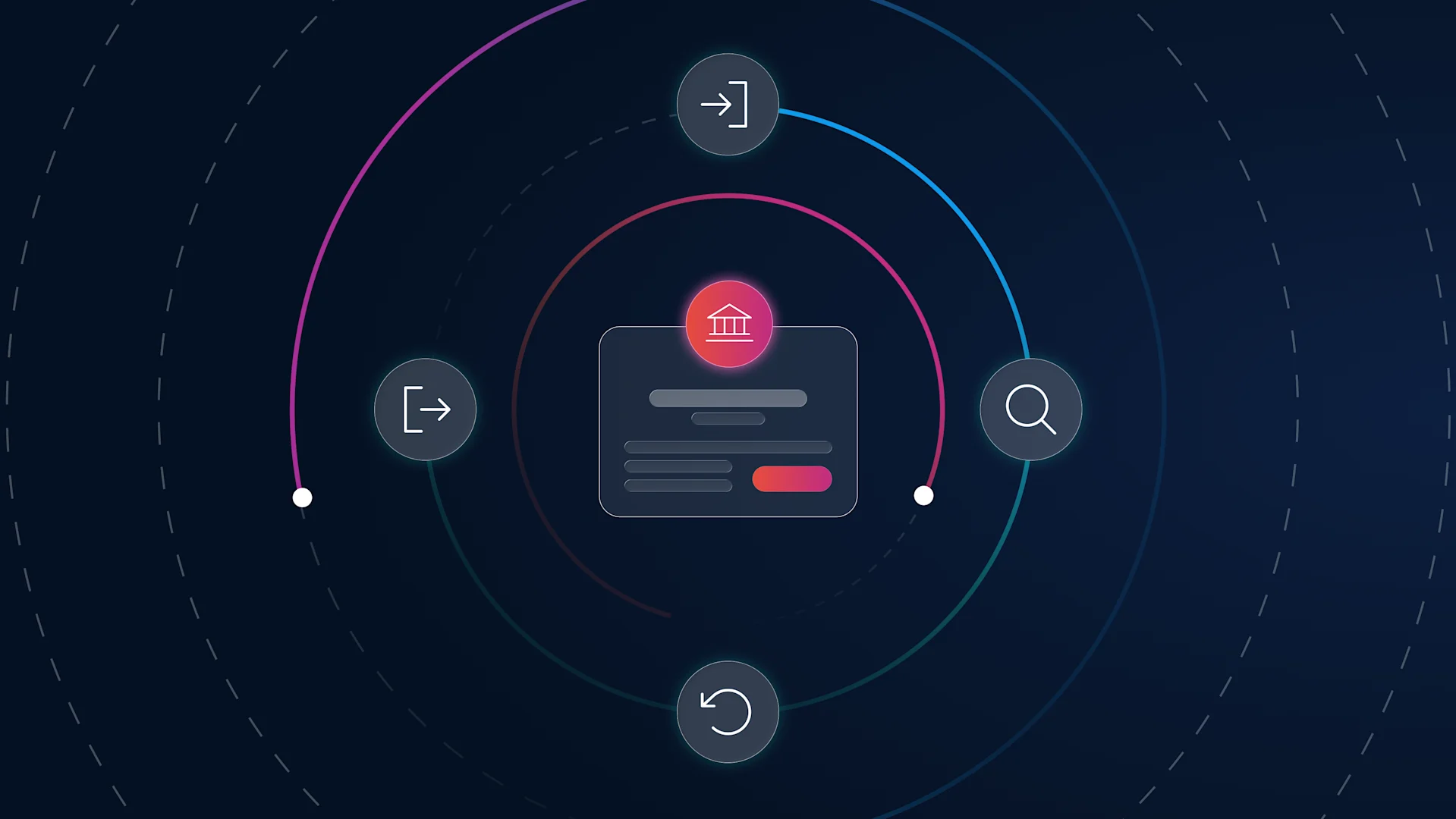
Client lifecycle management in banking goes beyond onboarding. See how case management keeps client context intact through KYC, reviews and offboarding.
n agentic workflow is more than a multi-agent diagram. See what the standard patterns omit once workflows meet exceptions, oversight, and audit requirements. Primary keyword: agentic workflow