
Insurance is an industry that has historically relied on paper-heavy processes. While it may be more challenging, this means it is well positioned to benefit the most from automation.
Customer expectations for speed and transparency now tie directly to satisfaction, and manual processing falls shorter every year: it is slow, error-prone, and costly. Technology closes the gap.
Advances in artificial intelligence (AI), machine learning (ML), and robotic process automation (RPA), and more recently AI agent integration, dynamic case management, and agentic case management, are driving a new era of efficiency, lower operating costs, and better customer experiences in claims.
Most of that story is about automating the standard path, from first notice of loss (FNOL) to final payment. The harder and more valuable question is how a platform handles the claim that does not fit that path: the multi-party, fraud-flagged, or regulation-sensitive case that needs human judgment partway through.
Insurance claims automation applies AI, RPA, and case management across the claims journey, from FNOL through validation, assessment, approval, and payment.
The standard, high-volume path is now largely automatable through straight-through processing. The real differentiator is how a platform handles the exceptions that need human judgment.
The main benefits are faster processing, lower cost, fewer errors, stronger fraud detection, consistent compliance, and scalability.
Insurance fraud costs the US an estimated $308.6 billion a year, which is why AI-assisted fraud detection is one of the clearest returns on automation.
Human-in-the-loop review at defined escalation points keeps high-stakes claims auditable rather than slower.
Insurance claims automation, also called claims process automation, is the use of technology to automate the tasks and workflows across the entire claims journey, from FNOL to final payment.
The traditional claims process usually involves five steps: submission, validation, assessment, approval, and payment. Automation streamlines each. On FNOL, intelligent systems capture and categorize claim data from multiple sources, removing repetitive data entry.
During validation, AI agents cross-reference policy details and historical data in seconds, flagging discrepancies or triggering fraud checks. Assessment can be accelerated with ML that analyzes damage reports and recommends settlement amounts, while automated workflows move approvals and electronic payments through quickly.
For the high-volume, predictable end of that range, the technology is mature. As McKinsey notes, for simple claims with predictable patterns, the technology to enable full straight-through processing already exists. The open question for most insurers is no longer whether standard claims can be automated, but how to extend that automation to the cases that need judgment without losing control of them.
The tools behind this are wide-ranging. Robotic process automation (RPA) handles repetitive, rule-based tasks, processing high volumes of claims by mimicking human actions. AI and ML let systems learn from data, make informed decisions, and spot patterns for fraud detection.
Natural language processing (NLP) reads unstructured text from claim documents and customer messages, while optical character recognition (OCR) and intelligent document processing (IDP) extract information from images, scans, and even handwritten notes.
Business process management (BPM) suites orchestrate these technologies into connected workflows, cloud BPM adds scalability, and chatbots handle common queries. Emerging tools like blockchain and IoT bring greater transparency and real-time data to demanding claims and risk assessment. AI agents go a step further, planning actions as a case evolves, requesting missing information, and moving a claim forward until a human reviewer is needed.
The benefits of insurance claims processing automation are spread across five areas.
Automation accelerates processing time and cuts manual work, freeing people for higher-value tasks. Because automated systems apply rules consistently and remove manual data entry, they are less prone to error, which means fewer rework cycles and faster resolution. The gains compound: McKinsey found that domain-level AI transformation in insurance delivered a 3 to 5 percent accuracy improvement in claims, and on large claim volumes even a few points of accuracy translate into meaningful savings and fewer disputes.
Cost savings come from lower operating expenditure and less time spent on corrections and re-processing. The largest single prize is fraud. Insurance fraud costs the US an estimated $308.6 billion a year, and AI-assisted detection, which spots the patterns and anomalies a manual review would miss, helps prevent losses that feed straight to the bottom line.
Proactive, transparent communication and AI-powered case management raise customer satisfaction. When a policyholder gets a fast, clear, and empathetic claims experience, it strengthens trust and loyalty to their insurer.
Automation supports consistent regulatory compliance by enforcing predefined rules and generating complete audit trails, which means better documentation and a more accountable process. On risk, advanced analytics, especially in fraud detection, strengthen security and protect sensitive data, safeguarding both the insurer and the policyholder.
Automated systems scale. Whether an insurer faces a sudden surge in claims or steady organic growth, an automation platform absorbs rising claim volumes without a proportional increase in headcount or operational strain.
The impact of claims automation looks different across lines of business.
Auto insurance: For minor collision and glass claims, image-analysis models assess damage from customer photos and apply pre-set repair algorithms, so a windshield or minor-dent claim can move from FNOL to approved payout in minutes rather than days, with an adjuster reviewing only the outliers.
Health insurance: Claims for common, well-coded procedures can be validated against policy terms and adjudicated automatically, clearing routine reimbursements in minutes and routing only the cases with coding conflicts or missing documentation to a human.
Home and property insurance: After a storm, AI can combine satellite imagery, weather data, and IoT sensor readings to assess widespread damage across many properties at once, triaging severity so adjusters reach the worst-affected policyholders first.
Commercial and specialty lines: These claims are exception-driven by nature, often multi-party and document-heavy. Here automation earns its place less through touchless processing and more by surfacing the right information, analyzing large document sets, and flagging the nuances a manual review might miss, so a specialist adjuster spends their time on judgment rather than paperwork.
Across all of these, the pattern is the same. Automation absorbs the routine and the high-volume, while people concentrate on the claims that carry real consequences. Large carriers apply RPA to routine data entry and policy verification, while smaller, agile insurers use AI-first platforms to offer a digital-first claims experience. The effect on roles is the point most often missed: adjusters spend more time on demanding investigations and high-value interactions instead of rekeying data, and customers get faster, clearer outcomes.
When evaluating a claims automation solution, a handful of capabilities separate a platform that scales from one that stalls.
Claims data lives in policy administration, billing, and legacy core systems. A platform that connects cleanly to those systems avoids creating a new silo alongside the old ones. Ask specifically how it handles legacy system integration, because that is where most claims-automation projects slow down.
Dashboards that show cycle time, straight-through-processing rates, leakage, and bottlenecks let claims leaders manage by evidence rather than instinct, and catch a degrading process before it shows up in customer complaints.
Given the scale of fraud, models that score claims for severity, fraud propensity, and litigation risk, and surface the reasons behind each flag, are among the highest-value features on the list. The reasoning matters as much as the score, because an adjuster and, later, an auditor need to see why a claim was routed the way it was.
Scalability and flexibility, security and compliance, and customizable workflows round out the list. One more criterion belongs on equal footing: whether the platform is built on open standards. An orchestration layer built on open standards such as BPMN, CMMN, and DMN keeps an insurer’s process logic portable and auditable rather than locked inside one vendor’s proprietary engine, which is worth asking any vendor directly.
No-code and low-code configuration matters too, letting business users adjust workflows without waiting on IT, which shortens deployment and keeps the process current as products and rules change.
Options range from configurable market suites, which offer breadth but need customization, to ready-made software that deploys fast with less flexibility, to custom builds that give full control at higher cost and longer timelines. Choosing the right process automation software depends on an insurer’s size, existing infrastructure, budget, and goals.
The market for claims automation is jam-packed with options, with several platforms leading the way. Flowable specializes in accelerating complex regulated and compliant insurance workflows. Its workflows adapt and evolve in real time using agentic case management. The platform's AI agent collaboration empowers your workforce with data and communication from across teams, systems, and channels to lighten the workload of every step while actioning analysis, next steps, and communication — and it is particularly suited for intelligent claims case handling, customer engagement, and underwriting automation.
OneShield offers a comprehensive suite for policy, billing, and claims management, known for its configurability. ClaimVantage specializes in absence and claims management solutions, focusing on life, health, and disability insurers. Insurity provides cloud-native solutions across the property and casualty (P&C) insurance lifecycle, including robust claims capabilities. Guidewire's ClaimCenter remains the core claims platform much of the P&C industry is built on, offering deep functional coverage for carriers that need it. Duck Creek Claims takes a SaaS-native, low-code approach to the same space, letting carriers adjust workflows without heavy custom development.
Salesforce Financial Services Cloud extends the brand's CRM power with industry-specific features, facilitating seamless customer service and claims interactions. Dedicated RPA providers like Automation Anywhere offer powerful tools to automate repetitive tasks across various systems, tapping into an AI model that's trained in over 300 million automations. Newer, AI powered entrants like Sprout.ai focus on intelligent claims triage and assessment, while Ushur specializes in AI powered intelligent automation for customer engagement throughout the claims journey.
Claims automation keeps evolving with new technology and shifting demand. The deepening integration of AI and ML is the dominant trend, moving beyond rule-based automation toward predictive analytics, cognitive automation, and autonomous processing for simpler cases. The move to cloud continues, adding flexibility, scalability, and lower cost.

Demand for digital claims experiences is pushing insurers toward self-service portals and mobile apps where policyholders submit documents, track progress, and communicate in real time. IoT devices feed richer, more immediate data into claims, from telematics for auto accidents to smart-home sensors for property damage. And blockchain is gaining ground for its ability to create tamper-resistant records of claims data, improving transparency and reducing fraud across the ecosystem.
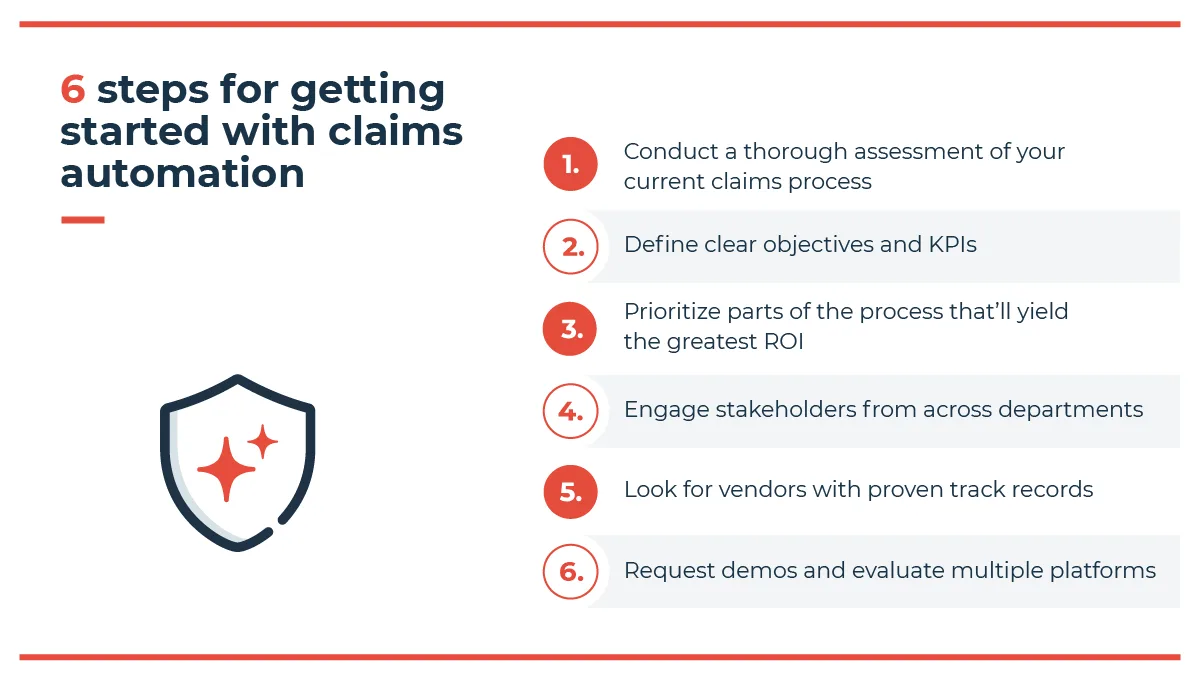
Getting started with claims automation works best as a phased approach. Begin with a thorough assessment of your current processes to find bottlenecks and the steps most ready for automation. Define clear objectives and KPIs so you can measure success. Prioritize the parts of the claims journey that will return the most when automated, often starting with high-volume, low-exception work like FNOL intake or data entry.
Engage stakeholders across claims, IT, and legal early to secure alignment and buy-in. Look for vendors with proven track records, strong integration capabilities, and solid security. Request demos and evaluate more than one platform against your own claim mix. For further learning, explore case studies, industry webinars, and consultations with automation specialists.
Insurance claims automation is the use of technology, including AI, RPA, and case management, to handle tasks and decisions across the claims journey, from first notice of loss through validation, assessment, approval, and payment. It aims to speed up routine claims, reduce errors and cost, and free adjusters to focus on the cases that need human judgment.
AI analyzes patterns across large volumes of claims and external data to score each claim for fraud propensity and flag anomalies a manual review would likely miss, from duplicate submissions to inconsistent damage patterns.
Given that insurance fraud costs the US an estimated $308.6 billion a year, even incremental improvements in detection carry a large financial return. The strongest systems also show the reasons behind each flag, so investigators and auditors can see why a claim was escalated.
Claims management software is the system of record that stores and tracks claims through their lifecycle. Claims automation is the layer that does the work: capturing data, applying rules, running AI checks, and moving claims forward with less manual effort.
Strong platforms combine both: claims management software as the system of record, paired with a case management tool that can adapt when a claim leaves the standard path
It depends on scope and the state of existing systems. Most insurers start with a phased rollout: a pilot on one high-volume claim type to prove value, then wider adoption. A focused pilot can show results within a few months, while an organization-wide program that integrates legacy claims systems is an ongoing effort rather than a one-off project.
Claims automation has become a baseline expectation for modern insurers. The benefits, from faster processing and lower cost to better customer experiences and stronger fraud detection, are well established.
By automating the routine and standardizing the rest, insurers shed the drag of manual processing and build a reputation for speed, transparency, and reliability.
In a competitive market, the differentiator is how an insurer handles the demanding claims, the multi-party, fraud-flagged, and regulation-sensitive cases, with the same speed and a clear audit trail, while keeping human judgment where it belongs. That is what lets insurers meet rising customer expectations without trading away control.

Business process management software covers very different tools in 2026. See how the category shifted towards BOAT and what buyers should evaluate.

Client lifecycle management in banking goes beyond onboarding. See how case management keeps client context intact through KYC, reviews and offboarding.

n agentic workflow is more than a multi-agent diagram. See what the standard patterns omit once workflows meet exceptions, oversight, and audit requirements. Primary keyword: agentic workflow