Enterprise workflow automation has a delivery problem. A 2026 study found 59% of executives believe their organization is ready for AI-scale operations, while 62% of practitioners running those systems reported fragmented tools and persistent visibility gaps.
The difference in perception between executives and practitioners impacts organizations in a measurable way: 80.3% of enterprise AI projects fail to deliver value, according to RAND research confirmed by Gartner in April 2026.
The arrival of AI raises the cost of leaving these processes uncoordinated. Embedding agents into workflows that already lack a unified view and consistent governance accelerates the existing problems instead of fixing them, producing flawed decisions faster than anyone can catch them.
Workflow automation itself is rarely the problem. Enterprises handle single-task automation competently. What breaks down is coordinating those single tasks into a governed, auditable process that runs across systems and people. Orchestration is the precondition for the scale their executives are aiming for.
This article explains:
What enterprise workflow automation means, and how it differs from the task automation most buyers settle for
Where workflow automation breaks down when a process spans systems, people, and decisions
What separates automation that scales from automation that stalls
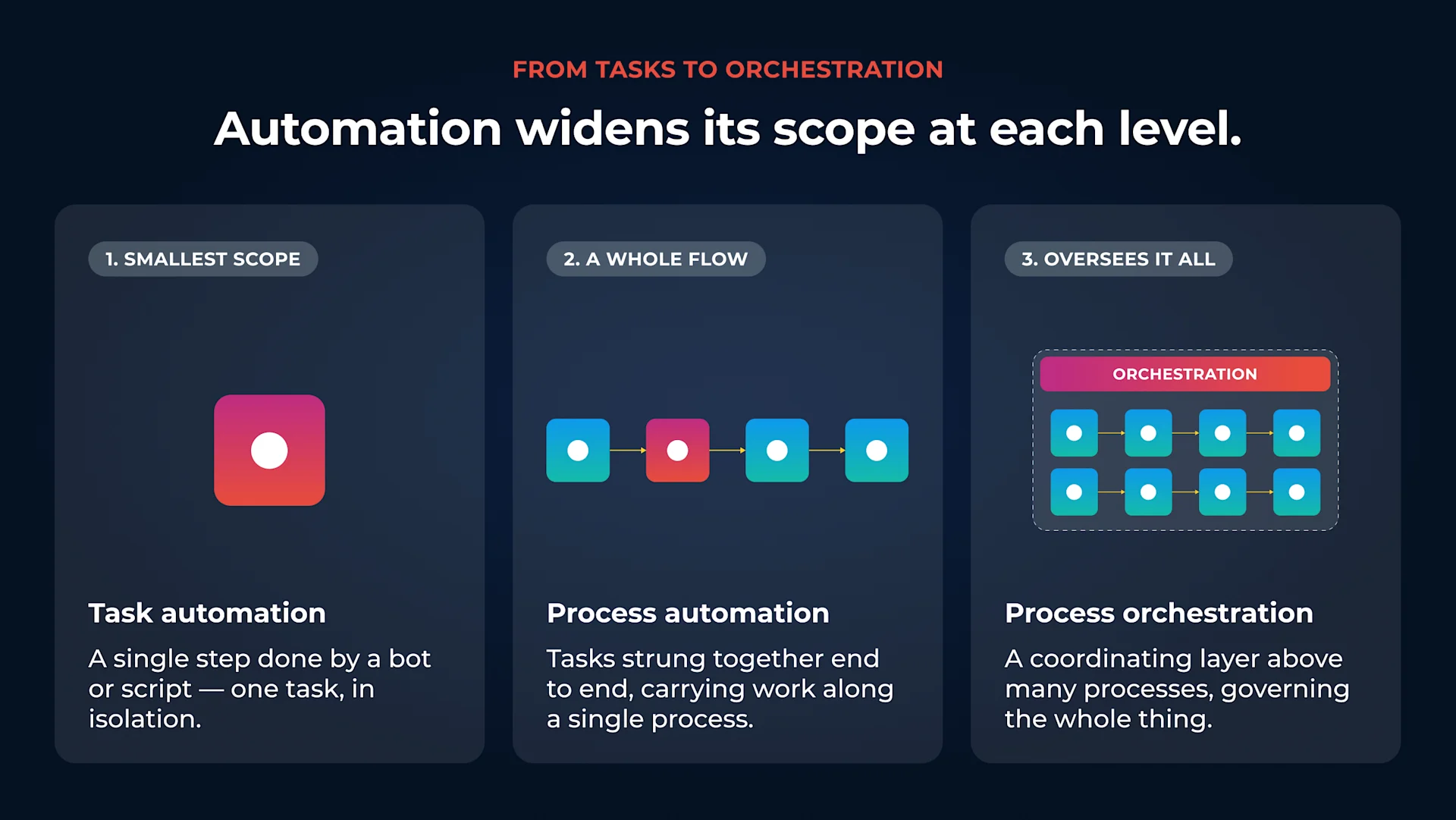
The workflow vs orchestration distinction is where most implementations go wrong, and where vendors blur the line. Workflow automation consists of three tiers: task automation, process automation, and process orchestration.
Task automation handles a single step, often an RPA bot or a script that extracts an invoice figure from an email and enters it into a finance system. The step runs reliably and the output is easy to verify.
Process automation connects steps into a defined sequence. The invoice is validated against a purchase order, matched to a delivery receipt, routed for approval, and posted for payment. The sequence follows one fixed order and works as long as nothing unexpected happens.
Process orchestration is the coordinating tier, the process orchestration layer that sits above the individual applications. It holds the bigger picture of multi-step processes across the systems and people involved, and can change route depending on what each step returns.
When the invoice check highlights a discrepancy, orchestration routes the invoice to a manager, waits for their approval or rejection, and continues down whichever route that decision sets.
Enterprise workflow automation spans all three tiers. Organizations that struggle to see value from it often conflate task automation with workflow automation, and in doing so lack the process automation and orchestration the work requires.
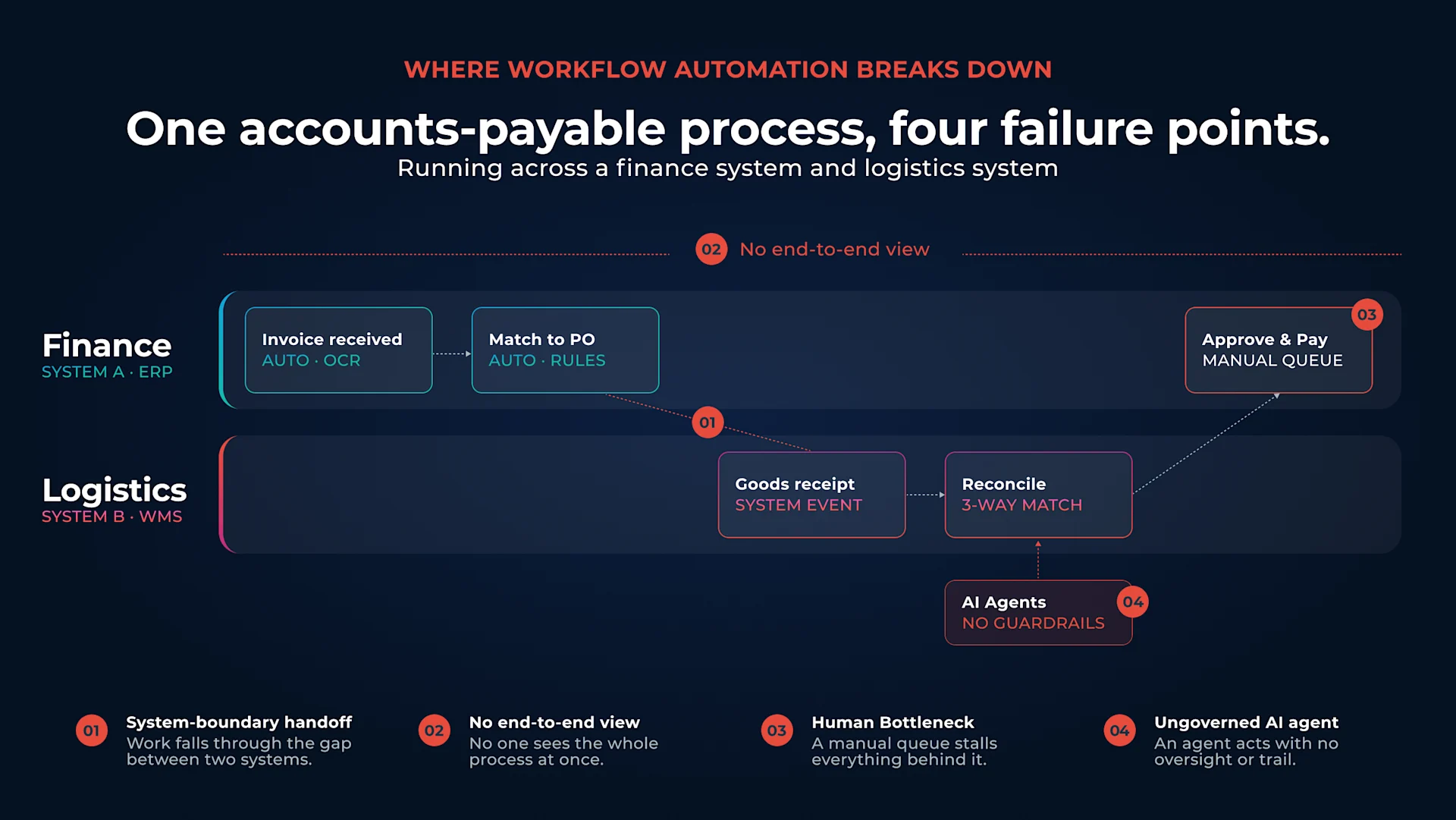
A single invoice is easy to automate. The same accounts payable process running across thousands a month, drawing on systems owned by different teams, breaks down in four ways.
Automation stops where one system ends and another begins. The process runs inside the finance system, the system of record for payment, but matching the invoice requires the goods receipt record, which is held in a separate logistics system.
The two are often older legacy systems with no link between them, so the cross-system handoff falls to a person, who retrieves that record and enters it into the finance system before the process continues.
No single system holds a view of the whole process. Finance sees what happens inside the finance system, procurement sees what happens inside its own system, but no one sees the invoice move from one system to the next.
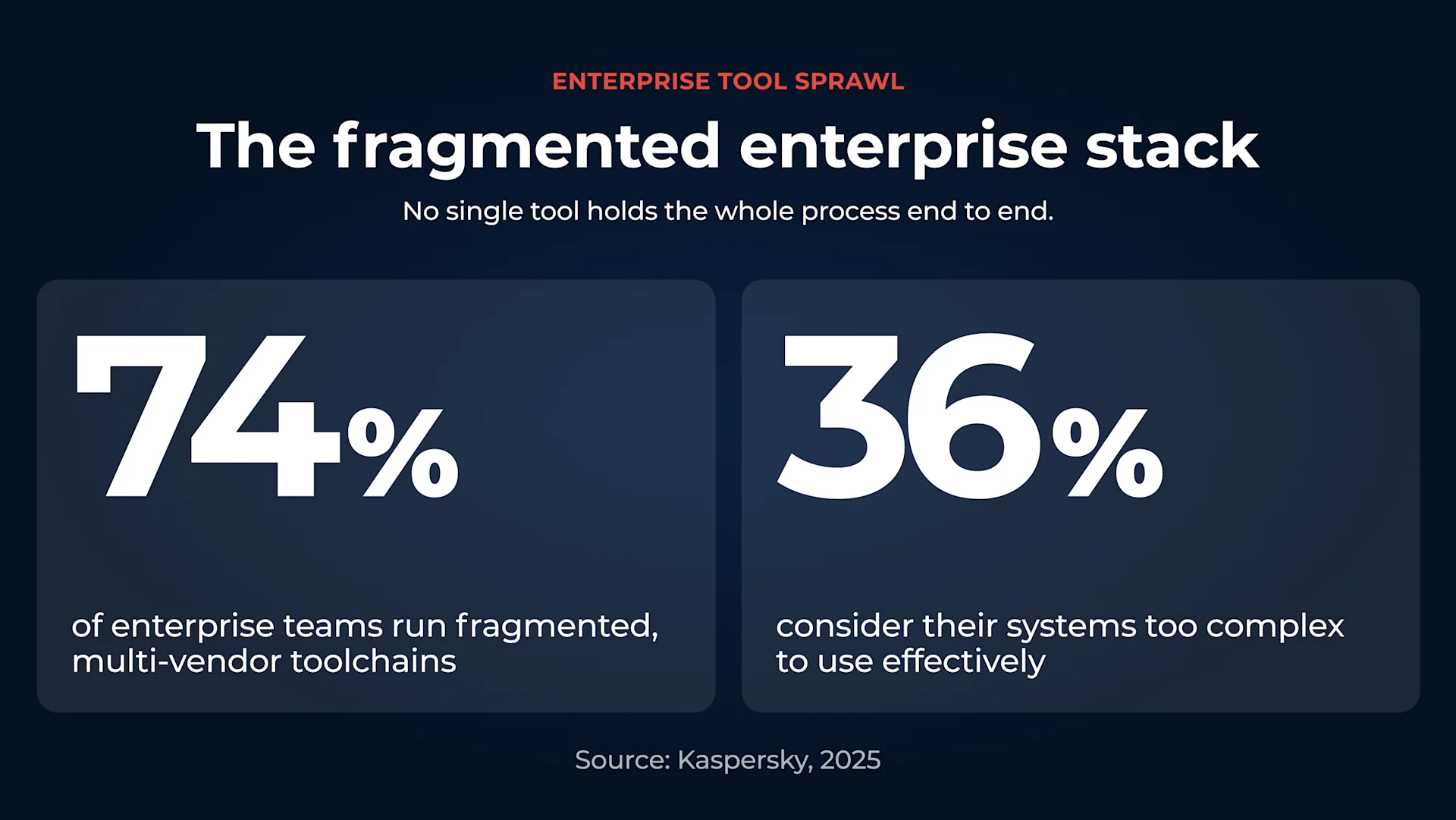
Finding out where a late invoice is stuck means manually checking each system, and the more systems the process touches, the wider the blind spot. This is the normal state of an enterprise stack rather than the exception. Kaspersky’s 2025 research found that 74% of enterprise teams run fragmented, multi-vendor toolchains, and 36% consider their systems too complex to use effectively.
A process that crosses tools no one can see end to end cannot be governed, audited, or improved, because no one can establish what it did, or hold anyone accountable for it.
While human intervention is a necessary step in many processes, it is often bypassed or turned into a bottleneck. While human intervention is a necessary step in many processes, it is often bypassed or turned into a bottleneck.
An invoice with a discrepancy outside the automation's rules may be paid without review. At the other extreme, over-routing decisions to people creates a queue where urgent invoices sit behind a stack of routine approvals waiting for the same pair of eyes.
Adding an AI agent to this process puts it to work with no structure governing how it operates. An orchestrator agent brought in to clear the backlog of flagged invoices decides each one on its own, with no defined rule for when it should act, when it should stop, or when a human should take over, and no record of why it decided what it did.
Every decision is improvised, and at the speed an agent works, the improvised decisions pile up faster than anyone can check them.
Workflow automation fails for a structural reason. Automation stays inside individual tools, and nothing governs the process running across them. An enterprise-grade platform needs four things to close this gap.
An orchestration engine holds the process itself, separate from the applications it runs across. Unlike a workflow engine bound to a single application, the process lives in the engine rather than inside the finance system or the logistics system, so you can see and govern it as a whole.
The engine tracks where each process has reached and what it is waiting on. If an invoice check finds a discrepancy, the engine sends it to a manager holding the process until a decision. A cloud-native engine adds the scalability to run thousands of these process instances at once.
Open process standards are shared, published notations for modelling how a process runs. BPMN (Business Process Model and Notation), CMMN (Case Management Model and Notation), and DMN (Decision Model and Notation) are the open ISO standards. Anyone who knows the notation can read a process modelled in them, and any platform supporting them can run it.
A proprietary modelling language locks every process inside one vendor’s tooling, so leaving the platform means rebuilding from scratch. For a buyer planning years ahead, open process standards keep the processes you build yours.
Reusable integration means connecting a system once and making the connection available to every process needing it. Connecting systems one by one produces a tangle of one-off connectors, all needing separate upkeep.
An API-first integration layer treats a connection as a shared resource, so once integrated, adding processes doesn't increase the maintenance load.
Human-in-the-loop has to be part of the design from the start, otherwise it can't route decisions to a person reliably. A review step designed into the process names the decisions needing a person, sends them the work with the context behind it, and holds the process until they respond.
A review step added on at the end increases the risk of bypassing human intervention when it matters. Designing review into the process makes intelligent automation safe to add too. An agent working inside a process with defined review points and a full record is governed the same way as the steps around it, which is what makes agentic workflows dependable in regulated work.
Our guide to agentic orchestration covers how that governance works.
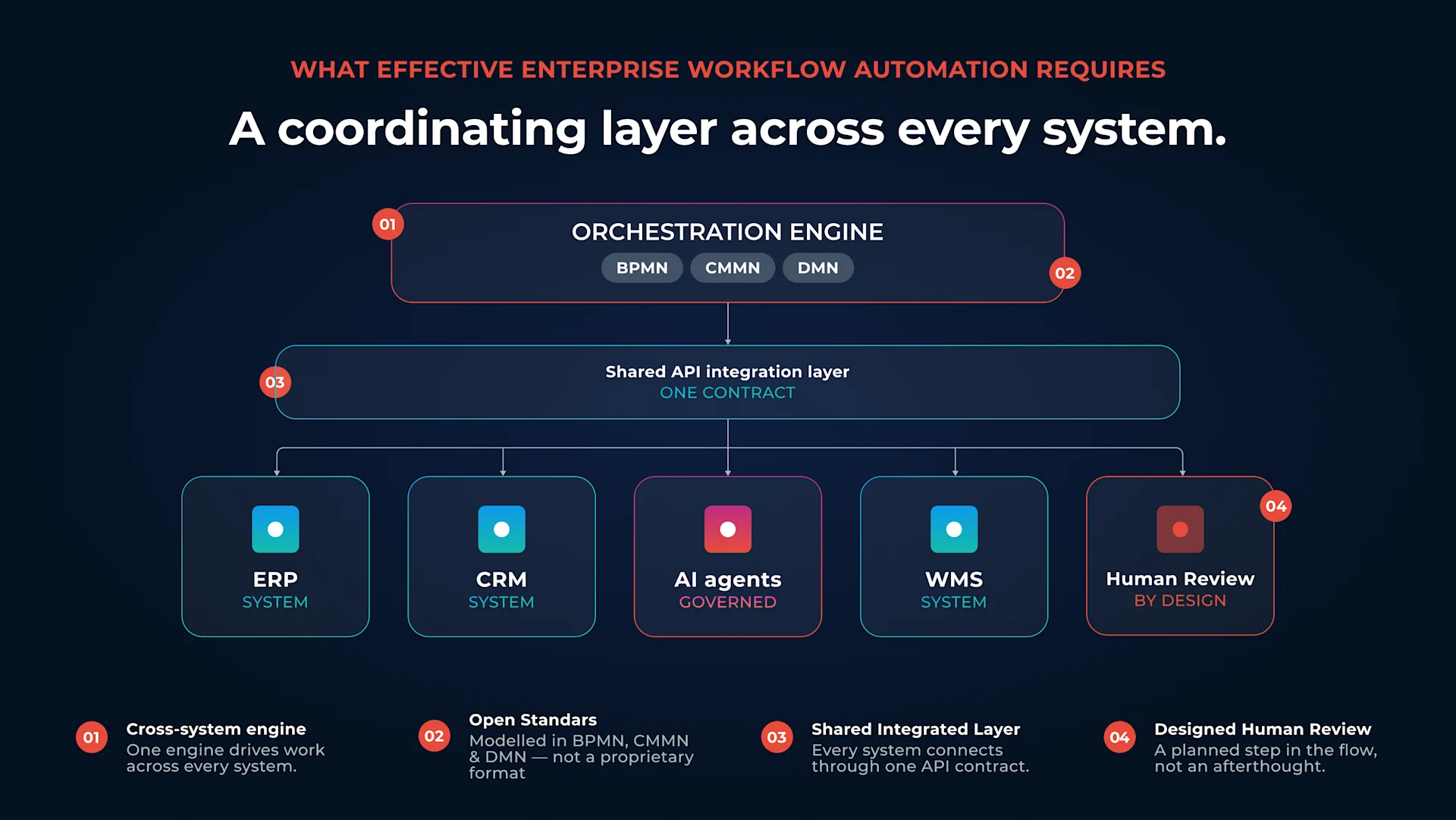
Enterprise workflow automation delivers across businesses in every industry, but the value is sharpest in regulated sectors, which run processes that cross many systems, carry compliance obligations on each decision, and produce exceptions no fixed rule resolves.
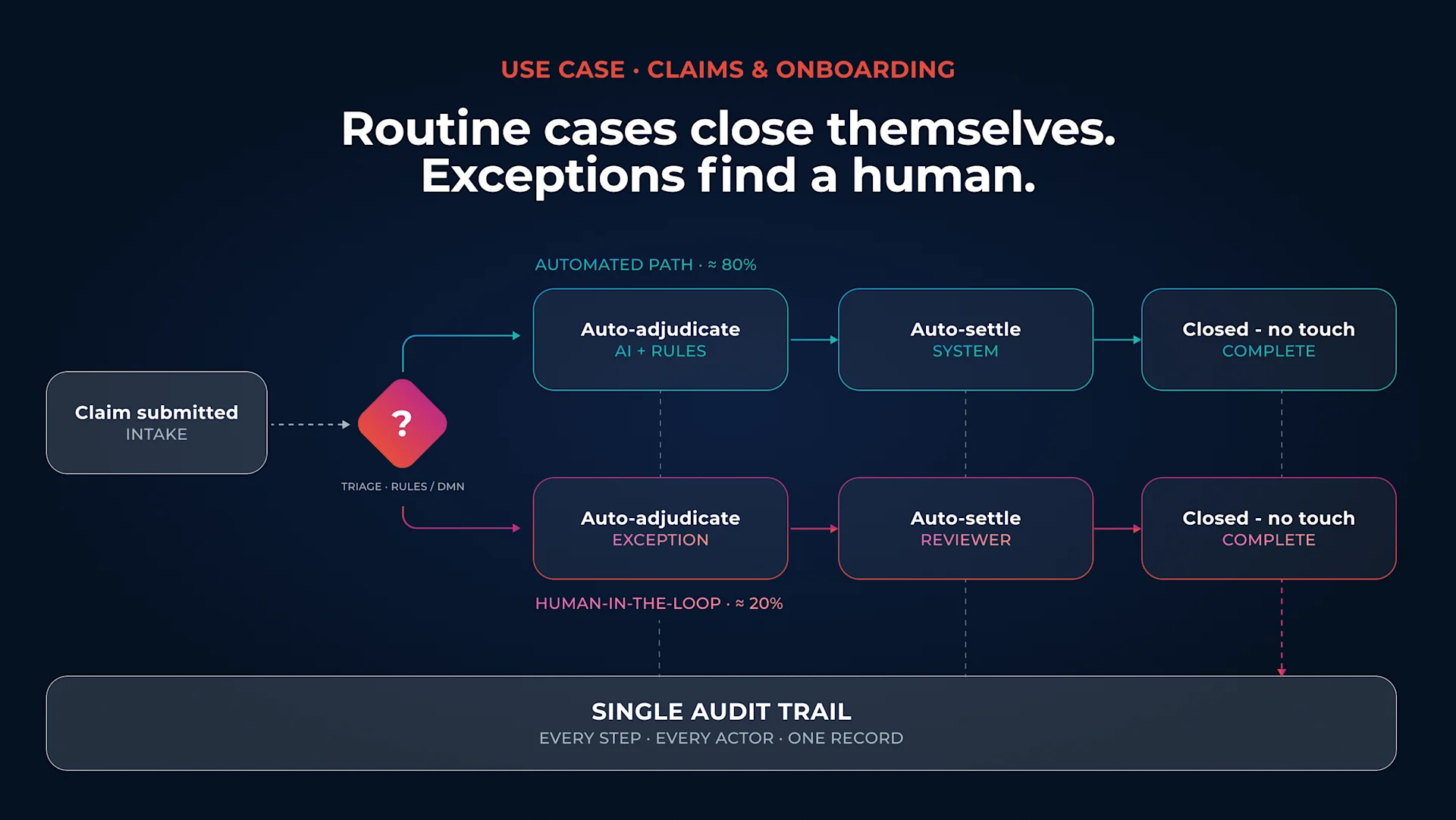
In financial services, onboarding a corporate customer requires identity verification, sanctions screening, and credit assessment, with Know Your Customer (KYC) checks behind each step. Workflow automation processes standard applications through to approval without intervention, and in flagged cases routes the work to a person for the due diligence a regulator expects.
This clears routine cases without delay, reduces the risk of an exception slipping through unreviewed, and produces the audit record a compliance team needs. Flowable’s banking solutions are built for processes like these.
Deloitte describes multi-agent KYC workflows that already split this work across agents: one agent pulls public-source data, another scores risk, and a third files regulatory updates, with audit trails and override checkpoints built in rather than bolted on afterwards.
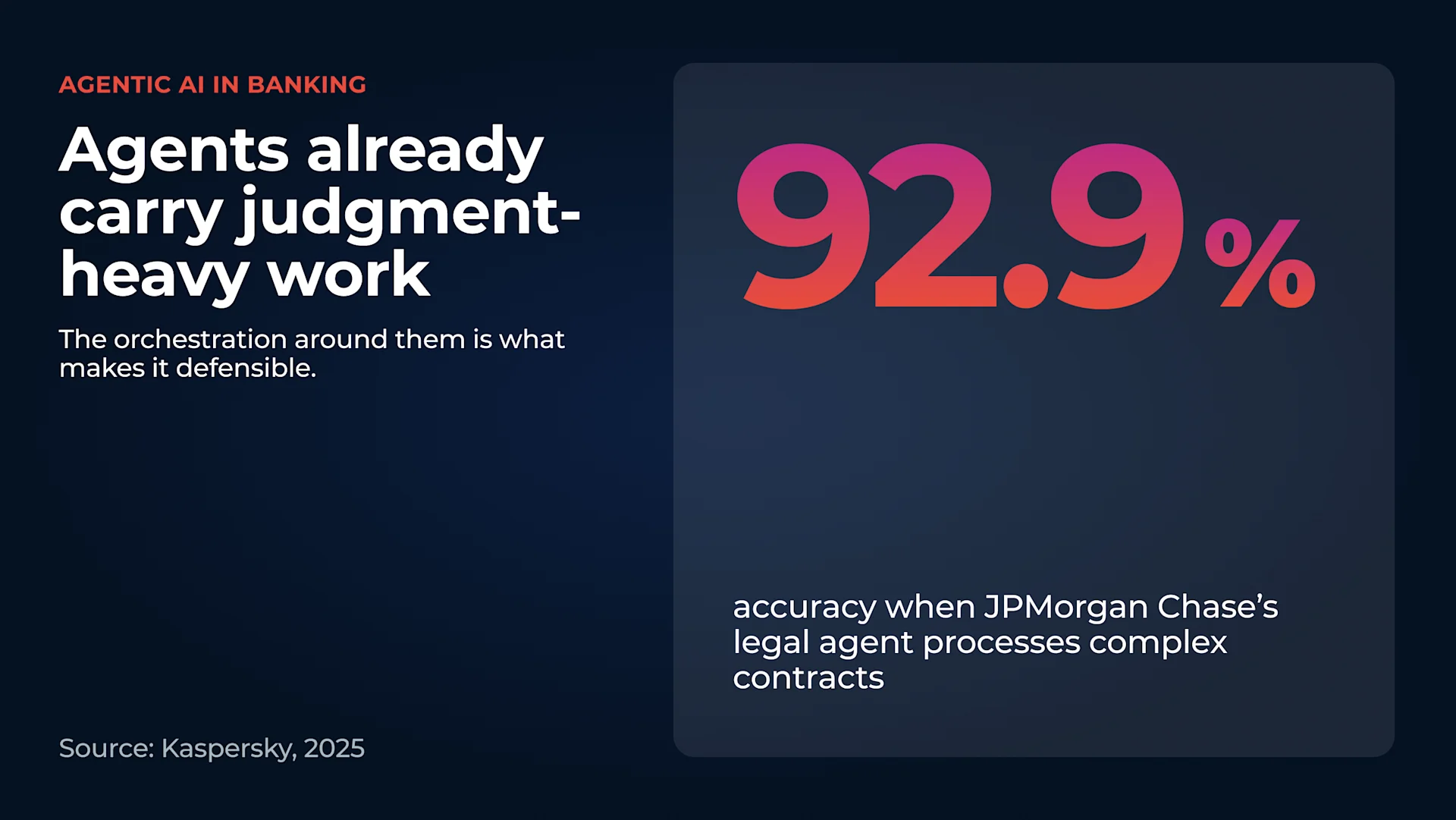
Its research explains how capable these agents have become, reporting that JPMorgan Chase’s legal agent processes complex contracts at 92.9% accuracy. The same report states that as AI agents spread through banking, regulators are likely to demand thorough data traceability and audit trails, which is the part of the orchestration the agents have to supply.
In insurance, a claim passes through intake, validation, and payment systems before it settles. Claims showing signs of fraud or falling outside standard cover need an adjuster’s judgment. Workflow automation settles the routine claims and routes the rest to the right adjuster with evidence behind the flag. This speeds up straightforward claims, lowers the chance of a fraudulent or miscovered claim being paid in error, and keeps a full record of each decision. Flowable’s insurance solutions address this directly.
Both industries answer the same regulatory demand: the automation must prove what happened, in what sequence, and on whose authority.
Most process orchestration platforms look alike on paper, and a digital transformation program can stall on the wrong one. When evaluating a vendor, weigh these five questions.
A tool automating tasks inside its own boundary leaves the handoffs between systems to people. A platform orchestrating the process holds the whole thing across the systems it runs on.
Open standards keep the processes you build portable and legible to an auditor. A proprietary language ties them to one vendor, and the cost of leaving rises with every process added. Evaluate open standards support early in the selection process, not after the contract is signed.
Work split across separate models for each type of actor fractures at the seams between them. One model covering all three keeps the process whole.
A review step designed into the process runs on set criteria. One added on at the end increases the risk of a decision bypassing the person who should have seen it.
An auditor needs to reconstruct what happened, in what order, and on whose authority. A partial trail is no trail at all. Not when a regulator is asking the questions.
Flowable answers all five. It runs BPMN, CMMN, and DMN in one platform, coordinates automated, integrated, and human steps in a single process model, and produces one audit trail across them. Book a demo to see how Flowable handles your KYC, claims, or onboarding process end to end.
Enterprise workflow automation coordinates the tasks, systems, and people in a business process so the process runs end to end. At enterprise scale it spans several systems, includes structured decision points, and covers the exceptions that require human judgment.
Workflow automation runs a defined sequence of steps. Process orchestration coordinates a process across systems, people, and decisions, changing route according to what each step returns and holding the process when it waits on a person or another system.
Most projects automate individual tasks but never coordinate them into a governed process across systems. The work breaks at the handoffs between systems, where no tool holds the whole process and no single record shows what happened. That gap is where compliance exposure lives.
BPMN (Business Process Model and Notation) is the open standard for modelling predictable, structured processes. CMMN (Case Management Model and Notation) is the open standard for modelling work where the next step depends on what just happened. Both are open ISO standards.
Look for five things: orchestration across systems, open process standards, support for humans and AI agents in one process model, human review designed into the process, and a complete audit trail across every step.
n agentic workflow is more than a multi-agent diagram. See what the standard patterns omit once workflows meet exceptions, oversight, and audit requirements. Primary keyword: agentic workflow
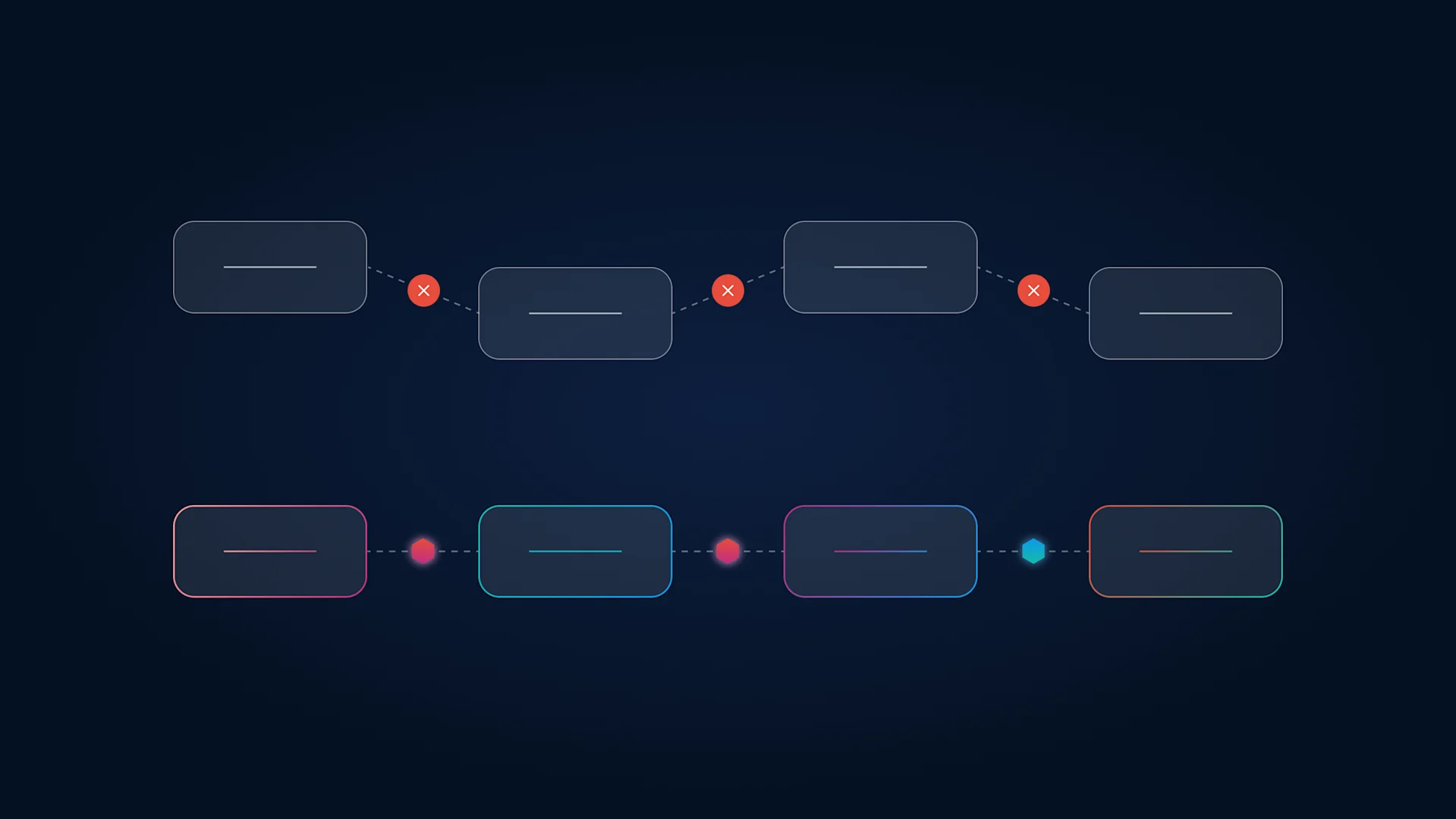
Automating single functions leaves the process broken at the handoffs. See why end-to-end orchestration beats function-by-function financial process automation.
A criteria-led framework for evaluating workflow orchestration tools, covering open standards, governance, exceptions, and lock-in, not another ranked listicle. Keywords: workflow orchestration tools