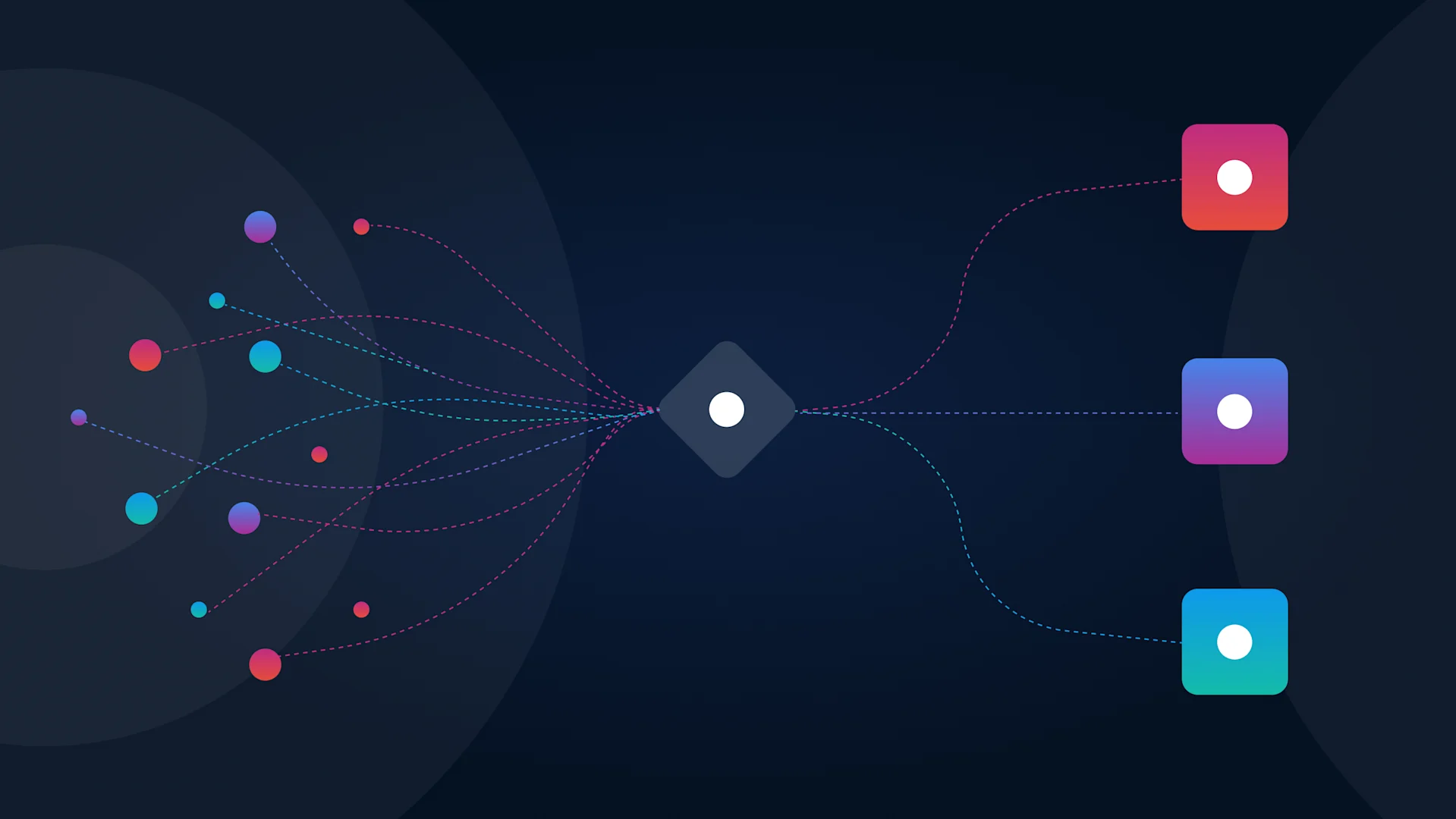
A claims investigation starts routinely enough. Then suddenly, three parties are involved, documentation conflicts emerge, there’s a fraud signal that requires human judgment, and a regulatory deadline is ticking down in the background. There is no fixed action plan that resolves this. The next step depends entirely on what the case reveals at each stage.
Nobody designed standard workflow automation for this kind of work. It assumes you know the structure upfront. When it isn’t, systems either stall, force the work into an ill-fitting path, or escalate everything back to a human without preserving meaningful context.
Agentic case management handles exactly this type of work. It enables AI agents to plan, adapt, and act inside long-running, exception-driven cases where the next step only becomes clear as the case evolves, and where human judgment is part of the operating model rather than an exception to it.
Most AI case management platforms don't actually qualify as agentic case management. This article draws that distinction and gives you a practical test: is the platform genuinely built for this kind of work, or is it repackaging AI features on top of a standard case management tool?
Agentic case management is the orchestration of AI agents, deterministic systems (such as rules engines and workflow automation), and human judgment across long-running, exception-driven work where the next step cannot be defined in advance.
It combines the case management model (adaptive work, knowledge worker oversight, and full case history) with AI agents that can analyze context, plan actions, and execute multi-step tasks within the case.
In practice, this enables platforms to:
Handle work that cannot be modeled as a fixed sequence of steps
Orchestrate AI agents and humans without losing case context
Maintain a complete, auditable record of both human and AI decisions
The agentic piece is specific: These are systems that evaluate the current state of a case, determine the next best action within defined boundaries, and execute it as part of ongoing case progression.
This is distinct from traditional automation, which follows predefined flows, and from generative AI, which produces outputs but does not operate within a governed case lifecycle.
Agentic case management builds on adaptive case management, the established discipline for knowledge-worker-led, non-linear processes, by introducing AI agents as active participants within that same framework.
The problem isn't that workflow automation is implemented badly. It builds on an assumption that doesn't hold for exception-driven work: that you can define the sequence of steps upfront.
Claims investigations, complex onboarding, fraud reviews, and Anti-Money Laundering (AML) escalations share a common characteristic: each step depends on what was uncovered in the previous one.
A fraud signal mid-investigation changes the direction of the case. A conflicting document introduces a new line of inquiry. A transaction anomaly triggers escalation that was not part of the original process design.
This is not edge-case behavior. In financial services and insurance, it is the dominant pattern in high-value operational work.
Business process management tools (BPMN-based workflow systems) are designed around a fixed sequence of steps defined upfront. That works well for structured, repeatable processes. For exception-driven work, it breaks down.
When reality deviates from the model, systems typically pause for human intervention, force the case into a predefined path, or escalate entirely to a human and remove the automation value.
The result is rarely visible failure. It’s a gradual degradation: manual workarounds, inconsistent handling, and cases that close without a complete operational record.
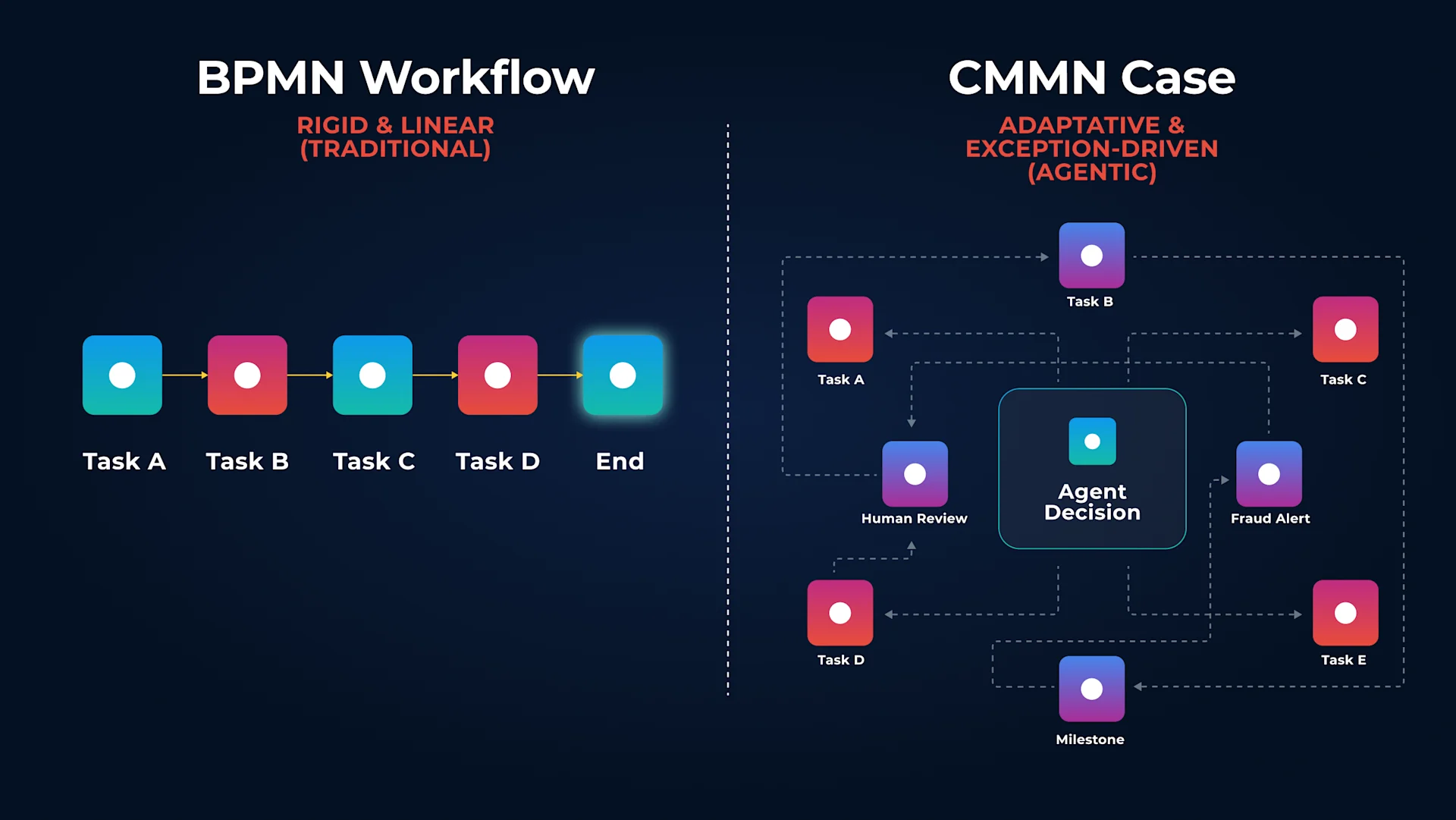

Case management was created for adaptive work: processes where the knowledge worker, not the workflow model, determines the path to resolution.
The modeling standard for this is CMMN (Case Management Model and Notation), maintained by the Object Management Group, the same body behind BPMN and DMN.
BPMN models a fixed sequence of steps. CMMN models a set of possible actions, triggered dynamically as the case evolves. It doesn't assume a predefined path. It provides the structure within which the path is discovered.
As an open standard, CMMN isn't owned by any single vendor. Platforms built on it avoid the proprietary lock-in that comes with vendor-specific modeling languages, a practical consideration for organizations running cases across multiple systems over long time horizons.
Case management provided the framework for adaptive work.
Agentic AI introduces a new class of participant within it. But not every platform using the term "agentic" is actually built for this type of work.
Three architectural characteristics separate genuine agentic platforms from workflow tools with AI features added on top.
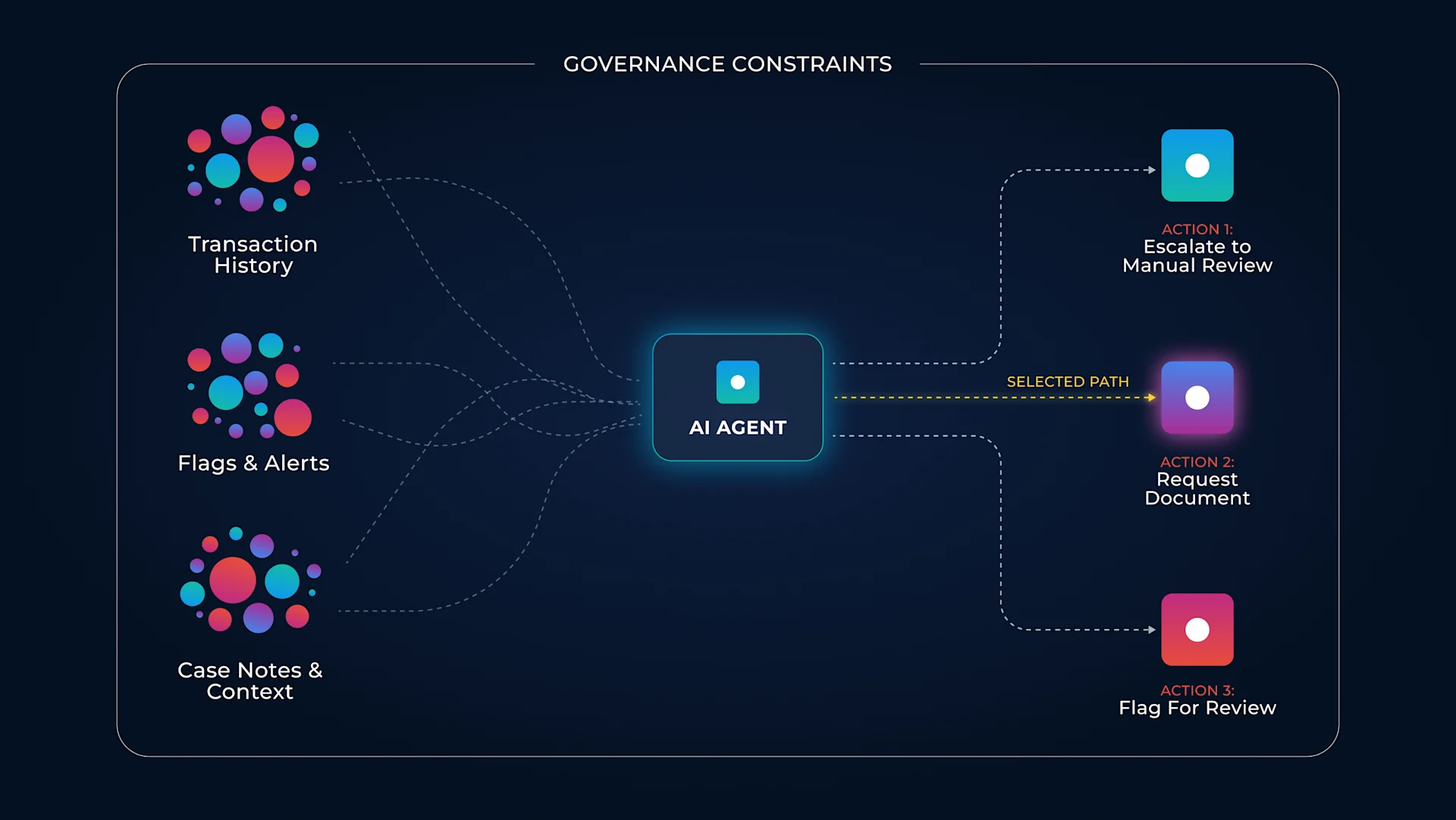
There's a meaningful difference between a routing engine and an agent. A routing engine moves work between predefined steps according to rules.
An agent evaluates the current state of a case, determines the next best action within defined constraints, executes it autonomously, and updates the case record. One is the execution of a flow someone else designed. The other is active participation in the case itself.
This matters because exception-driven work generates situations no routing rule anticipated. An agent can assess a novel case state and determine a response. A routing engine can only match it against patterns it was given.
Know Your Customer (KYC) investigations, complex claims, and fraud reviews often run for days or weeks, across multiple systems and multiple people.
A genuinely agentic platform maintains persistent case state across the entire lifecycle. Every agent action, every human decision, and every piece of retrieved context is part of a single continuous record.
When a case resumes after days of inactivity, or escalates from an AI agent to a human analyst, there is no reconstruction required. The full context is there. This is what makes complex, multi-party case work operationally viable at scale.
Human oversight in agentic case management is not a fallback for when AI fails. It is a structural component of governance and how the system operates.
This includes:
Defined escalation points where human judgment is required
Full context transfer at the moment of handover
A unified audit trail across human and AI actions in the same place
A case cannot close without required human decisions being explicitly made and traceable. For regulated industries, this is the difference between a system that produces defensible outcomes and one that doesn't.
The work where this matters most shares a common profile: high-stakes, multi-party cases that must produce defensible outcomes under time pressure, where the path to resolution cannot be scripted in advance. Financial services and insurance are the clearest examples.
A KYC alert triggers a case. An AI agent retrieves transaction history, cross-references external data sources, and identifies behavioral anomalies linked to the alert. By the time the case reaches a compliance analyst, the supporting analysis is already assembled.
The analyst reviews, makes the determination, and records their reasoning. The agent handles required reporting, updates the case record, and maintains audit continuity throughout.
The outcome is faster resolution and a complete, traceable record of how the decision was reached, not just what it was. That traceability is what makes the outcome defensible under regulatory review.
For financial services teams managing KYC and AML investigations at scale, Flowable's agentic case platform is built around exactly this kind of case architecture — where agent-driven triage and human oversight operate within a single governed environment.
A non-standard claim enters the system. An AI agent classifies severity, pulls policy data, and identifies anomalies consistent with known fraud patterns. It escalates to a human adjuster with full supporting context already in place.
The adjuster makes the coverage decision. The agent handles documentation, follow-up actions, and audit logging. Everything is captured end-to-end, in a single record: what the agent found, what the human decided, and why.
Agentic AI in insurance provides insurers managing claims volume at scale a level of traceability that is operationally significant and increasingly a regulatory expectation.
The pattern across both is the same. Work that has to produce a defensible decision under time pressure, with multiple parties involved, and no predetermined path to resolution. That is the domain of agentic case management.
Not every platform that uses the word "agentic" is built for the work described above. Four characteristics separate genuine agentic case management platforms from tools that bolt an agentic AI workflow onto standard automation.
The question to probe: what happens when a case deviates from the expected path? If the answer involves human intervention to get the process back on track, the underlying model is still workflow-based. Vendors will often describe this as "intelligent automation" or "AI-powered workflows." The framing tells you where the architecture started.
BPMN, CMMN, and DMN are open standards not owned by any single vendor.
A platform built on them means your process definitions remain portable over time. The red flag is a proprietary modeling language the vendor cannot explain in terms of recognised standards. If you cannot take your process definitions elsewhere, you are not buying software. You are accepting dependency.
For regulated industries, an incomplete audit trail is not a gap; it is a liability. The red flag is a vendor describing AI activity logs as a separate feature from case history. A genuine agentic platform does not join two records together after the fact. Human and AI actions are captured in the same place from the start.
Long-running investigations and multi-party case work do not resolve in a single session.
Ask what happens when a case resumes after days of inactivity, or when it moves from an AI agent to a human analyst. If context has to be reconstructed, or agent activity resets between interactions, the platform is not built for this kind of work. Persistent state is a basic requirement, not a differentiator.
Flowable is an agentic case platform built to support the type of work described above: long-running, exception-driven cases in financial services and insurance where outcomes must be defensible and audit trails complete.
It combines open standards, persistent case state, and human-in-the-loop design so that AI and human decisions are coordinated in a single governed environment. If your organization manages high-stakes case work, request a demo tailored to your financial services or insurance use case.
Agentic case management is the coordination of AI agents, deterministic systems like rules engines and workflows, and human judgment across long-running, exception-driven processes where the next step cannot be defined in advance. It combines adaptive case management with AI systems that can act within governed workflows.
Adaptive case management relies on human decision-making to determine the path of work. Agentic case management introduces AI agents that can execute steps, retrieve context, and support decision-making within the same case environment.
Most AI case management platforms add classification, routing, or summarization on top of workflow systems. Agentic case management is built for non-linear work, where AI operates inside the case lifecycle rather than around predefined process steps.
It is designed for exception-driven, judgment-heavy processes such as KYC, AML investigations, fraud detection, complex claims handling, and regulatory escalations in financial services and insurance.
CMMN is the open standard designed for adaptive case work. Unlike BPMN, which models fixed sequences, CMMN models the set of possible actions that can be triggered as a case evolves. For organizations running cases over long time horizons across multiple systems, building on an open standard means process definitions remain portable and vendor-neutral.
n agentic workflow is more than a multi-agent diagram. See what the standard patterns omit once workflows meet exceptions, oversight, and audit requirements. Primary keyword: agentic workflow
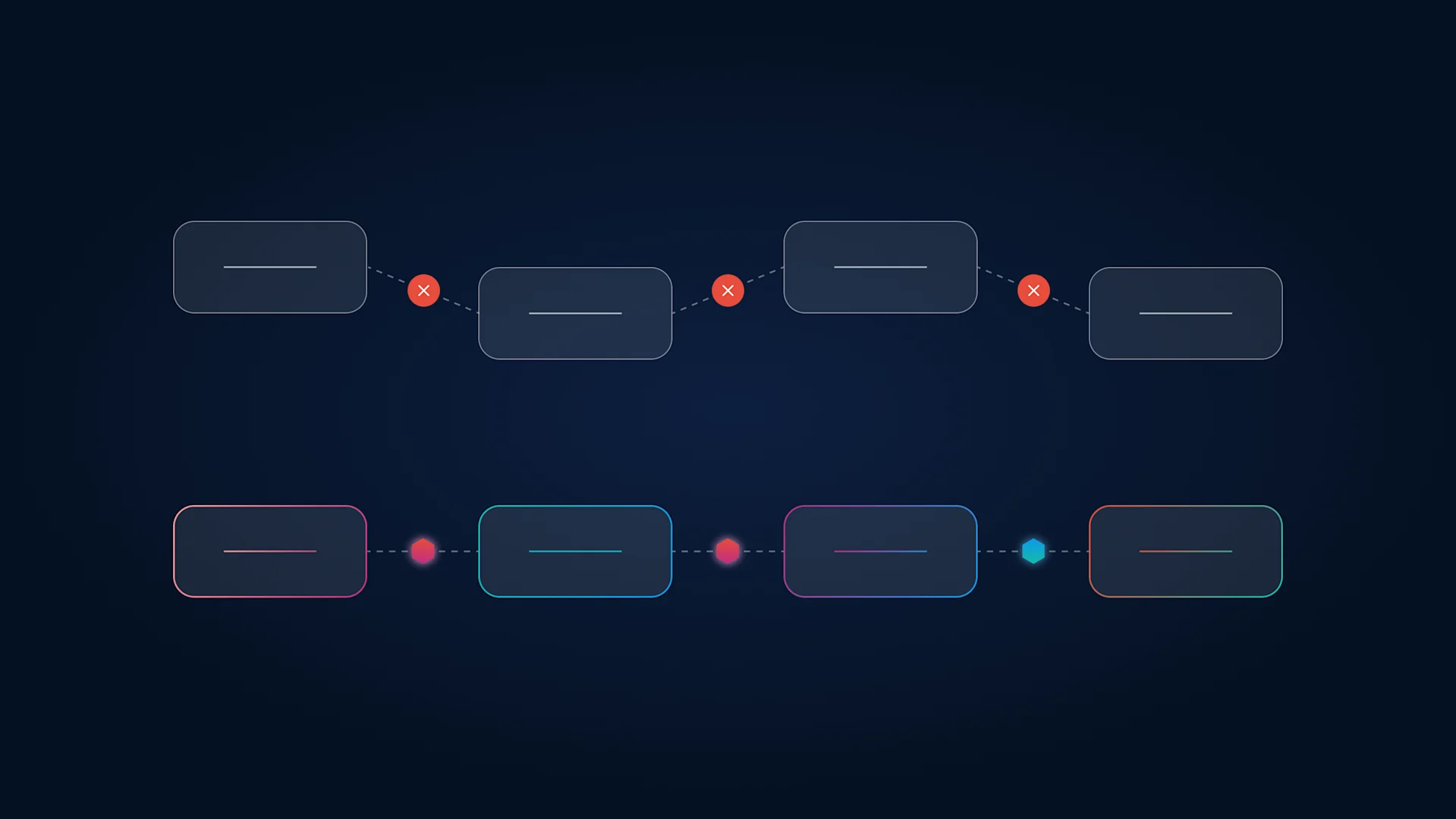
Automating single functions leaves the process broken at the handoffs. See why end-to-end orchestration beats function-by-function financial process automation.
A criteria-led framework for evaluating workflow orchestration tools, covering open standards, governance, exceptions, and lock-in, not another ranked listicle. Keywords: workflow orchestration tools