
With today’s business environment in a state of constant evolution, ensuring efficiency is paramount. And for many organizations, the traditional procurement process, laden with manual tasks, inefficiencies, and human errors, has become a tricky hurdle to clear.
From endless paperwork to disjointed communication, yesterday’s methods can lead to missed opportunities, inflated costs, and a lack of real time visibility and control over spending. Enter, procurement automation: A transformative approach that leverages cutting-edge technology to streamline the entire procure to pay process. By embracing automation, businesses can unlock substantial operational costs savings, dramatically increase both efficiency and accuracy, and gain a competitive edge in their supply chains.
Procurement automation uses technology to streamline the entire procure-to-pay process, eliminating manual tasks like data entry, approval routing, and invoice processing while reducing human error and processing times.
Organizations that implement procurement automation achieve significant cost savings through better spend visibility, volume discounts, automated contract compliance, and reduced processing overhead.
AI and machine-learning technologies now enable predictive analytics for demand forecasting, supplier risk assessment, and intelligent workflow optimization that adapts based on user behavior and historical data.
Companies should start by automating high-impact processes like purchase requisitions, invoice processing, and vendor management before expanding to full end-to-end automation.
At its core, procurement automation refers to the use of technology and software to automate repetitive, manual tasks, thereby streamlining an organization’s processes. It's about creating a seamless, digital workflow that enhances every stage of both sourcing and purchasing.
This involves leveraging specialized procurement automation software designed to manage everything from initial requisitions to final invoice payments. Key features can often include:
Electronic catalogs: Centralized, searchable databases of approved products and services, making it easy for employees to find and request what they need.
Workflow automation: Pre-defined structures that automatically route requests, approvals, and other documents to the right individuals or departments, reducing processing times.
Approval routing: Automated systems that ensure all necessary approvals are obtained both efficiently and in compliance with company policies.
Electronic signatures: Legal and secure digital signatures that eliminate the need for physical paperwork and accelerate contract execution.
Integration with accounting / ERP systems: Seamless data flow between procurement software and existing financial systems to ensure data consistency, eliminate double entry, and provide comprehensive spend management insights.
The advantages of adopting procurement automation extend beyond digital transformation and directly impact a company's bottom line and operational effectiveness.
By providing better real time visibility into spending, organizations can identify opportunities for consolidated purchasing, leverage volume discounts, and negotiate better terms with suppliers. Furthermore, automated contract compliance ensures that agreed-upon pricing and conditions are always met, preventing overspending.
And by eliminating tedious, repetitive tasks like manual data entry, matching purchase orders with invoices, and chasing approvals, procurement teams are freed up to focus on what really matters. This includes supplier relationship management, strategic sourcing, and risk assessment, boosting productivity in the process.

Automation processes also accelerate the procure to pay process. From faster requisition approvals to expedited purchase orders and quicker invoice processing, lead times are drastically reduced. This enhanced efficiency contributes to a more agile and responsive supply chain.
But one of the most significant benefits is the reduction in human error. Manual data entry is a common source of mistakes, leading to discrepancies, delays, and financial inaccuracies. Automated systems, with built-in validation and checks, minimize the chance for such errors to occur, leading to more reliable data and accurate financial reporting.
And this modernized approach translates directly into improved supplier performance. Prompt payments, clear communication, and efficient handling of requests foster stronger, more collaborative relationships with vendors, opening the door to both better service and preferential terms.
Finally, automating procurement processes helps guarantee compliance with both internal policies and external regulations. It enforces adherence to approved vendor lists, contract terms, and approval process workflows, thereby lowering the risk of fraud, non-compliance, and unauthorized spending.
Companies should start automating purchase requisitions, invoice processing, and vendor and contract management first, as these four processes deliver the fastest ROI and build momentum for broader automation initiatives.
Here’s a closer look at why those four processes should be prioritized:
Purchase requisitions and purchase orders: Automating the creation, submission, review, and approval of purchase requests speeds up the initial procurement stages. Employees can easily create requisitions that automatically route based on pre-defined rules, ensuring compliance and rapid turnaround. Automated PO generation, tracking, and status updates improve accuracy and directly impact supply chain efficiency.
Invoice processing: For finance departments, automated invoice processing is a game-changer. Intelligent data capture, automated matching of invoices to POs and receipts, and auto-approval for compliant invoices reduce manual effort and processing times. Integration with finance and accounting tools ensures seamless reconciliation.
Vendor management: Streamlining vendor management centralizes vendor information, automates onboarding, and tracks performance. The outcome is better supplier selection, improved supplier performance, and more effective relationship building.
Contract management: Automating contract management organizes all contracts in a central, searchable repository, elevates consistency in terms, enables automated renewal reminders, and reduces the risk of non-compliance.
These automation priorities create immediate value while building the foundation for procurement transformation.
Advancements in procurement automation are driven by exciting updates across a wide range of crucial technologies. Robotic process automation (RPA) bots can automate highly repetitive tasks that follow rule-based logic, including data entry, invoice scanning, and extracting information from documents. This substantially reduces the need for human intervention in mundane, high-volume activities.
Machine learning (ML) algorithms and AI agents can analyze vast amounts of procurement data, identifying patterns and anomalies. This in turn enhances decision-making and forecasting, predicting demand, optimizing inventory levels, and even identifying potential risks in supply chains.
Natural language processing (NLP) enables procurement automation software to understand, interpret, and process human language. It's capable of extracting critical data from unstructured documents like contracts, emails, and vendor communications, turning text into actionable insights.
Cognitive agents answer user queries, guide employees through the requisition process, and even recommend suitable suppliers based on historical data and user preferences. These actions result in an enhanced user experience and improved efficiency in the approval process.
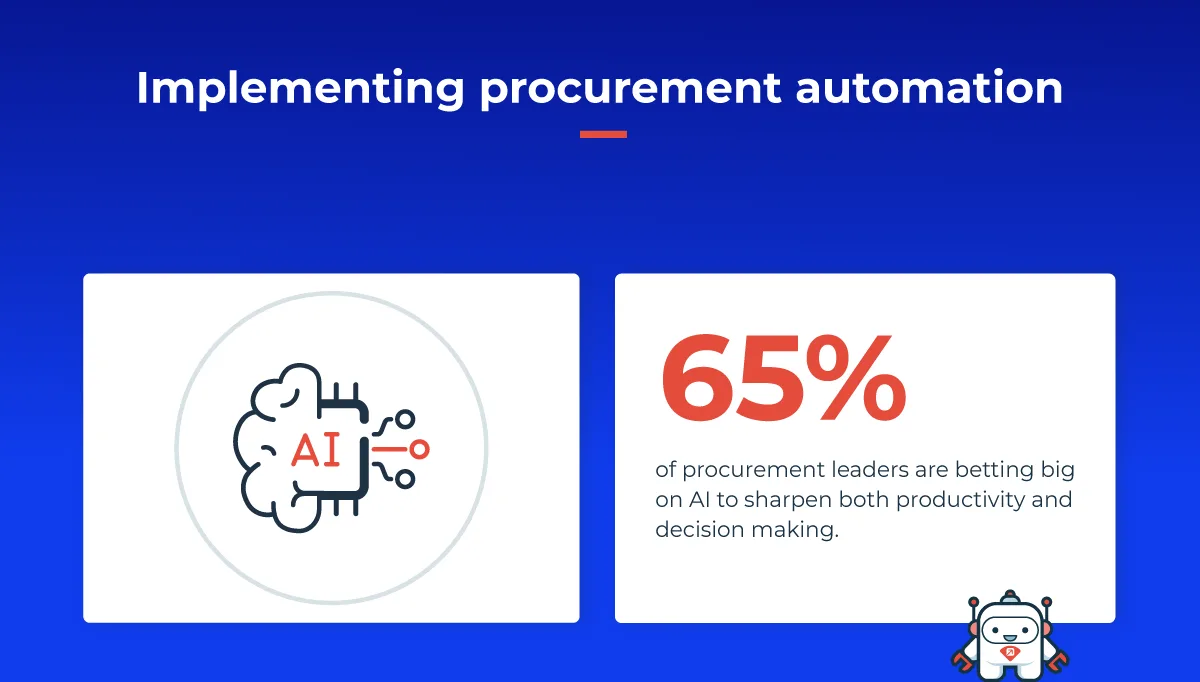
According to Gartner, 65% of procurement leaders are betting big on AI to sharpen both productivity and decision making. AI-powered workflow automation creates intelligent workflows that adapt and optimize over time. Through either natural language commands or learning from user behavior, AI, and in particular AI agents can dynamically adjust procurement workflows for greater efficiency and responsiveness.
The journey of automating procurement processes starts with selecting an automation software that fits your needs.
Consider factors like features offered. This may include e-procurement, spend management, contract management, and vendor management. Other elements not to be ignored cover integration capabilities with your existing ERP and accounting systems, scalability, user-friendliness, and pricing models. A thorough vendor assessment, including demos and references, is also highly recommended.
And there are a number of ways to optimize procurement workflows with automation. Embrace data analysis to continually identify areas for improvement. Foster strong supplier communication to ensure seamless transitions and maximum collaboration. Regularly review and update automated processes to adapt to evolving business needs and market conditions. Focus on a phased approach, starting with the most impactful areas, to build momentum and demonstrate value.
It should however also be noted that implementation can present its own set of barriers. Resistance to change from employees accustomed to traditional methods is common, so effective change management strategies, including clear communication and training, are vital. Integration issues with legacy systems can also arise, necessitating strategic planning and potentially phased rollouts.
The trajectory of procurement automation in 2026 and beyond points towards even greater intelligence and autonomy. Some emerging trends are:
Advanced AI and ML: AI will move past just automating tasks to becoming a strategic advisor, offering predictive analytics for demand forecasting, supplier risk assessment, and market trend analysis.
Predictive analytics: Leveraging historical data and real-time information, predictive analytics will enable procurement teams to anticipate future needs, identify potential supply chain disruptions before they occur, and proactively manage risks.
Blockchain for supply chain transparency: While still in its early stages for procurement, blockchain technology holds promise for enhancing transparency and traceability across supply chains, improving trust and reducing the risk of fraud.
Hyperautomation: The combination of RPA, ML, AI, and other technologies will lead to hyperautomation, where entire end-to-end business processes are automated with minimal human intervention, creating truly intelligent and self-optimizing automated systems.
By transitioning from outdated, manual processes to sophisticated, automated systems, organizations can realize significant cost savings, boost efficiency and accuracy, and gain unparalleled real-time visibility into their supply chains.
The benefits of procurement automation today are crystal clear: reduced human error, improved supplier performance, streamlined procure-to-pay process, and empowered procurement teams focused on strategic value. As technology continues to evolve, the future of procurement promises even greater innovation, meaning now is the perfect time to not only invest in automation, but also secure a long-lasting competitive advantage and growth, bringing tangible value to your business.
For organizations looking to move from procurement automation in theory to execution in practice, platforms like Flowable can play a supporting role. By orchestrating procurement workflows across systems, teams, and data sources, Flowable helps organizations automate approvals, enforce policies, integrate with existing ERP and finance tools, and adapt processes as needs evolve. This approach allows procurement automation to scale alongside the business, without locking teams into rigid, one-size-fits-all solutions.
Interested in learning more? Start a free trial to see how Flowable can help you save time and automate your procurement processes.
Automated invoice processing reduces manual effort by eliminating repetitive tasks like data entry, invoice matching, and approval chasing. Integration with accounting and finance systems further streamlines reconciliation, reducing delays, errors, and the overall cost of processing invoices.
AI and machine learning extend procurement automation beyond rule-based tasks by enabling predictive analytics, intelligent decision-making, and adaptive workflows. By analyzing large volumes of procurement data, these technologies can forecast demand, optimize inventory levels, assess supplier risk, and identify patterns or anomalies.
Robotic process automation (RPA) handles high-volume, rule-based tasks such as data entry, invoice scanning, and document extraction, reducing the need for human intervention. AI and machine learning complement RPA by adding intelligence — interpreting unstructured data, optimizing workflows, and supporting predictive decision-making. Together, these technologies enable hyperautomation, where end-to-end procurement processes are automated, optimized, and continuously improved with minimal manual oversight.

Senior Director OEM and Government Partnerships
Bob Jensen leads Flowable's strategic engagements with OEM integration and government entities leveraging its robust BPM and BPA capabilities. Bob's work centers around demonstrating how Flowable accelerates product development, enhances customer and citizen experiences, and automates mission-critical workflows.
Business process management software covers very different tools in 2026. See how the category shifted towards BOAT and what buyers should evaluate.
Client lifecycle management in banking goes beyond onboarding. See how case management keeps client context intact through KYC, reviews and offboarding.
n agentic workflow is more than a multi-agent diagram. See what the standard patterns omit once workflows meet exceptions, oversight, and audit requirements. Primary keyword: agentic workflow