
For years, intelligent automation has promised to remove friction from business operations. Artificial Intelligence (AI) agents are the latest technology to occupy this space. Agents can read documents, retrieve information, summarize complex content, generate responses, and support decision-making at a speed and scale previously unattainable. In isolation, each capability is impressive and often delivers localized efficiency gains.
However, a challenge emerges when organizations try to apply these agents against real-world business processes. AI agents tend to optimize single tasks, leaving humans to coordinate work across systems, reconcile partial results, and manage exceptions manually. Instead of removing friction, AI simply shifts it to another part of the process.
We don’t just need faster AI, more powerful AI, or even more AI agents. We need AI that integrates properly into business processes.
Multi-agent workflows enable this shift by changing how AI agents collaborate and participate in the work engine. Rather than treating agents as standalone tools, process orchestration coordinates specialized agents inside tightly governed business processes. This approach empowers AI to contribute where it adds the most value, while orchestration, structure, and human oversight ensure the process delivers an expected, reliable, and fast business outcome.
At a business level, a multi-agent workflow is not about adding more AI. It is about structuring how AI participates in work. Each agent plays a specific role in a workflow, contributing at the right moment, and handing off cleanly to the next step, whether that step involves another agent, a system integration, or a human decision.
This coordinated ecosystem is essential because isolated agents tend to create new problems. Without coordination, agents duplicate effort, act on partial context, or force people to assemble results manually.
Multi-agent workflows embed AI directly into the flow of work. The process determines when an agent should act, what context it should receive, and what should happen next. Orchestration ensures that agents work together toward an outcome rather than optimizing individual steps in isolation.
To see why this approach works, let’s explore a real example from a highly regulated, high-stakes environment.
Source-of-wealth verification ranks among the most complex processes in private banking. Before onboarding a high-net-worth client, a bank must prove that the client’s assets are legitimate, traceable, and compliant with regulatory requirements. Teams often analyze hundreds of pages of documents, validate claims against public records, and assess financial histories that span many years.
Traditionally, this work relies on manual coordination. Client advisors collect documents, due diligence officers review them, questions return to the client, and the cycle repeats. Each handoff introduces delay, and each clarification risks frustration. In practice, the process can take five or six weeks, with churn rates that reach alarming levels before the relationship even begins.
Banks do not struggle because they lack expertise. They struggle because the process depends on humans to coordinate information, apply context, and decide what should happen next. Source-of-wealth verification is an ideal candidate for a multi-agent workflow, provided the organization designs it with governance and oversight at its core.
Instead of forcing the process into a rigid sequence, a process orchestration platform like Flowable enabled the bank to model source-of-wealth verification using case management. Each new client becomes a case that evolves as information arrives, allowing the workflow to adapt to complexity without losing structure.
As soon as documents enter the case, the workflow activates a Document Agent to classify and extract data from unstructured files, such as PDFs, contracts, and financial statements. This step eliminates time-consuming, error-prone manual data entry at the very start of the process and provides the case with a structured foundation on which everything else depends.
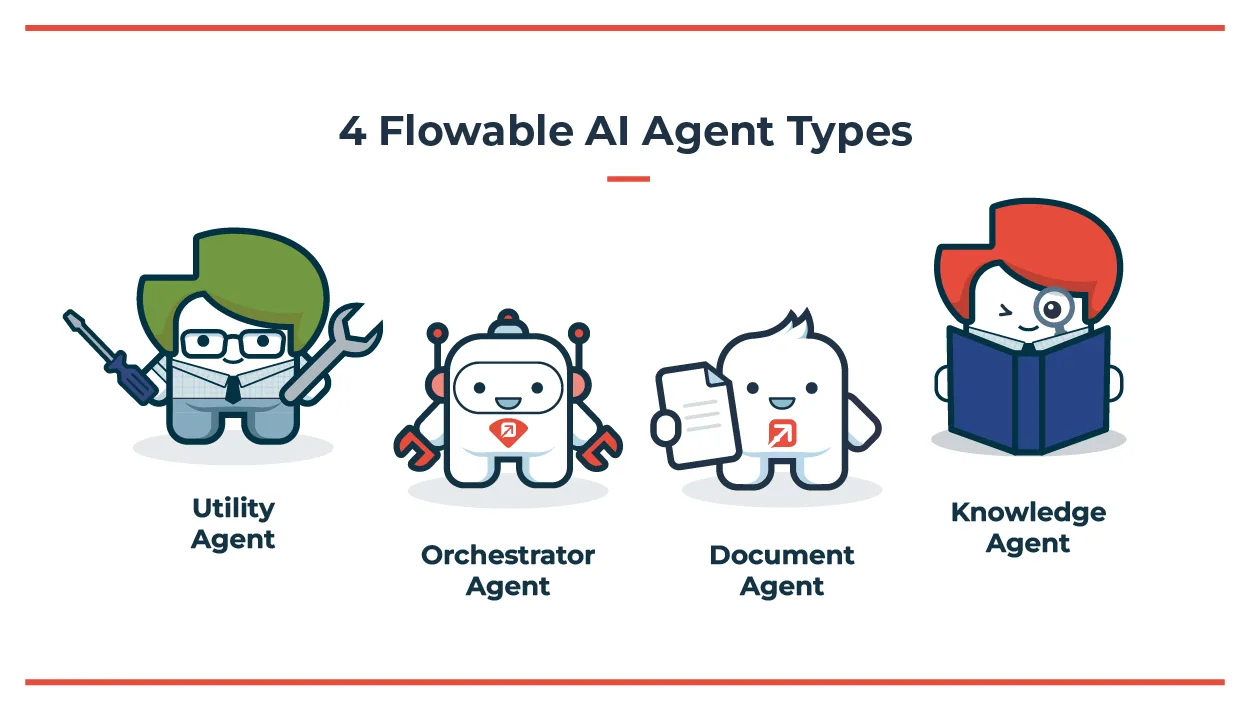
Once the system captures the extracted data, the workflow uses that information to trigger contextual checks. At this stage, a Knowledge Agent retrieves relevant internal policies and prior cases, then validates claims against external reference data. For example, when a client references a past business exit or employment history, the system checks those claims against public records and institutional knowledge to ensure consistency before the case progresses.
As the case builds, the workflow invokes Utility Agents to perform focused analytical tasks. These agents perform tasks such as summarizing long document bundles into clear narratives, benchmarking earnings trajectories against comparable profiles, and highlighting potential inconsistencies that require closer attention. Each task remains narrow in scope, but together they reduce hours of manual analysis into structured, decision-ready inputs.
Throughout this process, an orchestration agent keeps everything aligned and running smoothly. The workflow tracks the case status and knowledge, what evidence remains outstanding, and which actions should run next. It ensures that agents contribute in the correct order and that no activity runs without the necessary context.
The key concept within this use case is process orchestration, or put simply, how the case operates.
Without orchestration, agents would operate independently, producing outputs that teams would need to reconcile manually. Compliance teams would lose visibility, and trust in the system would erode quickly. In regulated environments, that risk alone would prevent adoption.
Instead, orchestration governs the entire case lifecycle. It determines when document analysis should occur, when contextual validation becomes necessary, and when the workflow should escalate to human review. It enforces decision flows, maintains data permissions, and ensures that every action remains traceable and auditable.
However, the case is not 100% automated, as human-in-the-loop checkpoints form part of the orchestration by design. The workflow routes cases to experienced professionals at defined points, both to support complex decision-making and to enable ad hoc validation. Structured summaries and evidence (rather than raw documents) support each human interaction. The AI agent handles the preparation and analysis, while people retain ownership of judgment and final decisions.
The breakthrough is not because of smarter individual agents or more powerful technology. It comes from orchestrated systems that intelligently coordinate multiple agents toward a clear outcome, under governance that business leaders can trust.
This balance builds trust. Teams see how the system reaches conclusions, understand why it escalates certain cases, and rely on it to handle the administrative burden that previously consumed their time.
This use illustrates how multi-agent workflows can drive a meaningful shift in intelligent automation. The breakthrough is not because of smarter individual agents or more powerful technology. It comes from orchestrated systems that intelligently coordinate multiple agents toward a clear outcome, under governance that business leaders can trust.
The technology to achieve these results already exists in many organizations. What is lacking, however, is the architecture to enable the most effective use of the technology. Flowable delivers orchestration, case management, AI agents, and governance in a single platform. When combined with deliberate human oversight, Flowable helps turn a collection of powerful tools into an outcome-driven system that organizations can deploy with confidence.
For leaders looking to move beyond isolated automation gains, multi-agent workflows offer a practical and achievable path forward. They align AI capabilities with real business processes, enabling automation to deliver not just efficiency but also resilience, transparency, and measurable impact.
Business process management software covers very different tools in 2026. See how the category shifted towards BOAT and what buyers should evaluate.
Client lifecycle management in banking goes beyond onboarding. See how case management keeps client context intact through KYC, reviews and offboarding.
n agentic workflow is more than a multi-agent diagram. See what the standard patterns omit once workflows meet exceptions, oversight, and audit requirements. Primary keyword: agentic workflow