
Enterprises are examining how AI agents can enhance their automation efforts and improve operational performance. The appeal is clear because an agent that can interpret information, apply rules, and progress work has the potential to reduce friction across many processes.
However, as many early projects show, AI agents do not function well without the right operational foundations. The right IT architecture is essential. Agents require clean and consistent data, dependable system connectivity, well-governed workflows, and clear parameters for human oversight.
Adoption of AI agents is not a technical experiment; it represents a structural change in how work travels across the organization. Success depends on creating conditions that enable an agent to operate with accuracy, predictability, and alignment with business and regulatory expectations. There are key elements of an AI agent's software environment vital for the safe and scalable use of agentic AI.
Enterprise data is the primary reference point for AI agents, so data quality directly affects the reliability of the decisions they make. But most organizations hold data across multiple systems that were not designed to work together:
CRM platforms handle customer interactions
ERP systems manage financial and operational records
Legacy applications often contain valuable historical information
Each system uses its own structure, naming conventions, and validation rules. While agents can access these systems directly, they end up with a myopic view of the business as a whole.
One way to address this challenge is to use a virtual data layer to create a unified view of business data without moving it from the underlying systems. The core element of this layer with the Flowable Platform is the Data Object, which defines the structure of a business entity, such as a customer, a claim, or a loan application. The Data Object remains stable even when the values it represents come from several different back-end systems. As a result, an AI agent can interact with one coherent data model rather than a fragmented mess of data from multiple sources.
An orchestration platform such as Flowable manages the complexities of integrating multiple systems into the virtual data layer. Systems connect through REST APIs, Java data base connectivity for existing data models, or dedicated connectors for enterprise platforms such as Salesforce, SAP, or cloud storage.
The separation between the business model and the systems that supply the data is important. It insulates the agent from the technical complexity of the data landscape and ensures that reasoning, workflow decisions, and business rules all operate on a consistent foundation.
AI agents do more than interpret information. They also take actions inside enterprise systems: updating records, sending requests, opening cases, retrieving documents, and more. To perform these actions safely and reliably, an agent needs stable connections to every system involved in the process.
The virtual data layer provides a singular view on data from the business applications, but we also need to understand how to control work in and around those systems.
A workflow engine controls how we route calls, handle exceptions, and maintain process flow even when a back-end system is slow, unresponsive, or unavailable. It manages retries, maintains state across long-running transactions, and ensures that each action follows the correct pattern for the target system.
This controlled oversight prevents issues such as partial updates or duplicate submissions and allows agent-driven processes to scale. High-volume work often involves thousands of actions running in parallel, so the orchestration layer must support that level of activity without loss of accuracy or performance.
This integration layer becomes even more critical in multi-agent scenarios. When several agents collaborate across a single workflow, the orchestration platform must ensure that each agent receives the right information at the right time. The result should be a predictable, well-controlled flow, irrespective of the number of agents, the variety of underlying systems, and the volume of work.
For AI agents to be truly effective and integrated, they need to operate within business workflows, not outside them. An orchestration platform provides the structure that determines when an agent should act, what context it receives, how it interacts with other agents, and how its output shapes the next step in the process. Without orchestration, an agent becomes an isolated actor with no understanding of business intent or the broader workflow.
Flowable supports orchestration through three open standards. Business Process Model and Notation (BPMN) describes structured, repeatable workflows and provides a clear, shared way for technical and business teams to design tasks, decisions, parallel flows, and exception paths. Equally, Case Management Model and Notation (CMMN) supports work that is less predictable and depends on events or human insight. Finally, DMN, which stands for Decision Model and Notation, captures business rules in a transparent and easily updated format.
Collectively, these frameworks create an environment in which AI agents can contribute effectively in a controlled, connected manner. BPMN provides the predictable structure, CMMN allows for flexibility, and DMN ensures that rule evaluation remains clear and consistent.
An agent does not need to understand the entire process. It simply needs to know when to act, what information to use, and what output to provide, all of which come from the orchestration platform. This level of structure is essential for operational reliability, especially in high-volume, high-value processes such as onboarding, lending, claims handling, and service resolution.
As soon as an AI agent begins to influence or complete business actions, governance becomes essential. Governance provides the guardrails that keep automated decisions aligned with policy, ethics, and regulatory expectations. Without these controls, organizations risk errors, bias, data misuse, or regulatory exposure.
Each industry has its own set of compliance and governance regulations, and while these frameworks differ in scope, all require traceability, accountability, and oversight for automated actions. For example:
The General Data Protection Regulation (GDPR) requires transparency around automated decisions and clear justification for the use of personal data.
The Health Insurance Portability and Accountability Act (HIPAA) requires full auditability for any action involving protected health information.
The Sarbanes-Oxley Act (SOX) requires evidence of consistent application of financial controls.
The Payment Card Industry Data Security Standard (PCI DSS) introduces strict requirements for securing payment data.
The California Consumer Privacy Act (CCPA) gives individuals rights over how personal data is collected and processed.
Explainability is a critical part of governance. For any decision that affects customers, finances, or compliance obligations, the organization must understand why the agent reached a particular outcome. Without explainability, leaders cannot justify automated decisions or defend them during audits.
Flowable adopts a compliance by design approach to ensure processes include the validations, approvals, and checks required to meet regulatory expectations without relying on manual oversight. This approach protects the organization and builds confidence that the AI agent operates within defined boundaries.
By providing role-based access control, detailed audit logs, and complete visibility into the execution of every process and AI agent, every step in a workflow can be traced, including the data the agent uses and the rules applied.
The introduction of AI agents to any business changes how people work. Agents take on many of the structured, repeatable tasks previously performed by humans, allowing staff to focus on tasks that require higher levels of judgment and nuanced oversight. This shift can improve productivity and consistency, but it also requires clear communication and well-defined responsibilities so teams understand where the lines of accountability lie.
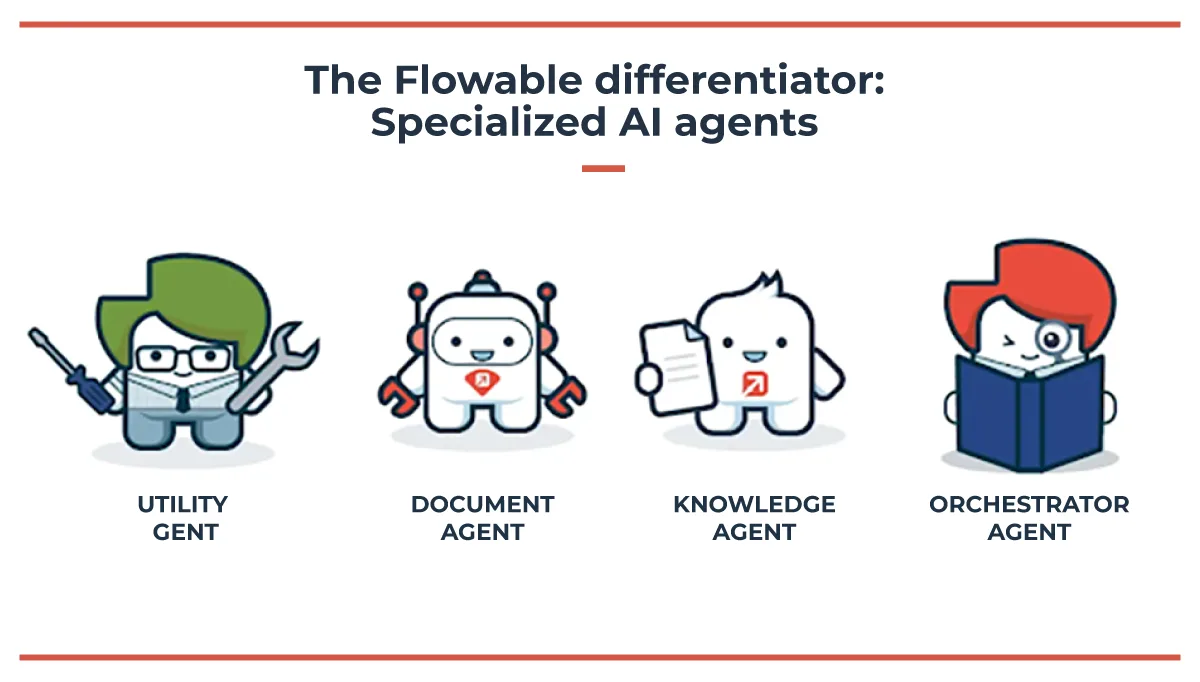

A human-in-the-loop model helps organizations manage this transition. The term refers to workflows where humans actively review, approve, or override agent outputs, especially for high-risk or sensitive tasks. Human oversight ensures quality and provides a safeguard when the agent encounters scenarios beyond its training or confidence levels. It also reinforces that AI agents augment the team's work, rather than replace them.
Selecting the right early use cases for AI agent deployment is equally critical in building trust with staff. Stable and high-volume tasks provide an ideal environment for early agent deployment because they offer repeatability, predictable outcomes, and remove mundane, manual work from humans. As teams gain experience with agent-driven work, organizations can expand their use to more complex activities that require deeper reasoning.
AI agents can improve decision-making, reduce process friction, and support complex operations at scale, but these benefits appear only when an organization provides the right environment.
Unified and consistent data gives AI agents clarity.
Robust integration ensures that they can operate safely inside enterprise systems.
Orchestration provides the structure that defines an agent's role.
Governance protects the business and ensures regulatory compliance.
Human oversight maintains quality and builds trust.
When these foundation elements work together, agentic AI becomes practical, controlled, and incredibly valuable. Organizations that invest in this groundwork today will position themselves to extend agent-driven automation across more processes with confidence and predictability.
Business process management software covers very different tools in 2026. See how the category shifted towards BOAT and what buyers should evaluate.
Client lifecycle management in banking goes beyond onboarding. See how case management keeps client context intact through KYC, reviews and offboarding.
n agentic workflow is more than a multi-agent diagram. See what the standard patterns omit once workflows meet exceptions, oversight, and audit requirements. Primary keyword: agentic workflow