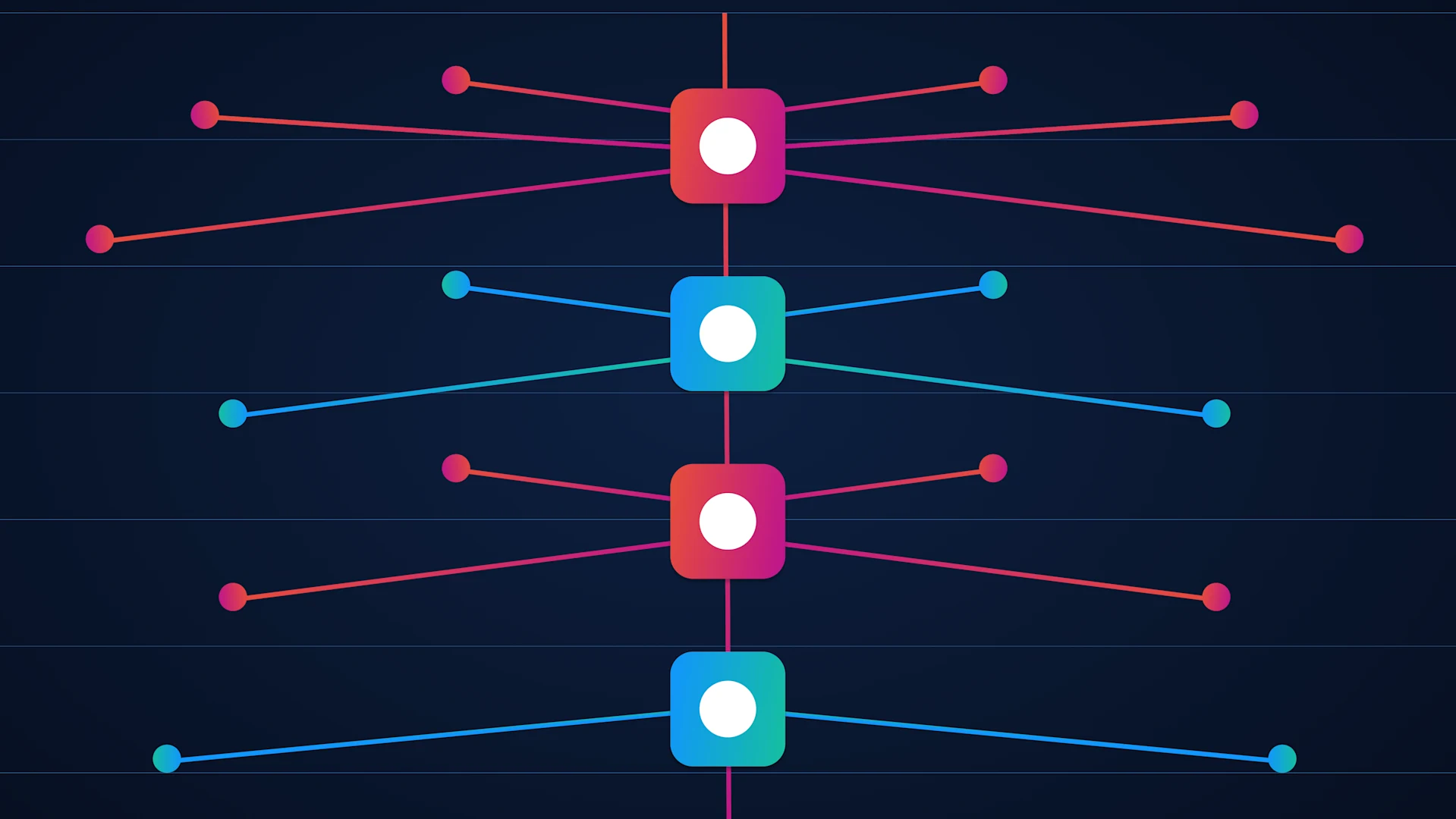
Organizations rarely redesign work around Artificial Intelligence (AI) from the start. More often, a team adds an agent to one part of a process and gets a result that looks useful straight away. Maybe customer documents are summarized faster, case teams receive recommendations, or repetitive tasks are automated. Those early wins matter, but they also hide the challenges that appear when AI output starts to affect live work.
A recommendation may change how a case moves forward. A summary may shape a human decision. A generated response may need approval before it reaches a customer. The output is promising, but how should it work with the rest of the process?
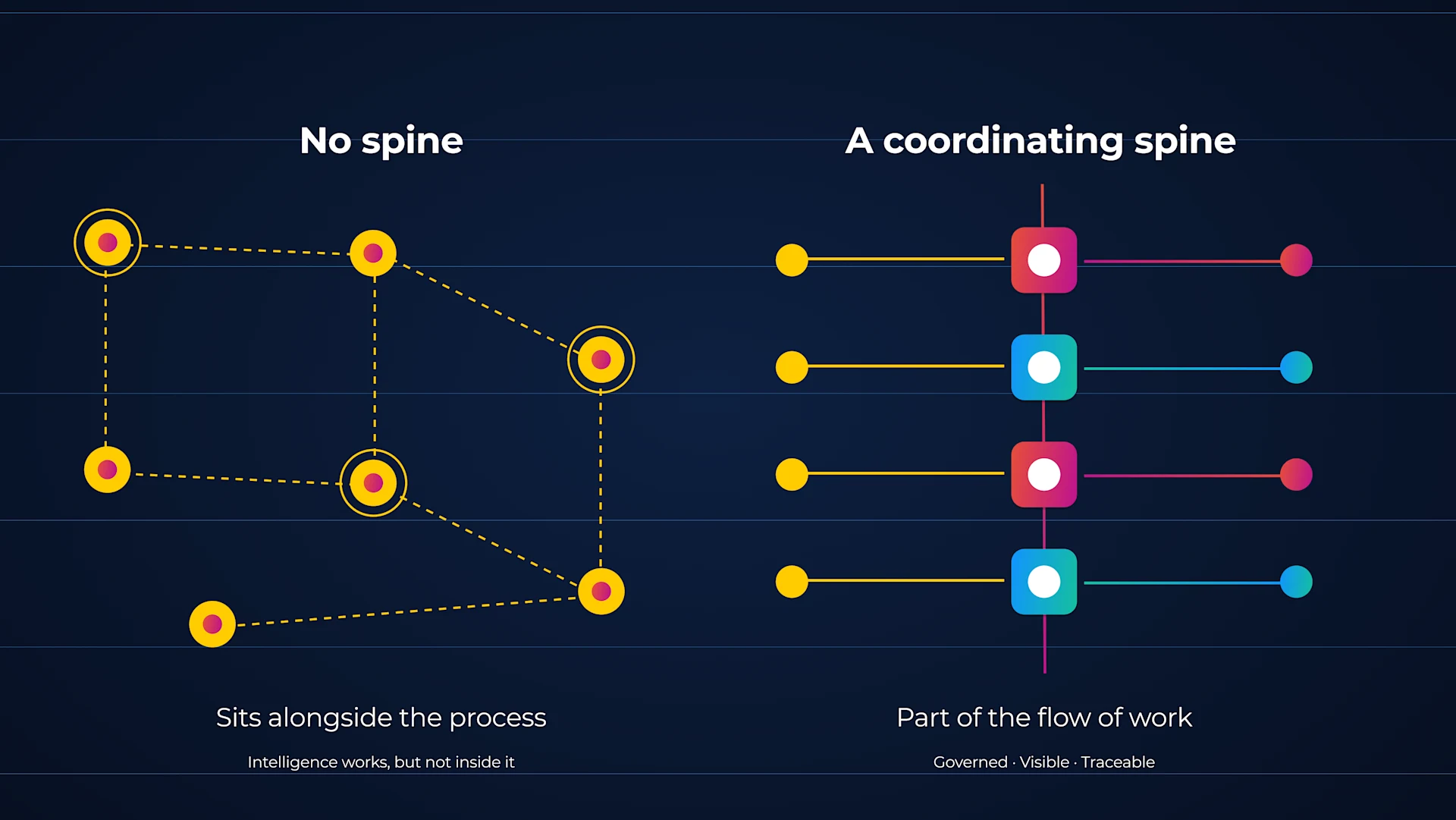
This is where many intelligent process automation efforts lose clarity. The intelligence works, but sits alongside the process, not inside it. The business needs intelligent process automation in a form it can govern, explain, and scale. Most organizations are not getting that today, and the gap becomes more costly as AI adoption grows.

Intelligent process automation is often described as automation made smarter by AI, but that only tells part of the story.
In practice, the value of AI does not come from simply adding intelligence to a task. The value comes from placing intelligence inside work that already has timing, dependencies, approvals, rules, and consequences.
A document summary generated by AI is not intelligent process automation. A recommendation engine on its own is not intelligent process automation. Even an agent that completes a narrow task creates limited operational value unless the wider process defines:
when to invoke it,
what information it should use,
how the result should be handled,
and what should happen next.
Without that structure, AI improves a task but leaves the wider journey fragmented.
This distinction matters because enterprise work typically slows down where systems, people, and decisions meet. For AI to contribute meaningfully in that environment, it has to be part of the flow of work, not waiting at the edge of it.
AI generates results quickly, which is why so many pilot projects look promising. The difficulty is that a useful output is not the same thing as a coordinated outcome.
For example, a model may extract relevant information from a document, but the process still needs to determine:
whether that information is sufficient to proceed,
whether it should trigger a rule,
whether a person needs to review it,
whether downstream systems should act on it.
None of these actions happens automatically because the model produced something plausible. This is the point at which organizations discover that moving from static automation to intelligent process automation requires more than smarter components.
Static automation works by defining a flow and pushing work through it. Intelligent process automation still requires that flow, but it also requires a way to introduce intelligence at the right points without making the overall process opaque or unpredictable.
The moment AI starts to influence decisions, routing, or priorities, the business needs a record of how that happened.
Without orchestration, that record becomes difficult to assemble. Logic ends up distributed across prompts, integrations, custom code, user interpretation, and separate systems that each hold part of the story. Teams can often reconstruct what happened, but only after the fact. That is not a durable operating model as AI use expands.
Orchestration gives intelligent process automation the structure it needs to operate as part of the business rather than as an external helper. The process layer determines when an agent should run, provides the right context before execution, and captures the result afterward. It then connects that output to the next step in a visible way: continuing automatically, requesting human review, escalating an exception, or updating case state.
The business consequence is straightforward.
Instead of leaving each service or team to decide how to interpret an AI result, the organisation models that behaviour. Timing becomes explicit. Decision points become visible. Approval requirements become part of the design rather than something people remember to apply later. The AI becomes a governed participant in the work, not an external input that the process has to absorb.
This matters more as AI adoption grows.
A single agent attached to a single task can often be managed informally for a while. Several agents acting across processes, cases, and systems create a fundamentally different situation. At that point, the business is not operating with isolated AI features. It is operating an environment in which intelligent inputs can change outcomes across several stages of work. That environment needs a coordinating spine.
Some work follows a clear sequence. A customer service request arrives, checks run, responses occur, and a result is delivered through a predictable path. Not all work is like this.
An insurance case, for example, changes shape when new information arrives, a review raises a concern, or an exception forces the organization to reconsider what should happen next. Intelligent process automation must support both conditions, because most enterprises deal with them simultaneously.
This is where established modelling standards become important. Business Process Model and Notation (BPMN) and Case Management Model and Notation (CMMN) give organizations a clear way to define how work should behave, keeping processes visible, governed, and understandable over time.
BPMN is suited to work where sequence and timing matter and the path needs to be modeled clearly, the structured end of the intelligent process automation spectrum. CMMN supports a different kind of work, where progress depends more on judgment, changing information, and the current state of the case than on a fixed, predefined sequence.
Used together, BPMN and CMMN allow AI to participate in both predictable and adaptive work without stripping away the context that makes outcomes explainable. That matters because the real business question is rarely whether an agent can do something useful in isolation. The real question is whether the organization can see how that intelligent contribution affected the wider journey.
Enterprise value from AI comes from understanding how generated output affects outcomes over time. Teams need to see where a process or case currently stands while agents are acting within it. They need to understand when an output triggered a new task, changed a decision, altered case state, or created the need for review. They also need a reliable execution history that shows how intelligent input influenced the overall result.
This is not only a governance concern.
Visibility affects operations and costs directly. When work slows down, changes direction, or produces an unexpected result, teams need to understand whether the issue came from the model, the process design, the surrounding rules, or the handoff into downstream systems. If that relationship is not visible, every adjustment becomes slower and riskier, because teams are changing part of a system they cannot fully see.
Flowable brings workflow, case management, and AI together in a single orchestration environment. The intelligent process automation platform becomes much easier to manage when the business does not have to coordinate those capabilities across separate layers that each hold only part of the logic. Teams can model structured processes, dynamic cases, and decision points in a unified way, then place AI agents directly inside those executable models where their role is visible and controlled.
This approach fundamentally changes the practical role of AI in enterprise automation. Agents are not treated as disconnected add-ons that produce output somewhere outside the flow. They become first-class participants in the modeled work itself. The platform can invoke them at defined points, pass relevant context into the interaction, and connect the result to the next step across people, systems, and decisions. Because those interactions sit inside the orchestration layer, the business retains visibility into state, transitions, and outcomes from end to end.
This is where Flowable acts as more than another intelligence process automation tool. It provides the coordinating spine that allows AI to contribute inside structured work without fragmenting the work around it. As organizations move from isolated AI experiments toward broader operational use, that spine becomes the difference between intelligence that looks impressive in demos and intelligence that can be trusted in production.
To learn more about how Flowable can become the spine for your AI initiatives, why not get hands-on with a free trial.
It means using the orchestration layer to determine when agents run, what context they receive, how their output is handled, and what happens next. The AI contributes inside the flow of work rather than outside it.
BPMN supports AI activity inside structured workflows where timing, sequence, and handoffs matter. CMMN supports AI participation in case-based work where changing information and judgment shape what becomes possible next.
Orchestration does not remove flexibility. It gives AI a defined place to operate, so the business can benefit from intelligent behavior without losing control of approvals, exceptions, and downstream actions.
Yes. Organizations can introduce AI at specific points in an existing process or case, define review and escalation conditions around that interaction, and expand from there as confidence grows. This is how most regulated enterprises approach intelligent process automation in practice: proving value at one point in the process before broadening scope.

Business process management software covers very different tools in 2026. See how the category shifted towards BOAT and what buyers should evaluate.

Client lifecycle management in banking goes beyond onboarding. See how case management keeps client context intact through KYC, reviews and offboarding.
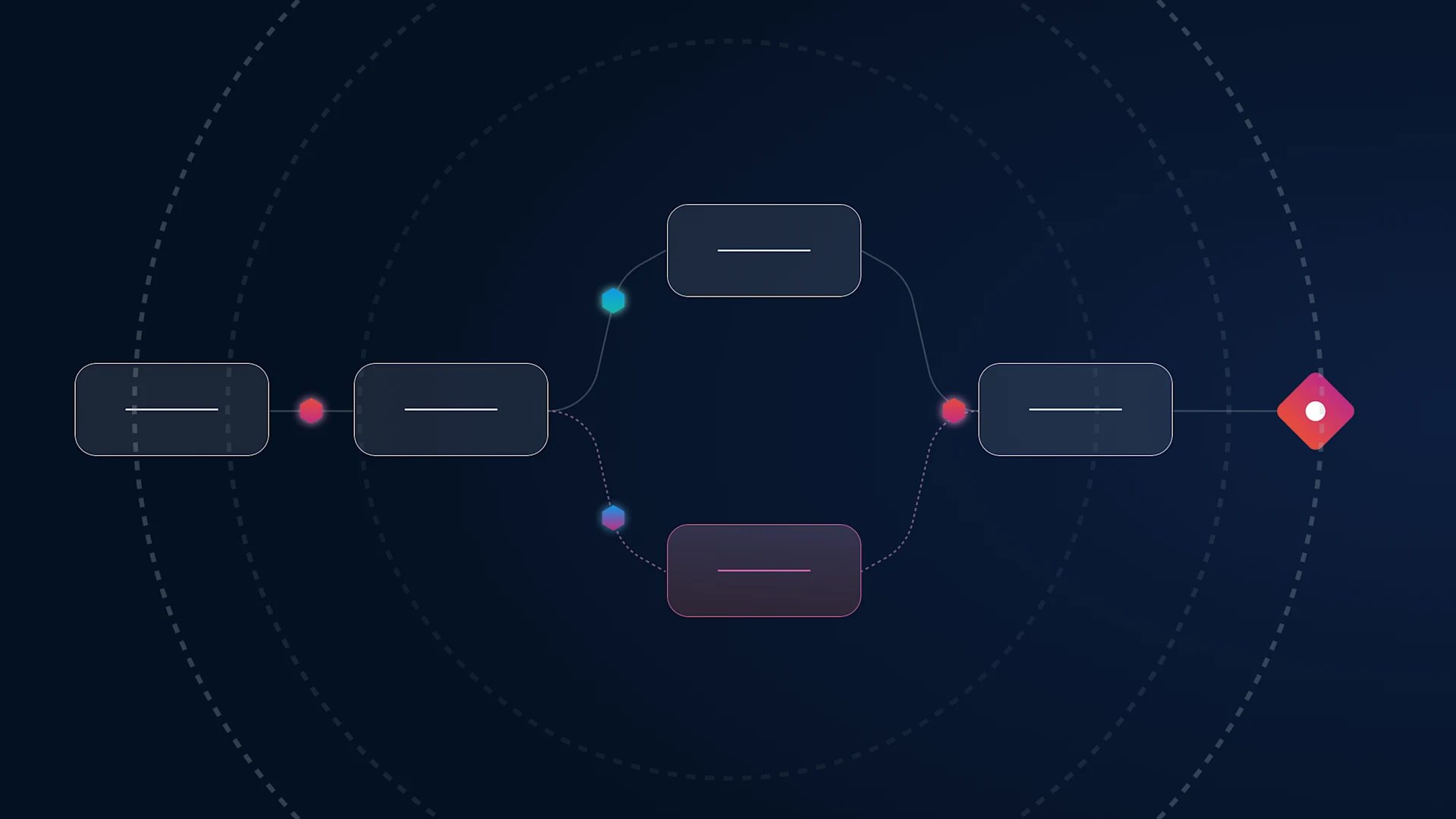
n agentic workflow is more than a multi-agent diagram. See what the standard patterns omit once workflows meet exceptions, oversight, and audit requirements. Primary keyword: agentic workflow