
Client lifecycle management (CLM) automation with AI agents is a superpower for building outstanding customer satisfaction. The relationship between a business and its client is arguably the most critical asset an organization holds. And for many companies, especially in regulated industries like banking or insurance, managing this relationship is a manually intensive challenge. But enterprise automation software makes this challenge highly optimizable.
The shift requires moving past inflexible workflows and demands an intelligent, adaptive approach that sees the client journey as a dynamic set of interconnected and ever-changing business processes.
Today, it’s the difference between surviving and achieving operational excellence in CLM. Flowable addresses this need as the agentic AI-native dynamic process automation and orchestration platform built for regulated enterprise work.
One of the biggest CLM barriers for businesses at scale is that clients’ journeys are unpredictable. A customer’s path, from initial inquiry to long-term loyalty and even eventual offboarding, rarely follows the linear, clean flow that traditional business systems support.
In reality, real-world events introduce complexity. A client’s risk profile might change mid-way through onboarding, new regulatory updates could mandate an immediate re-check of Know your customer (KYC) documentation, or a service request could escalate quickly, requiring simultaneous actions across multiple departments.
When workflows are too rigid, they fail to adapt to these events, leading to stalled processes, client frustration, and compliance risks. This operational drag is often made worse by manual oversight, systems that do not communicate, and data silos that form a pile of inefficiencies, eroding both profits and customer trust.
A shift in operational approach is the best solution: viewing the client lifecycle as a dynamic set of business processes that can be supported by orchestrated processes and adaptive automation for maximum efficiency and value. Orchestration software ensures that every interaction, decision, and compliance check is aligned, creating an adaptive, governed system for client lifecycle management.
Business process automation (BPA) has long been the foundational tool for streamlining high-volume, often for lower-complexity tasks, like initial data collection, standard form processing, and document routing. It delivers greater efficiency by streamlining work and removing repetitive manual steps.

However, advanced client lifecycle management solutions tackle the complex parts of the lifecycle with adaptive automation too: Those processes that require human-like judgment, interpretation, and real-time adaptation. This is where intelligent automation takes center stage, and AI agent collaboration too.
ntelligent automation leverages advanced technologies like agentic AI, AI-enhanced case management, and sophisticated analytics to handle complexity at scale. And that capability is crucial for organizations dealing with high stakes and high volumes, particularly in client lifecycle management that requires governance and accuracy.
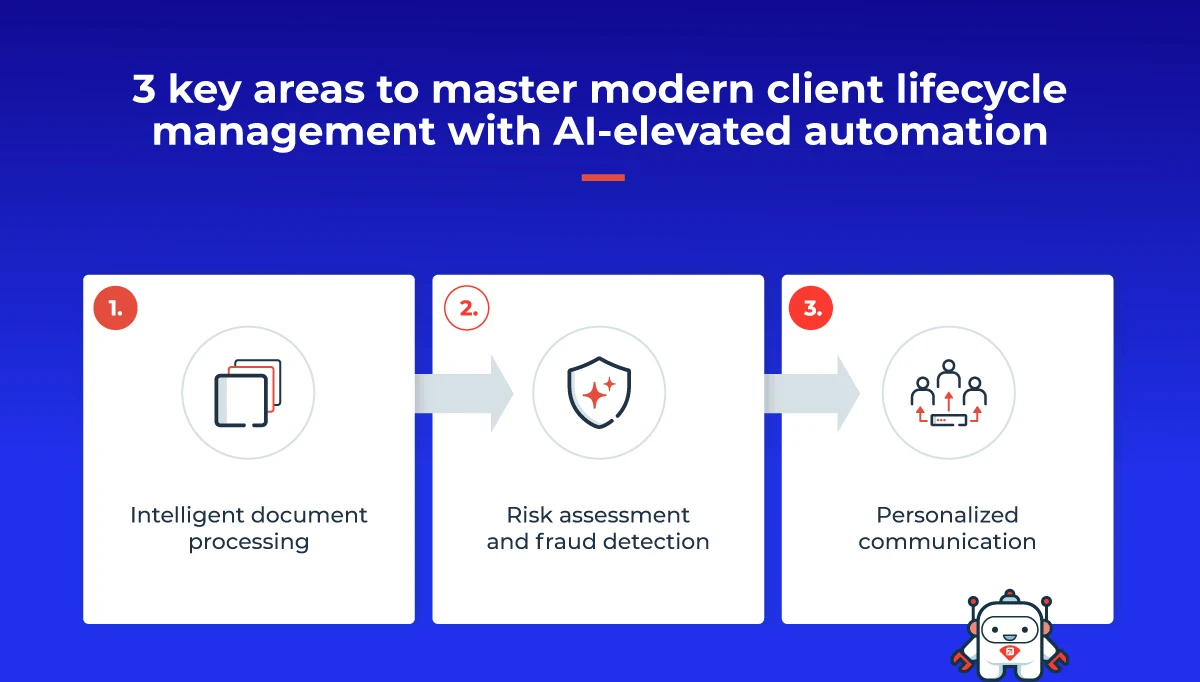
Key areas where AI elevates automation include:
Intelligent document processing (IDP): Enabled by the Flowable Knowledge Agent, it’s essential for dealing with the pile of unstructured client documents (contracts, passports, statements, emails, images), automatically extracting and validating critical data with high accuracy.
Risk assessment and fraud detection: AI agent models analyze client behavior, transaction patterns, and external data sources in real-time, flagging changes in a client's risk profile or potential fraudulent activity.
Personalized communication: Sentiment analysis and contextual data are used to trigger personalized, empathetic communications, ensuring the client receives the right message at the right time, fostering better retention.
The differentiator for advanced client lifecycle management capable systems is that they do not just automate a series of isolated tasks; they orchestrate the entire lifecycle as a unified, adaptable process that efficiently connects humans, systems, and AI agents.
A well-architected, automated client lifecycle management process transforms operational headaches into strategic advantages. By injecting intelligence and automation at every touchpoint, businesses can ensure compliance while delivering an optimal client experience.
First impressions are everything. In a world of instant gratification, a slow, complex onboarding process can be a point of attrition.
Automation reduces friction for the client and guarantees immediate compliance. This involves three critical actions: Digital identity verification using automated tools to confirm client identities; automated document collection and validation where systems prompt for missing documents and perform preliminary checks on submitted files; and executing automated KYC and anti money laundering (AML) checks that screen against global watchlists and data sources in real-time. This ensures that the organization maintains control from day one, which is vital for effective client lifecycle KYC management.
Proactive and personalized service is the cornerstone of client retention. Intelligent automation ensures that when a client reaches out, the process is swift and effective.
This is enabled by smart routing of client queries, analyzing and routing them to the agent best equipped to handle the specific issue. Furthermore, the system provides a 360-degree client view, eliminating the need to search across multiple systems and data silos. Finally, AI agents can be integrated to handle communication and action on routine inquiries and simple transactions automatically, freeing human agents to focus their expertise on complex, high-value issues that require judgment and empathy.
For any organization in a regulated space, the relationship is a marathon, not a sprint. Automated client lifecycle management technology provides continuous, governed monitoring that traditional periodic reviews cannot match, including: Continuous monitoring where systems track external and internal data sources, flagging changes in a client’s risk profile or corporate structure; automated triggers that, based on pre-defined criteria (e.g., a large transaction or a change in beneficial ownership), proactively launch an immediate, targeted compliance check or a human review task; and comprehensive auditability, maintaining a complete, unalterable audit trail of every automated check and human decision, dramatically simplifying regulatory reporting for AML client lifecycle management.
Even the conclusion of a relationship must be handled with efficiency and care to maintain a strong final impression. This includes data archival and destruction where the system ensures all data is handled according to legal requirements and internal policies, alongside contractual closure with automated checks confirming all outstanding obligations are met and necessary legal sign-offs are obtained, guaranteeing a compliant conclusion to the business client lifecycle management.
Mastering the client lifecycle management platform requires a solution that recognizes the unpredictable nature of real-world business. Flowable moves beyond the limitations of rigid, linear workflows by utilizing a dual-standard approach: BPMN (Business Process Model and Notation) is used for highly structured, repeatable tasks where the path is known and defined, which is perfect for initial data capture and compliance checks.
CMMN (Case Management Model and Notation) is used for flexible, unpredictable processes that evolve based on events and judgment, making it ideal for complex risk investigations, escalated service requests, or custom product configuration. This intelligent unification ensures businesses can create solutions that are both highly efficient BPMN and highly adaptable CMMN.
The key accelerator in Flowable’s architecture is the native integration of agentic AI, a capability managed through the Flowable Agentic Case Platform to securely create and orchestrate AI agents, and integrate them into operations. These autonomous software agents are empowered to perform tasks, access systems, and make decisions within the flexible framework of CMMN.
With Flowable, organizations have the sophisticated client lifecycle management software and tools necessary to transform complex client journeys into an efficient, compliant, and client-centric business process
For example, an AI agent can be tasked with:
Auto-enriching a client profile by securely searching public databases for relevant corporate information, ensuring up-to-date and complete data for client onboarding and lifecycle management tools.
Suggesting the next-best action for a human agent handling an escalated case, based on real-time analysis of the client’s history and the current regulatory context.
Proactively triggering a new compliance check based on an external event, such as a major sanction update, without requiring human initiation.
By orchestrating people, legacy systems, and intelligent AI agents on a unified platform, Flowable provides the essential human-in-the-loop approach for critical decisions. This unified approach delivers complete transparency and auditability over every automated process and AI-driven action, providing the essential governance and guardrails for autonomous AI.
Mastering the client lifecycle is a strategic imperative that requires intelligent automation and adaptive orchestration. With Flowable, organizations have the sophisticated client lifecycle management software and tools necessary to transform complex client journeys into an efficient, compliant, and client-centric business process.

Business process management software covers very different tools in 2026. See how the category shifted towards BOAT and what buyers should evaluate.

Client lifecycle management in banking goes beyond onboarding. See how case management keeps client context intact through KYC, reviews and offboarding.
n agentic workflow is more than a multi-agent diagram. See what the standard patterns omit once workflows meet exceptions, oversight, and audit requirements. Primary keyword: agentic workflow