
Intelligent automation ushered in a reshaping of how businesses operate and embrace digital transformation that is still evolving to this day. At its core is a fundamental evolution from rule-based, traditional automation. By blending technologies like robotic process automation with the power of artificial intelligence and machine learning — today often decisioned and orchestrated by AI agents that bring entire proactive workflows to the table — intelligent automation creates a system that can learn, adapt, and make informed decisions. It moves automation away from simple automated task completion to end-to-end workflow optimization that leverages dynamic, adaptive, proactive workflow automation.
The key result of intelligent automation is creating a more efficient, responsive, and resilient organization.
In an era defined by growing volumes of unstructured data and intense competition, businesses are under pressure to do more with less. Intelligent automation tools address this challenge by freeing people from time-consuming information heavy tasks, enabling your workforce to focus on creative and expertise-led, high-value task aspects to drive growth from where it matters most.
Intelligent automation is a powerful fusion of distinct technologies, each playing a critical role in a broader, cohesive system. Understanding these components is key to grasping its full scope.
Robotic process automation (RPA): RPA serves as the "hands" of intelligent automation, handling the day-to-day, rule-based tasks that can be a drain on people’s time. Bots are configured to mimic people’s actions by interacting with digital systems, whether it's entering data into a spreadsheet, navigating a legacy application, or generating a report. In an intelligent automation system, RPA provides an action layer, executing tasks in workflows as directed by more intelligent components. RPA bots are precise and tireless, providing a reliable backbone within more cognitive processes.
Artificial intelligence (AI) and machine learning (ML) with AI agents: While tools such as RPA handle the "how," AI and ML provide the "what" and "why." They enable systems to learn from data, to identify patterns and make data-driven decisions. Instead of following a predefined script, AI-powered systems, often with the added autonomy of AI agents can analyze vast datasets to uncover insights for knowledge workers in real time, while leveraging ML models to allow the system to continuously improve its performance over time. This includes capabilities like using predictive analytics to forecast customer demand, or running sentiment analysis on customer feedback to gauge satisfaction. These sophisticated functions are what transform simple automation into an intelligent, adaptive process.
Natural language processing (NLP) with AI agents: To automate processes that involve communication, intelligent automation tools like AI agents rely on NLP, a technology that allows them to analyze, understand, and generate unstructured text and spoken language. A common use case is processing incoming customer communication. The system can read an email or other unstructured text, understand the customer's intent (for example, a refund request, a technical support query), extract key details like an order number, and route it to the correct department or even generate a personalized response without human intervention. This capability is vital for streamlining customer service and data communications at scale.
Intelligent document processing (IDP): Much of the data businesses work with is trapped inside documents like invoices, contracts, and forms. IDP uses a combination of AI and optical character recognition (OCR) to extract, classify, and process this data. This enables systems to recognize text and understand its context and structure, allowing it to accurately capture details from different document formats. This capability eliminates the need for manual data entry from physical or digital documents, significantly accelerating workflows in finance, legal, and other information process heavy departments.
Business process management (BPM): BPM provides the overarching framework for managing and optimizing entire workflows, providing a holistic view of processes and ensuring that all components — tools and software, AI models, and employees — work together cohesively. BPM helps identify where automation can be most effective and provides the governance and visibility needed to manage it. Intelligent process automation connects disparate technologies within cohesive, and highly manageable workflows.
Beyond efficiency gains, the automation of repetitive tasks frees up people to focus on more strategic, high-value work that requires both creativity and critical thinking. And intelligent automation software brings business automation from single point execution and applies it end-to-end within spanning business processes.
By providing faster, more accurate service through tools like AI-powered and automated inquiry responses, intelligent automation means an enhanced customer experience, while also offering scalability and agility
Intelligent automation also leads to cost reduction. Automating processes with intelligent input reduces operational workloads and minimizes the impact of human error in compliance heavy work at scale. A consistent, data-driven system makes fewer mistakes, increasing work confidence and lessening time spent on rework and corrections.
By providing more accurate service through tools like AI agent-powered customer communication and automated inquiry responses, intelligent automation means an enhanced customer experience, while also offering scalability and agility through ongoing workflow support. As business needs evolve, underlying workflows can be quickly adapted, ensuring organizations more agility and responsiveness to market changes. A key competitive advantage in today's fast-paced environment.
While many platforms may feature intelligent automation, Flowable takes it into the future by transforming it into a first-class citizen within the workplace with agentic automation. This approach positions AI agents as peers to traditional automation engines, enabling the orchestration and management of complex, multi-agent workflows and tools — a key differentiator in the market of intelligent process automation tools today.
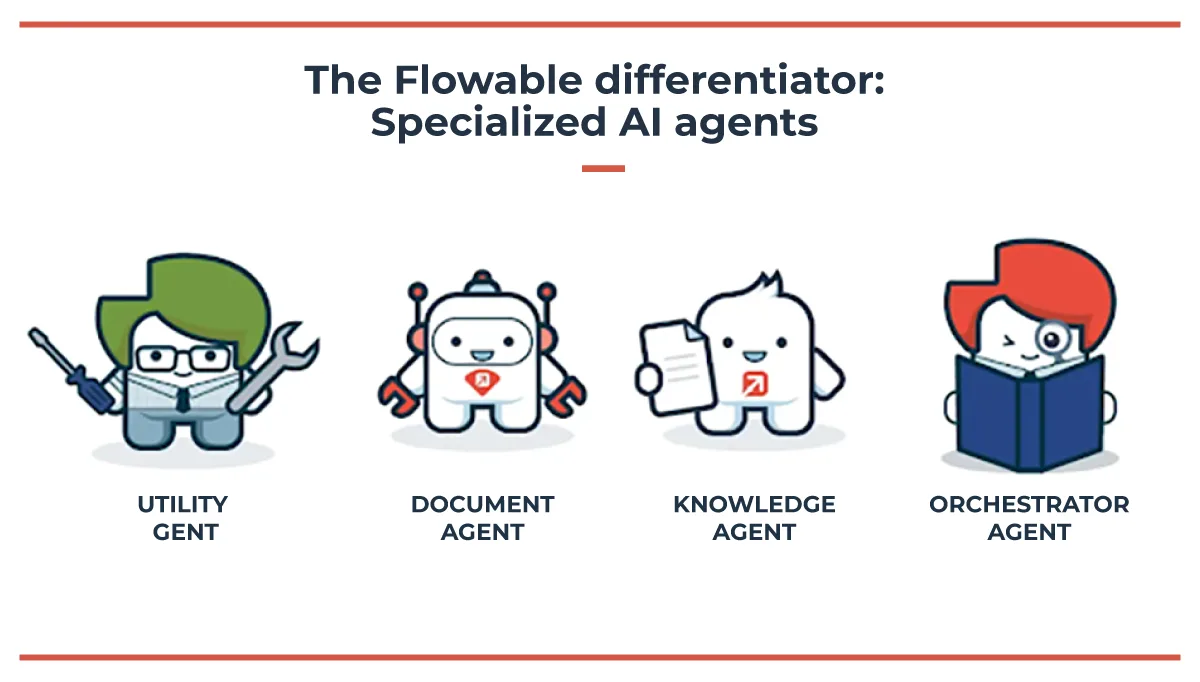

Flowable offers a unified, low-code platform that brings together people, AI agents, and business processes, enabling the orchestration of complex workflows with the highest level of transparency and governance. While integrating your AI provider of choice, and external AI agent integration and governance, Flowable also allows you to choreograph and manage a network of its own specialized AI agent types, each designed for a particular task:
Utility agent: Automates tasks like data enrichment and sentiment analysis.
Document agent: Extracts and processes data from unstructured documents.
Knowledge agent: Provides contextual answers from internal knowledge bases.
Orchestrator agent: Coordinates and manages other agents and tasks based on rules or dynamic inputs.
Because it's built on open automation standards engines including BPMN, CMMN, and DMN, Flowable provides smooth integration with any existing systems, and helps organizations avoid vendor lock-in with their business automation journey.
The platform's focus on transparency and governance is key for process-intensive, compliance-driven enterprises looking to maintain oversight and create auditable, transparent records of their AI-enhanced operations. It’s precisely this robust governance framework and integration ability that separates Flowable as an enterprise-grade platform from simple artificial intelligence automation tools.
Intelligent automation boils down to augmenting your team’s capabilities. By handling the repetitive, high-volume tasks that can be so time consuming, and connecting optimization across departments and teams, intelligent automation allows more focus on innovation, creativity, and the complex problem-solving that only people can do.
Today, the transformative power of intelligent automation lies in its ability to coordinate a unified workforce of people and AI agents together with the full scope of automation technology within existing software and processes. Ingrained end-to-end orchestration and governance are paving the way for a future where technology and people work in tandem to drive efficiency, innovation, and digital transformation.
Business process management software covers very different tools in 2026. See how the category shifted towards BOAT and what buyers should evaluate.
Client lifecycle management in banking goes beyond onboarding. See how case management keeps client context intact through KYC, reviews and offboarding.
n agentic workflow is more than a multi-agent diagram. See what the standard patterns omit once workflows meet exceptions, oversight, and audit requirements. Primary keyword: agentic workflow