
Time to market of enterprise automation workflows — and keeping those workflows aligned as the business evolves — remain key pain points for business analysts, process modelers, and process owners.
Demanding process modeling is often where automation initiatives slow down. What continues to consume time is the work required to move from discussion to structure, and from structure to a model or update ready to run in a live environment.
The newest version of Flowable continues to solve this challenge not by positioning AI as a replacement for modeling standards or practitioner expertise, but by embedding AI support directly into the modeling environment, accelerating deployment while preserving structure, governance, and accountability.
Process modeling is often considered a mechanical task, but in practice, it is largely cognitive work that requires significant interpretation and judgment. Modelers listen to business stakeholders, interpret intent, identify decisions and exceptions, and express that understanding in structured models for reliable execution.
This translation effort occurs repeatedly, starting during initial discovery, continuing through validation, and resurfacing whenever processes change. Even relatively minor adjustments can require disproportionate effort when models need manual editing and revalidation step by step, particularly in environments where change is frequent.
AI-assisted modeling capabilities represent a shift in how practitioners interact with models rather than a change to the models themselves.
By introducing conversational interaction directly into the design environment, Flowable allows modelers to describe what they want to create or modify in natural language, instead of relying solely on drag-and-drop actions. Instructions can be precise, such as requesting a specific task or gateway, or more declarative, such as describing a review-and-approval pattern that reflects how work typically unfolds.
The AI assistant interprets these instructions and proposes changes to the model, with the resulting artifacts created as standard BPMN processes, case models, decisions, forms, or data structures in precisely the same way as manually designed flows.
This approach preserves modeling discipline while reducing the mechanical effort required to shape a model, ensuring that responsibility for structure, correctness, and intent remains firmly with the modeler.
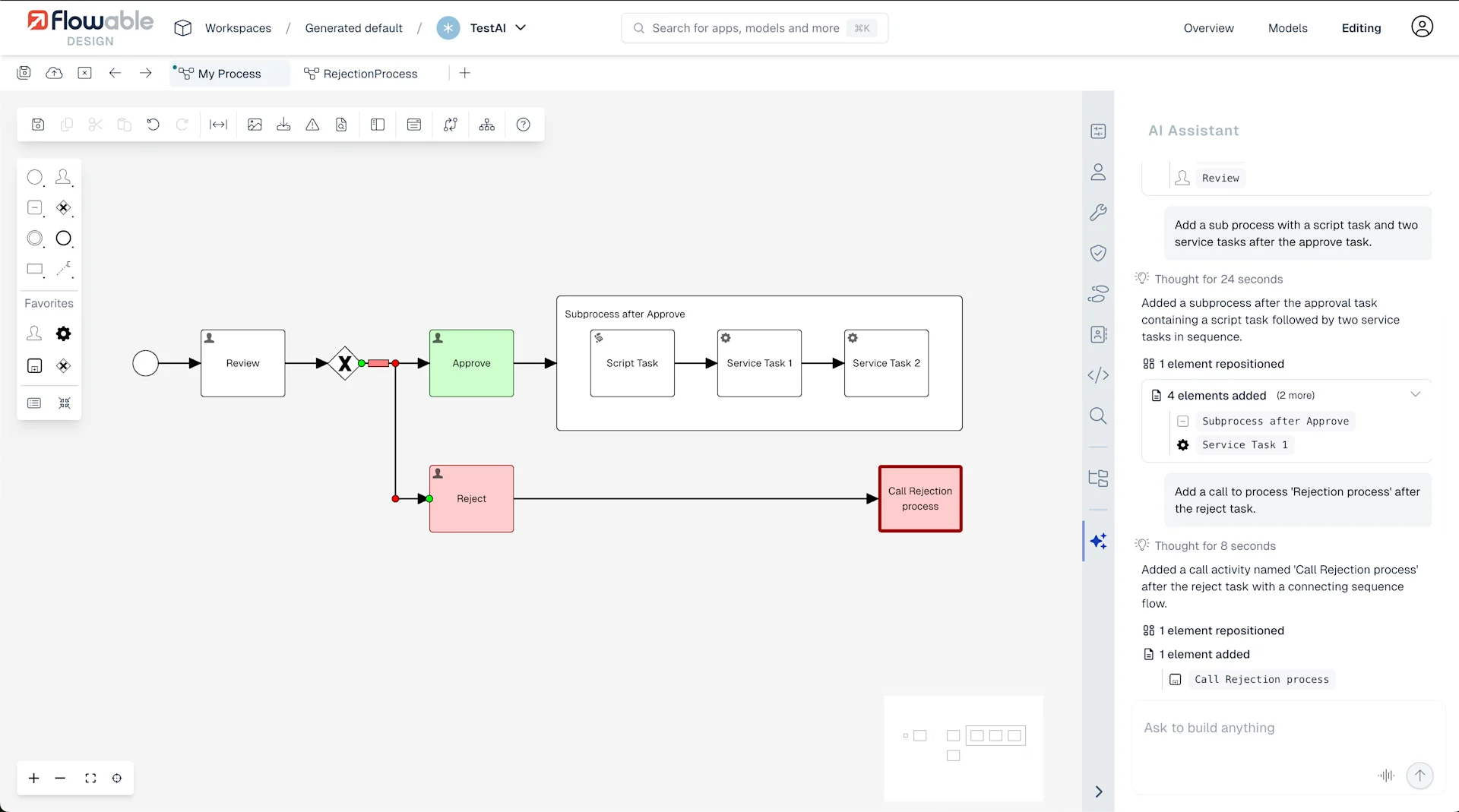

Model Chat supports both direct instructions and goal-driven prompts, allowing modelers to describe what they want to achieve while letting the platform propose structured changes to the model.
Relevant features: Model Chat
The earliest phase can also be where momentum stalls, even when workshops and discovery sessions generate clarity, the effort to move from discussion to a concrete model can slow progress and weaken alignment if it takes too long.
AI-supported modeling within the Flowable Design environment allows conversion of high-level descriptions into an initial model structure that provides a practical starting point for automation work. From a short description of a process or case, Flowable generates the main flow, relevant tasks, supporting forms for human interaction, and the data elements required to execute the workflow.
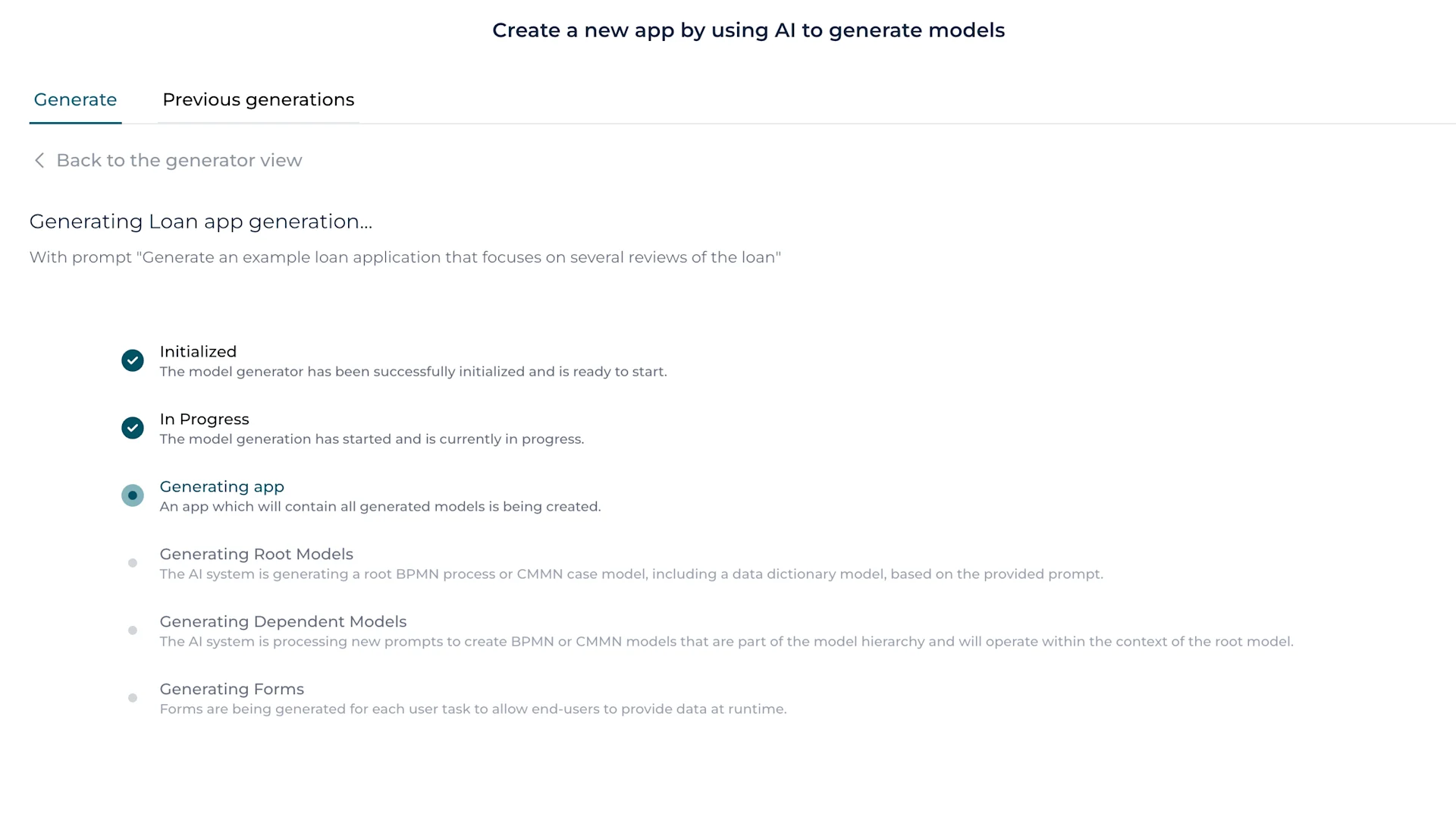
A key advantage is producing a tangible model quickly, while the context is still fresh. This means stakeholders can review and refine an actual model rather than abstract notes, supporting collaboration and avoiding starting from a blank canvas.
Generated models remain fully editable and governed, following the same lifecycle as any other Flowable design.
Flowable can generate complete models and application scaffolding from high-level descriptions, including root processes or cases, supporting forms, and data structures, all created as governed, executable artifacts.
Relevant features: Generative App Creation Generative Model Creation
Automation work rarely ends at deployment, and in many organizations, the most significant effort occurs after a process goes live, when exceptions become more common, and business rules continue to change.
AI-driven modeling with Flowable supports ongoing refinement by making it easier to adapt existing models without extensive manual rework, allowing modelers to adjust flows, update decision logic, and refine scripts through assisted interaction while keeping the overall structure intact.
AI assistance is applied selectively and transparently, with scripts used in processes and cases generated or refined through natural language prompts while still relying on built-in controls to ensure portability and consistency. All suggested changes require explicit review and acceptance by the modeler, reinforcing human accountability at every step.
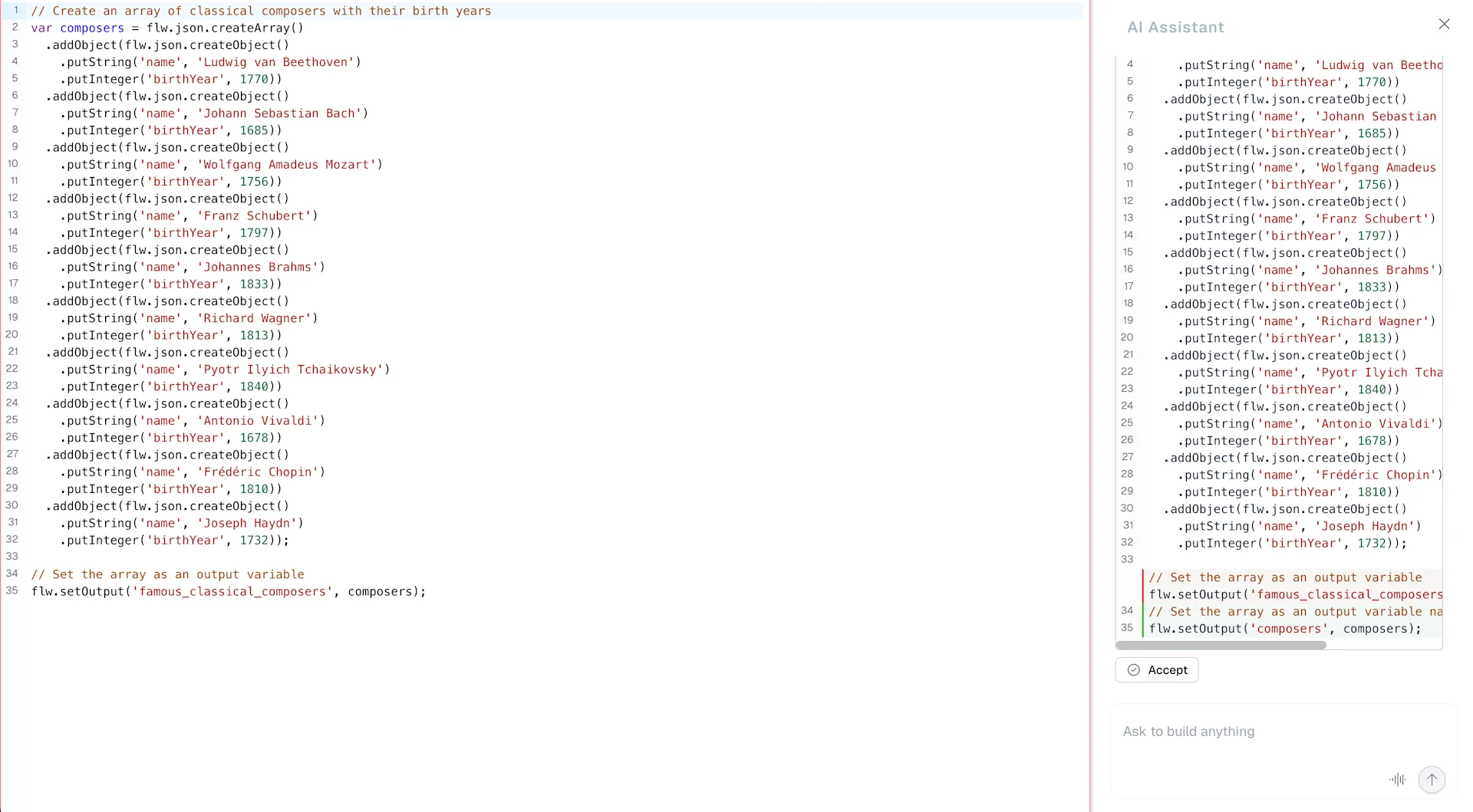
Modeling remains a continuous activity that evolves alongside the business, rather than a one-time design step completed before execution.
AI-powered assistance to refine existing models, including generating or updating scripts within processes and cases, while keeping all changes under explicit human control.
Relevant features: AI-Powered Scripting for BPMN and CMMN Human-in-the-loop acceptance of AI suggestions
Speed only creates value when it is balanced with control, accountability, and transparency across the full lifecycle of an automated workflow.
Flowable’s existing governance framework incorporates AI-enabled modeling support to ensure all design-time changes remain explicit, versioned, and subject to the same validation rules as any other model.
That same governance approach extends beyond modeling into runtime interaction and operational insight. AI capabilities are orchestrated components that operate within the boundaries defined by the process or case model.
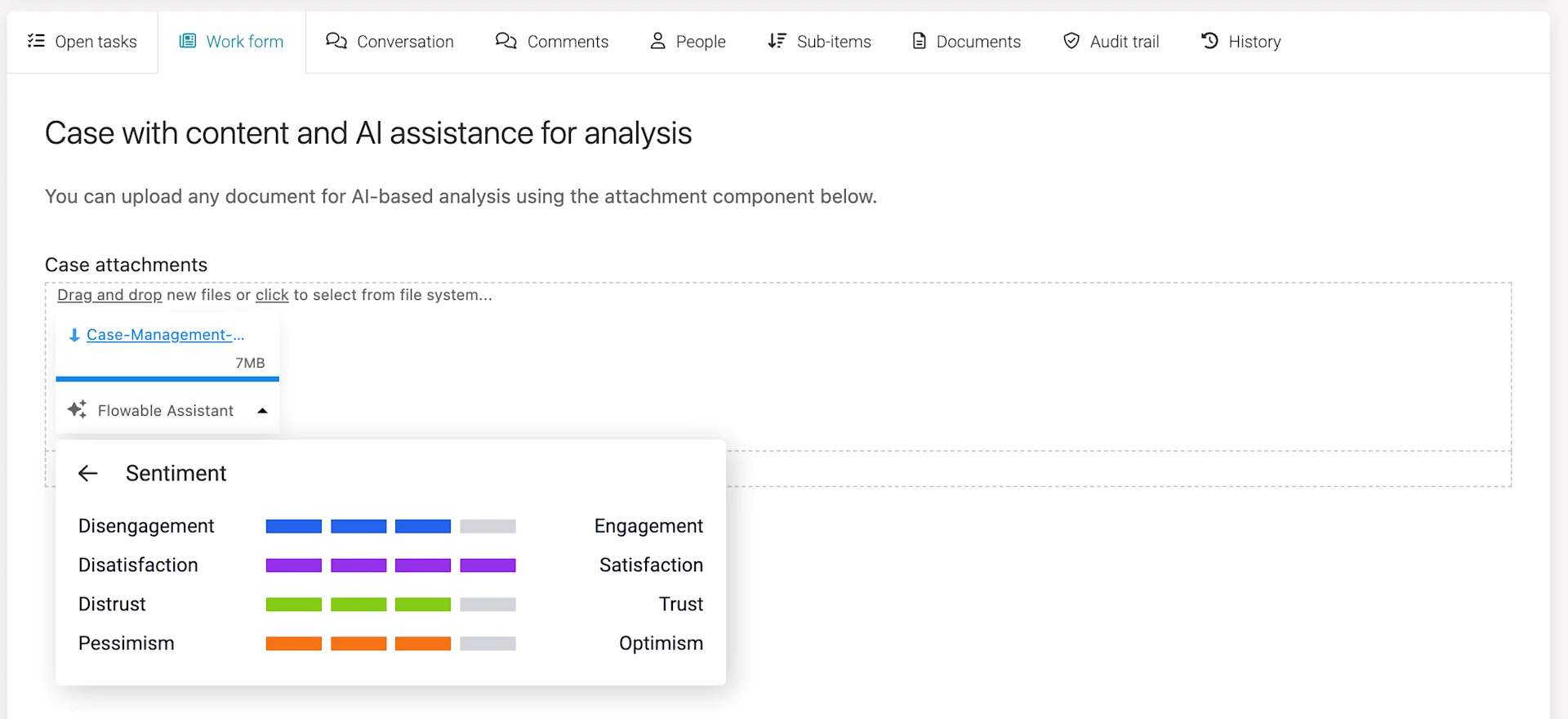
Documents attached to forms often contain critical information that influences decisions, yet traditionally remain locked behind manual review. Flowable allows users to interact with document content directly within the context of a process or case, supporting tasks such as asking questions about a document, generating summaries, translating content, or assessing sentiment.
Instead of manually assembling reports and dashboards, modelers can describe the operational view they want to create using natural language, allowing the platform to generate an initial dashboard layout that includes charts, labels, and visual structure.
Across design, execution, and reporting, AI interactions are treated as first-class citizens within Flowable, ensuring that AI contributes to automation in a way that remains understandable, auditable, and aligned with enterprise expectations.
AI capabilities operate across modeling, runtime interaction, and reporting, ensuring consistent governance and transparency throughout the automation lifecycle.
Relevant features: AI-Powered Content Analysis Document Translation Sentiment Analysis
The addition of AI-driven modeling within Flowable is not a new category of automation, but an evolution of how organizations apply established modeling practices in environments where speed, adaptability, and governance must coexist.
By embedding AI assistance directly into your automation modeling environment, Flowable reduces the distance between business intent and executable design, allowing analysts and modelers to spend less time on mechanical tasks and more time on structure, logic, and alignment with business goals.
At an enterprise level, businesses continue the shift to platforms that enable consistent governance which is built into reliable execution engines for integrating automation and intelligence into core systems securely.
And business automation with Flowable means modeling can once again serve as a bridge between conversation and execution without becoming a bottleneck between the two.
Business process management software covers very different tools in 2026. See how the category shifted towards BOAT and what buyers should evaluate.
Client lifecycle management in banking goes beyond onboarding. See how case management keeps client context intact through KYC, reviews and offboarding.
n agentic workflow is more than a multi-agent diagram. See what the standard patterns omit once workflows meet exceptions, oversight, and audit requirements. Primary keyword: agentic workflow