
Organizations introduce microservices accelerate change and improve agility. By breaking large systems into smaller, independently owned services, teams can release changes without waiting on centralized coordination or shared deployment cycles.
Naturally, work spans multiple services, and coordination among them becomes unavoidable. Most teams deal with this implicitly. Each service responds to events around it, adjusting its behavior based on signals from other parts of the system. The overall flow emerges organically, like people on a dance floor or a crowd in a concert, where flow forms through local reactions rather than through a shared plan.
For simple interactions, this organic flow is usually sufficient. But when work must follow a specific sequence, achieve a particular outcome, or adhere to defined business rules, someone must set the tempo and guide the flow. This moment is when organizations move from the choreography of services to the orchestration of work and processes.
In a choreographed architecture, each service decides how to respond to changes elsewhere in the system rather than following a centrally defined sequence.
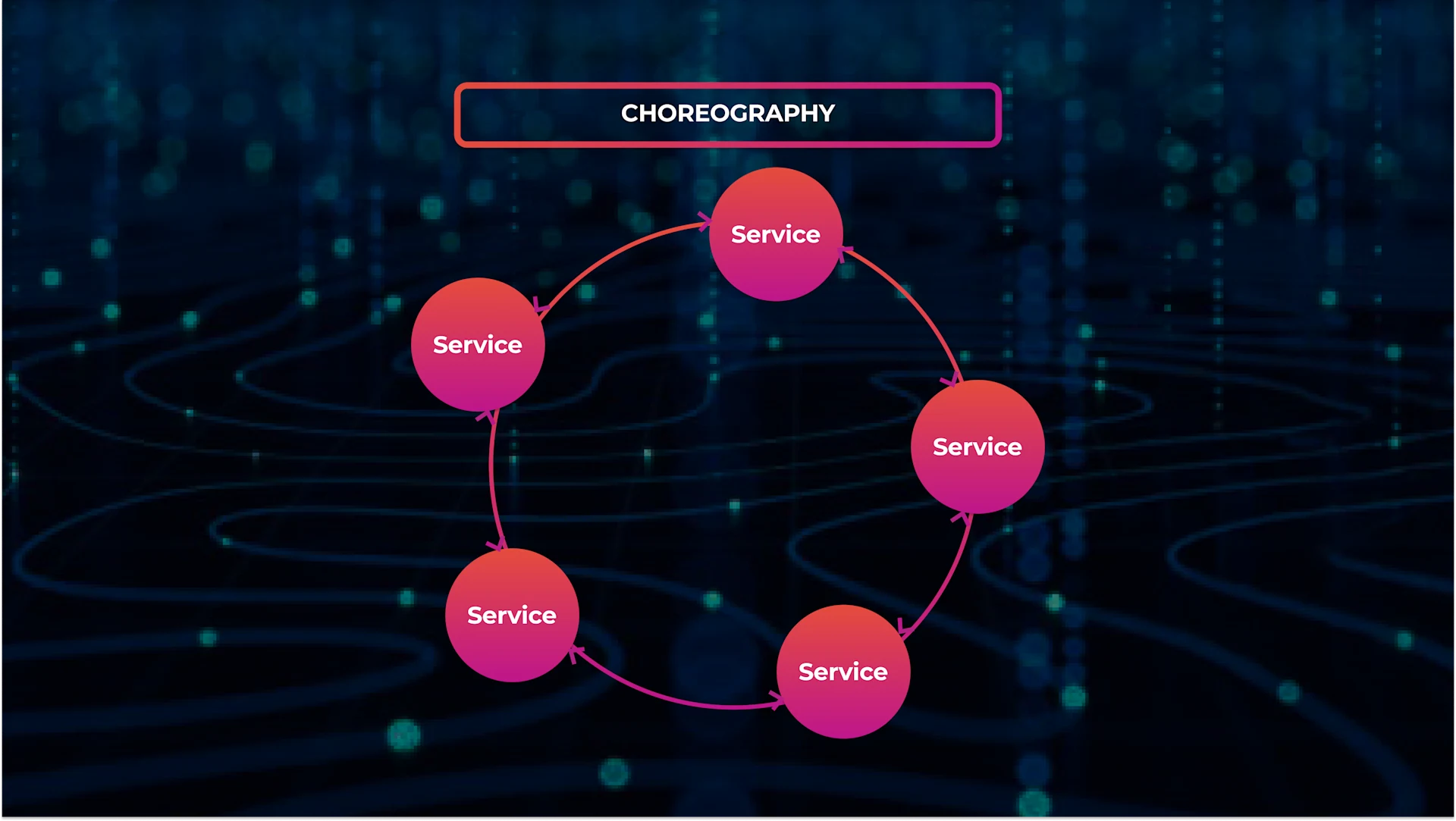

On a small scale, this approach offers flexibility because teams can move quickly and changes tend to remain local. No shared flow needs to be updated or agreed upon before progress continues. However, as more services are added, interactions become increasingly unpredictable.
A single business action may trigger several downstream services, each producing further events that drive behavior elsewhere. efore long, critical business journeys span codebases, configurations, and messaging systems. Understanding this behavior often requires retrospective analysis—tracing tools, log reviews, or conversations with experienced team members.
At this stage, several challenges arise:
Developers need more context just to understand workflows.
Operations teams struggle to explain failures that cross service boundaries.
New team members take longer to become productive, because there is no shared representation of how work flows through the system.
When complexity reaches this point, relying solely on choreography is no longer sufficient. Orchestration provides visibility, control, and predictable outcomes across the enterprise.
Once work gets more complex and needs to move in a deliberate way, relying on services simply reacting to one another stops working. At this point, someone has to set direction, establish sequence, and keep the overall movement aligned to an outcome. Enter the conductor.
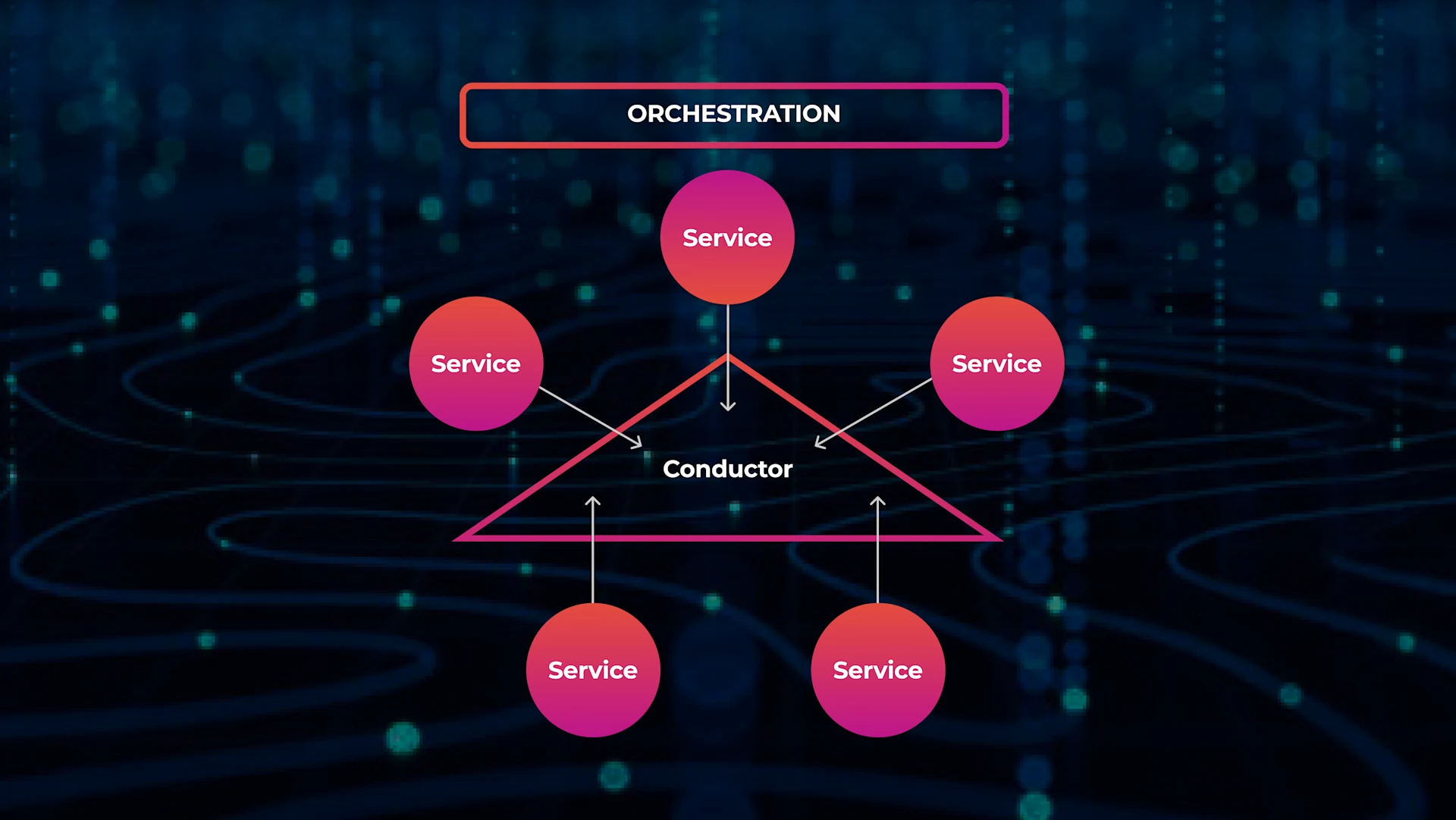
In practical terms, process orchestration assumes the role of conductor, defining coordination explicitly rather than letting it emerge indirectly from chains of events. Work is set out deliberately, giving teams a clear view of how activity should progress without changing how services are built, owned, or deployed. Much like in an orchestra, a conductor does not play each instrument.
Instead, they focus on timing, sequence, and state, ensuring that individual contributions come together into a coherent output. Each service continues to act independently, but its actions now occur within a broader structure that gives direction to the overall journey, even if the service itself isunaware of that wider context. This separation works because logic, flow, and execution occupy different layers.
Service logic stays close to the capability it implements.
Process logic moves into a shared model that describes how work should unfold over time.
Execution occurs at the microservice level.
Keeping these layers separate lets teams control what happens, in what order, and under what conditions without digging through code or relying on memory. Orchestration explains why they played at that moment, providing the context teams need to understand intent rather than just activity.
Developers spend less time working out how behaviour emerged. Operations teams gain clearer insight into where work slows or stops. Architects can evolve systems with greater confidence because dependencies no longer hide in the spaces between services.
In practice, orchestration allows microservices to keep their independence while providing a conductor to set the tempo and guide the work toward outcomes that matter.
Flowable applies orchestration at the process layer, enabling cross-service flows without interfering with the autonomy of individual microservices. The use of Business Process Model and Notation (BPMN) provides a shared, executable representation of workflows that are understandable and clear to both technical and business stakeholders.
This framework shares sequence, decisions, and state in terms that reflect exactly how work is understood and executed. Existing microservices continue to expose APIs and publish events as usual.
Flowable can invoke those services or react to those events as part of a clearly defined process, ensuring distributed execution and still enabling explicit and observable coordination.
With orchestration operating above individual services, teams can evolve and deploy their services more easily. The overall process model defines how those services contribute to the broader journey, introducing structure in a clearly visible environment, without overt binding or central control.
Overall process visibility improves quickly as long-running processes can be monitored end to end, any exceptions appear in a clear context, and changes become safer and easier to roll out because their impact on the wider flow is visible beforehand.
Governance also becomes easier to manage in practice with audit trails reflecting actual business behavior and the application of policies at the process level, removing duplication of effort across multiple services.
In practice choreography and orchestration coexist naturally. Simple interactions remain event-driven while complex journeys gain structure and control from orchestration.
Process orchestration becomes relevant when teams struggle to explain end-to-end behavior, even though individual services appear healthy. At this point, execution is not the problem; coordination is.
Slower debugging, fragile changes, and increasing reliance on tribal knowledge indicate that work is moving without a clear, guiding structure. At this point, organizations need an orchestration layer to act as a conductor, setting direction across services rather than allowing flow to emerge implicitly.
Long-running business processes that span teams or systems benefit most from orchestration. These processes require activities to occur in a controlled environment and to converge on consistent outcomes, which is difficult to achieve without a coordinating mechanism. Examples commonly include onboarding, fulfillment, compliance, and case-based work.
Introducing orchestration at the process layer allows teams to define how work should progress without changing how services are implemented or owned. Existing APIs and events can be reused, enabling orchestration to act as a conductor that guides coordination without taking over execution. Orchestration can be introduced alongside existing interaction patterns, rather than forcing immediate service redesign.
Preparation focuses on clarity before control. Teams should identify processes needing guidance, assign clear ownership, and align on shared modeling standards. This ensures orchestration can direct work across services deliberately, rather than imposing order retroactively.

Business process management software covers very different tools in 2026. See how the category shifted towards BOAT and what buyers should evaluate.

Client lifecycle management in banking goes beyond onboarding. See how case management keeps client context intact through KYC, reviews and offboarding.
n agentic workflow is more than a multi-agent diagram. See what the standard patterns omit once workflows meet exceptions, oversight, and audit requirements. Primary keyword: agentic workflow