

Customer and employee engagements are critical business functions that require long-term precision and efficiency through the treating interactions within context. This is case management, and is key to operational efficiency and long-term success. Companies handle hundreds to thousands of high value, and high cost, customer and employee interactions which require directing to the appropriate processes and decisions.
Case management systems help organizations maintain contextual interactions with clients, enabling them to maximize the value of each interaction, minimize rework, and more rapidly obtain the correct outcome. Business units can also prioritize and resolve more business-critical cases swiftly while managing staffing and improving customer and employee experiences. By optimizing case handling, companies can reduce workload strain, maintain accuracy, and enhance service quality, ultimately empowering their teams to deliver optimal business performance in their high-stakes, fast-paced competitive environment.
Case management is a modern, strategic approach to managing and coordinating complex processes in ever-changing business environments. As many organizations face semi-structured or unstructured, complex workflows, involving humans and automated tasks, case management provide the framework for end-to-end automation while still putting humans in the loop.
By combining automation, orchestration, and human decision-making, case management provides the flexibility to adapt to unpredictable tasks and decisions. It helps businesses manage diverse workflows efficiently, especially when processes are not linear or fully defined.
According to Gartner, case management solutions are "applications designed to support complex processes that require a mix of human tasks and electronic workflows, such as loan applications, claims, or complaints. These solutions facilitate collaboration, workflow management, document storage, and decision-making, often with industry-specific templates to streamline implementation."


Flowable can provide end-to-end automation, using Case Management to handle complex scenarios and leveraging BPM for repetitive parts of the overall solution. By offering all the open standards – BPMN, CMMN, and DMN – within a single flexible application, Flowable helps businesses create solutions that deliver operational excellence and outstanding customer experiences, no matter the automation needs.
Flowable supports both CMMN (Case Management Model and Notation) and BPMN (Business Process Model and Notation), providing powerful tools for creating and managing complex case processes that adapt to real-world business needs.
Designed for more than simple service orchestration, Flowable’s engine is proven to handle complex case management and critical business processes effectively, supporting companies with high demands for reliability and performance.
Flowable’s case management solution is designed to keep humans in the loop, integrating seamlessly with workflows that require human judgment and decision-making. This approach ensures that complex cases involving multiple human touchpoints are managed efficiently, combining automation with critical human oversight for optimal outcomes.
Flowable’s case management capabilities offer a flexible and comprehensive approach for businesses that need end-to-end visibility and control over complex processes. CMMN combined with BPMN translates into an organized, auditable process that can adapt to unexpected changes, making Flowable an ideal solution for managing intricate, multi-stage business scenarios with confidence.
As an open-source solution, Flowable offers the flexibility of community-driven enhancements, with scalable and adaptable pricing options to suit various business needs and growth.
Flowable adheres to open standards, ensuring compatibility and integration with other systems, enhancing interoperability and long-term viability for enterprise use.
While both case management and CMMN (Case Management Model and Notation) address the management of complex, dynamic workflows, they serve different purposes:
Case management is a broad term for managing complex tasks across various industries like healthcare, legal, and business. It tracks, assesses, and manages cases over time, whether it's patient care, legal disputes, or customer support.
CMMN, on the other hand, is a standardized modeling language designed by the Object Management Group (OMG) to describe case management processes. It's particularly useful for scenarios where tasks are unpredictable and cannot be pre-defined, although its application extends beyond just case management.
Aspect | Case Management | CMMN |
|---|---|---|
Scope | Broad concept applied across many fields. | Specific notation for modeling case management. |
Standardization | No formal standard, flexible in approach. | Formal standard (OMG), provides a structured model. |
Usage | Applied in healthcare, law, customer success, etc | Primarily used in business process and IT management. |
Flexibility | Highly flexible, based on human decisions. | Allows flexibility, but provides a framework to model it. |
Tools | May or may not use structured tools. | Requires tools that support CMMN notation. |
Decision Making | Human-driven, often ad-hoc. | Modeled, with discretionary tasks to support decisions. |
Graphical Notation | No specific visual standard. | Provides graphical elements to model cases. |
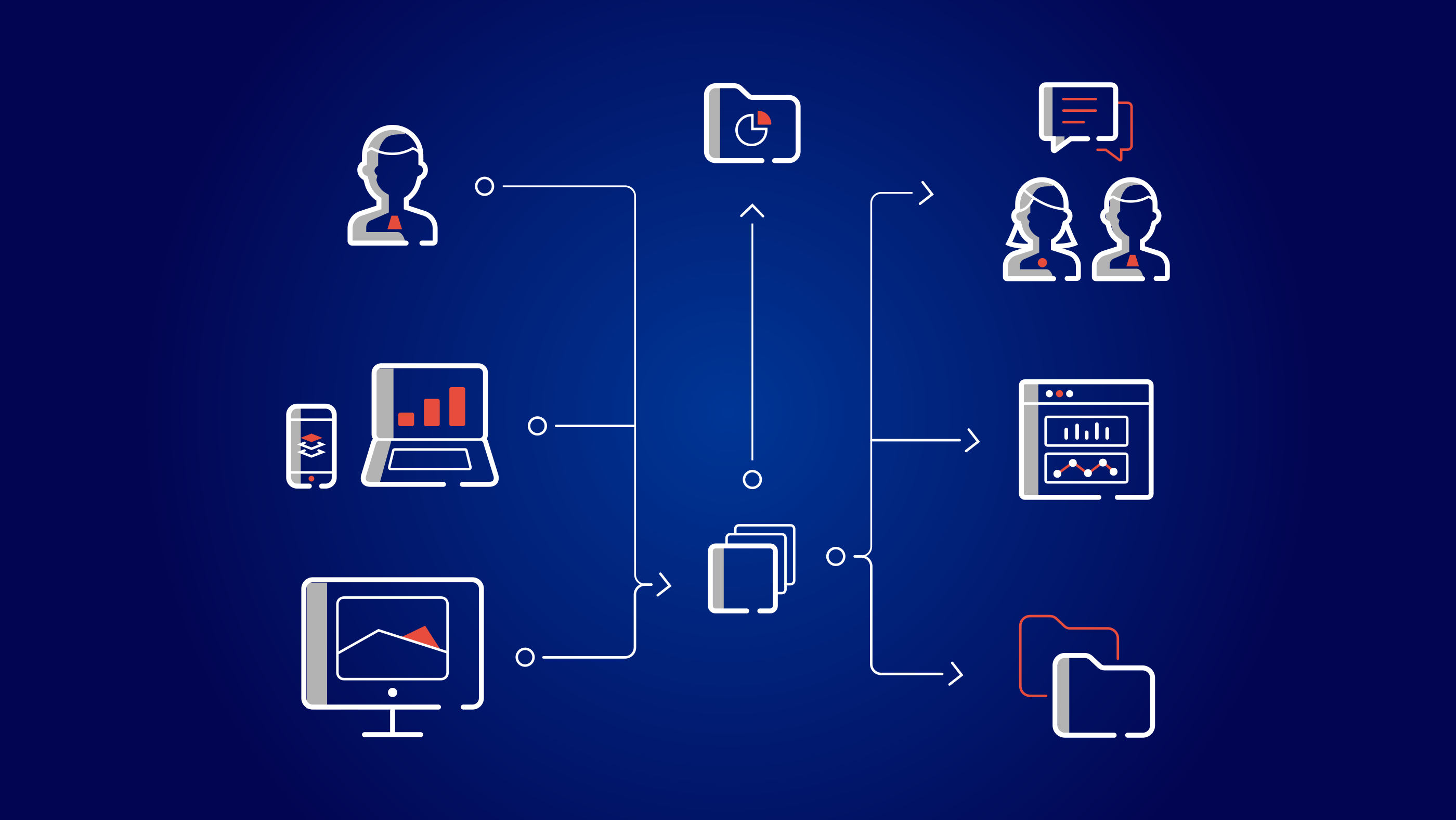


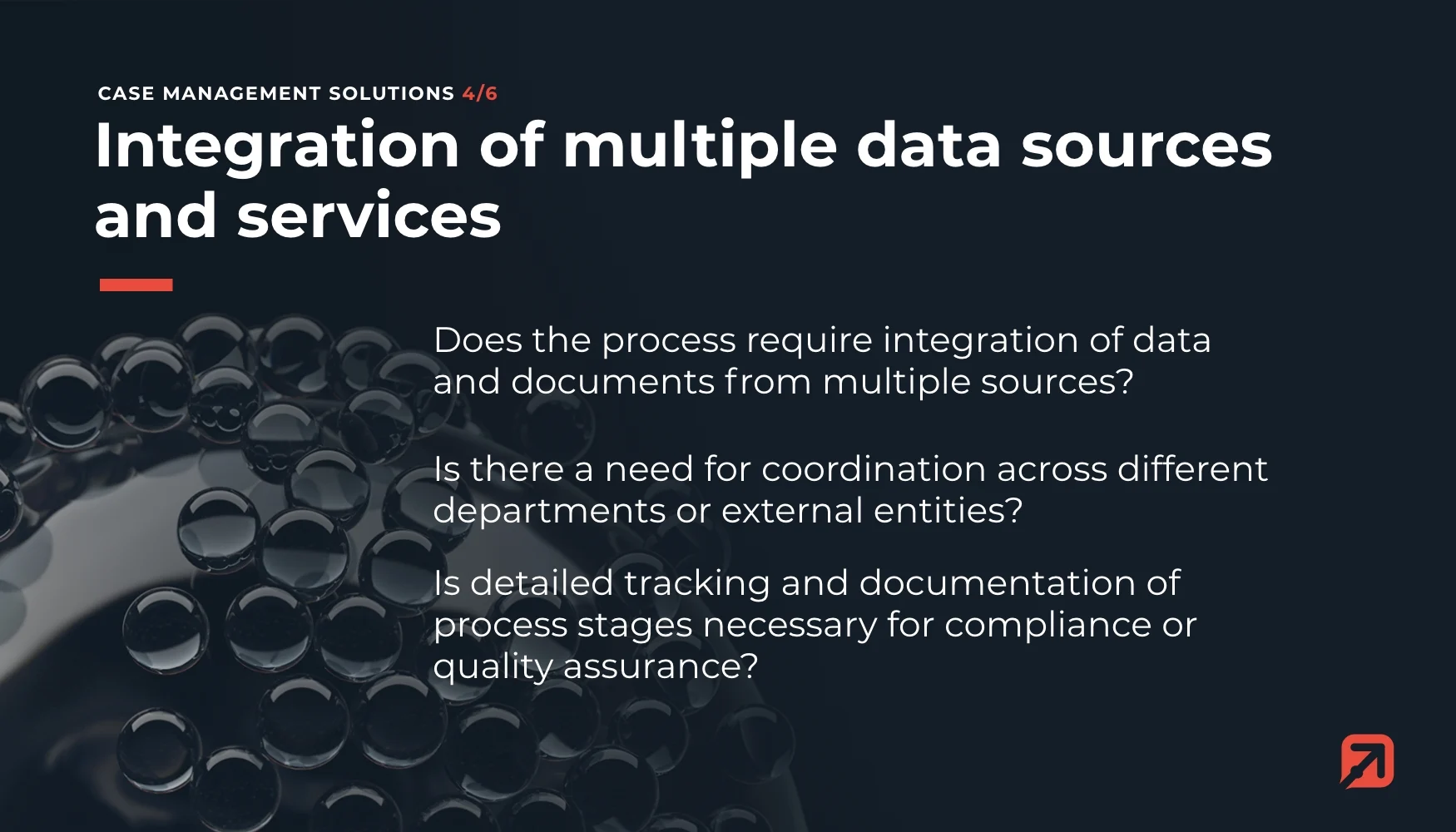
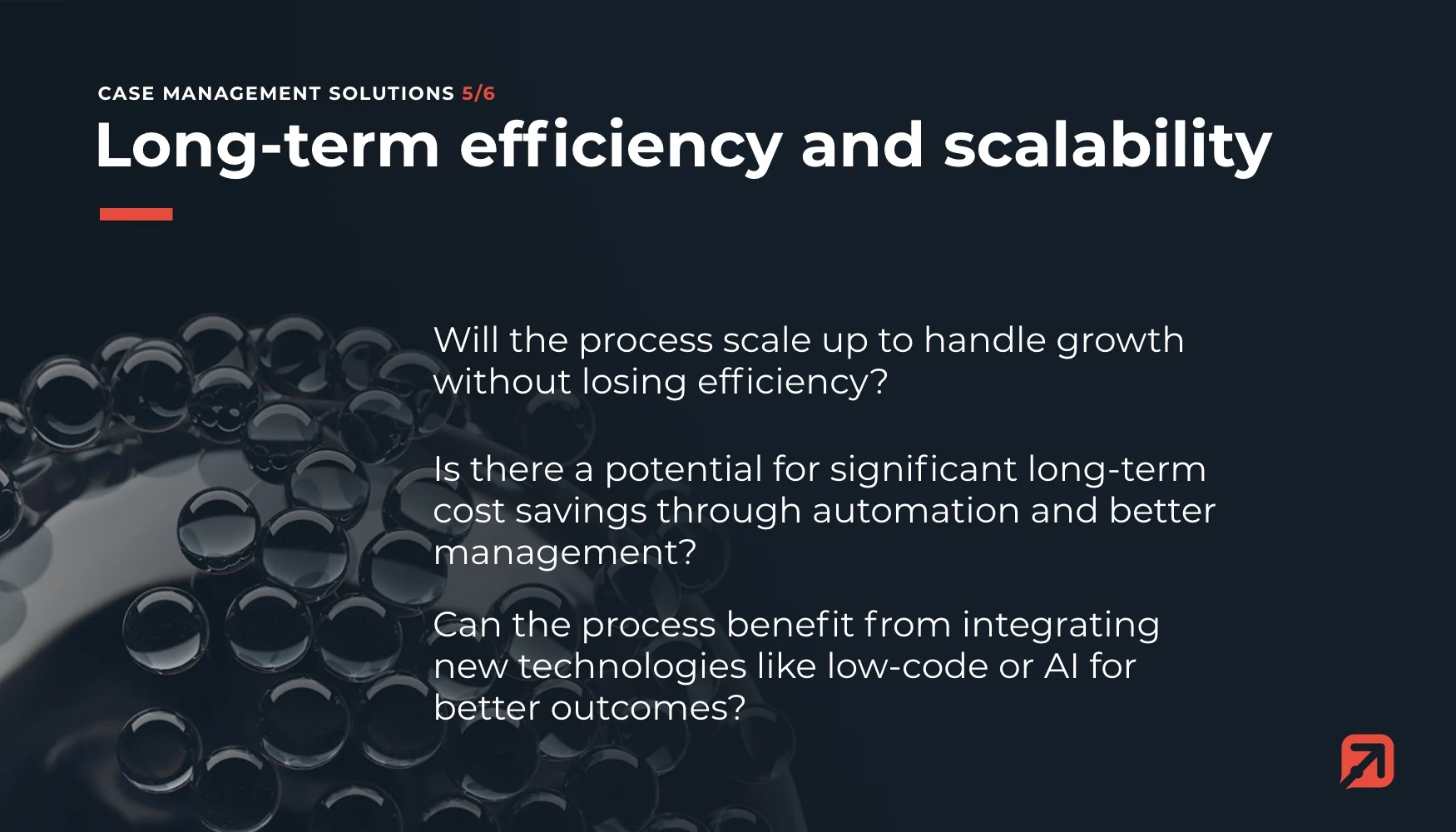
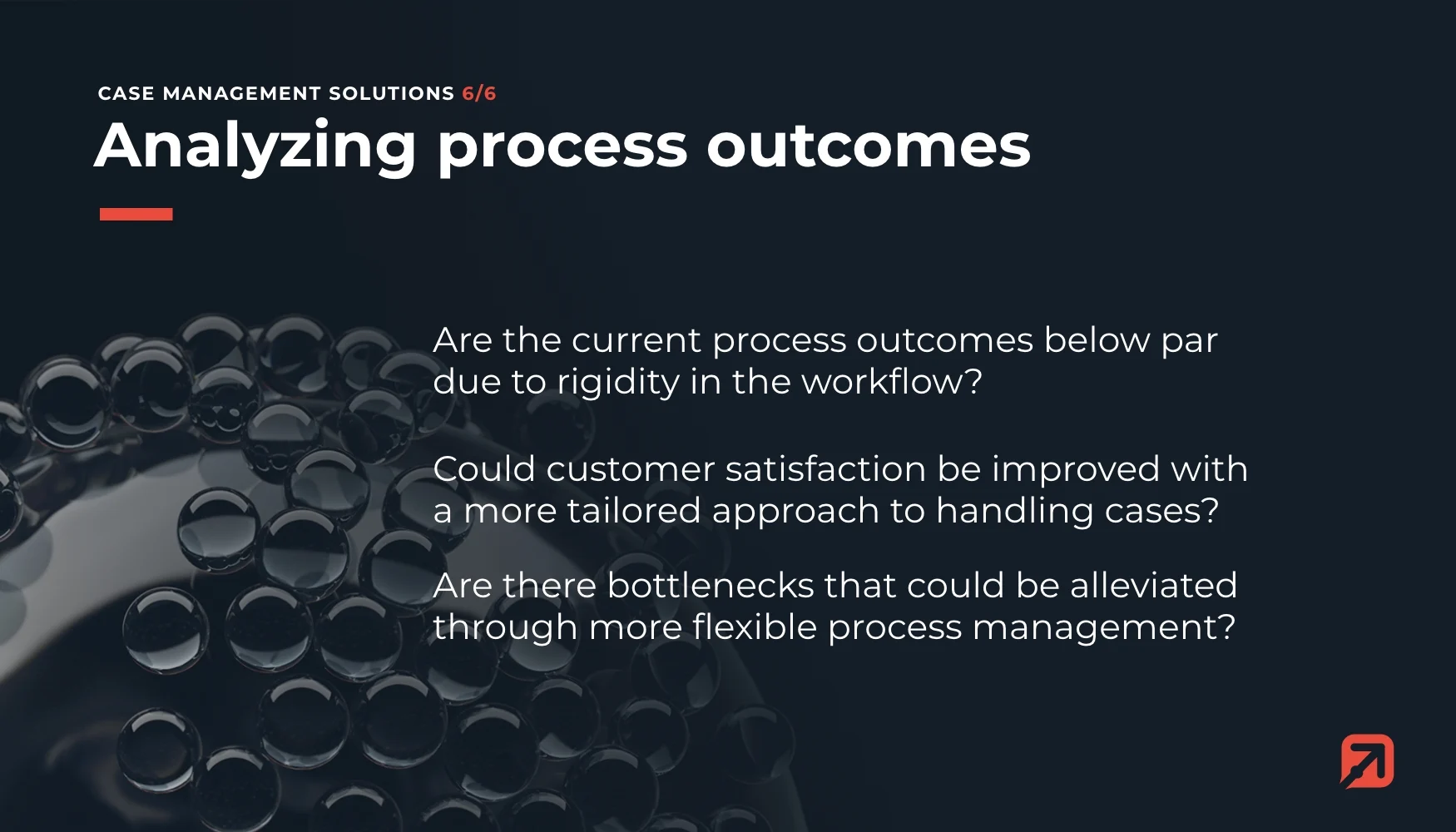
Answer Yes or No to the questions in the carousel to determine whether case management is an appropriate solution to enhance your business processes.
Mainly NO responses: If most responses are negative, your current process management tools may be sufficient. However, keep monitoring for any changes in process complexity or as your business scales.
Mainly YES responses: If most responses are positive, this indicates a strong case for implementing case management. Your processes likely involve significant complexity, require adaptability, and benefit from enhanced coordination and human judgment.
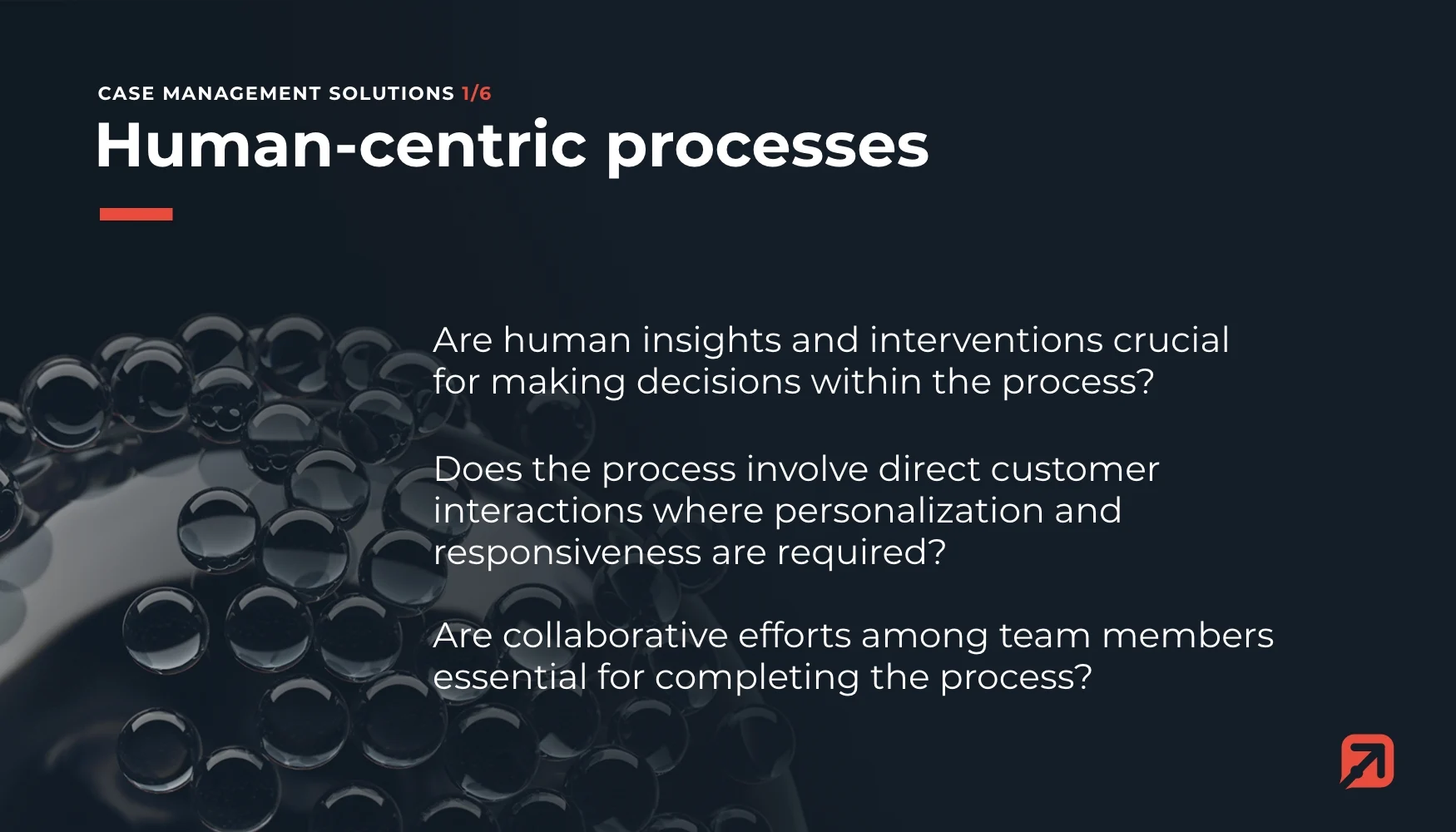
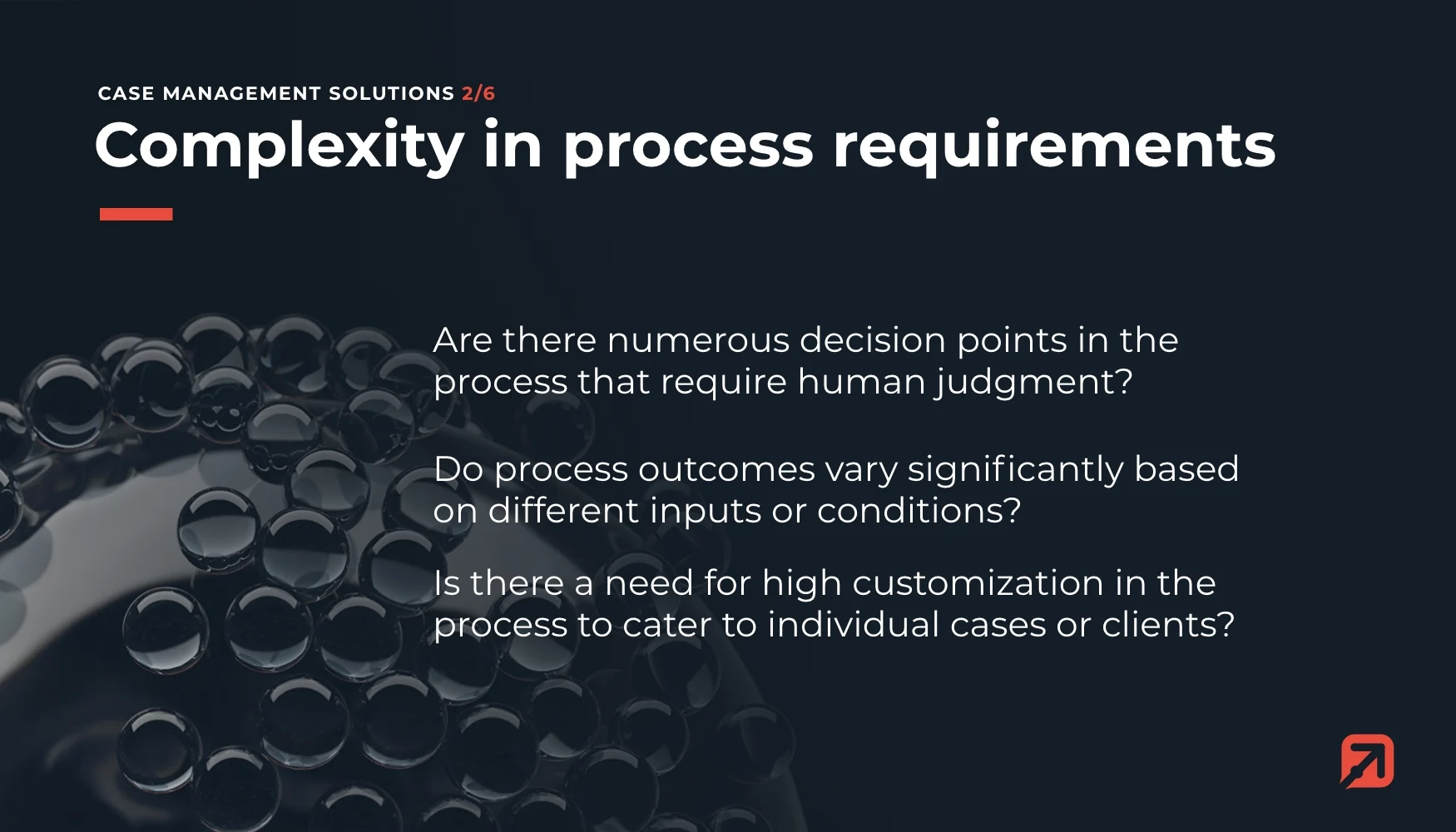
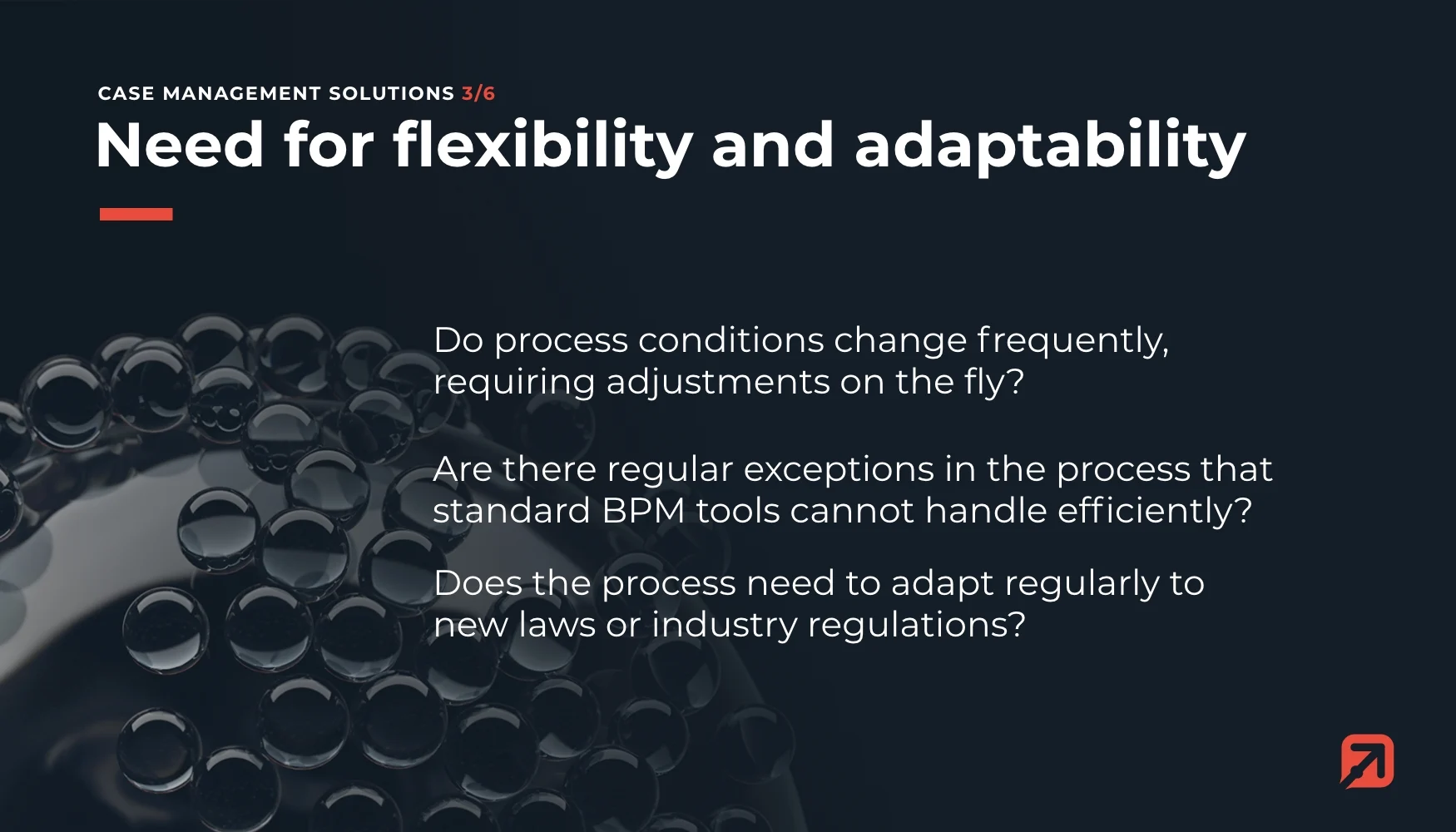

This release brings a powerful enhancements to help you work smarter and more efficiently.

In this eBook, you will learn about the capabilities and advantages of Case Management.

Managing an insurance claim requires both human intervention and system processing.