All Articles
The integration nightmare: Why enterprise connectivity has become every CIO's biggest headache
/6 min read

/6 min read
Every enterprise technology leader knows the feeling. You walk into a meeting room filled with frustrated department heads, each armed with stories about systems that don't talk to each other, data trapped in silos, and processes that require manual intervention at every turn. The promise of digital transformation feels increasingly distant when your organization operates more like a collection of isolated islands than a connected enterprise.
This problem isn't just about technology anymore. It's a core business challenge that's costing organizations millions in lost productivity, missed opportunities, and competitive disadvantage. McKinsey research reveals that 90 percent of organizations are currently undergoing some form of digital transformation, yet most struggle with the fundamental challenge of making their systems work together effectively.
“McKinsey research estimates that nowadays 90 percent of organizations are currently undergoing some form of digital transformation, yet most struggle with the fundamental challenge of making their systems work together effectively.”
The cruel irony is that while individual applications have become more powerful and sophisticated, the enterprise as a whole has become more fragmented. Each new system promises to solve specific problems, but collectively they create a web of complexity that threatens to strangle operational efficiency.
But help is at hand. Orchestration platforms are shifting from being nice-to-have workflow tools to the master application that determines whether an enterprise thrives or survives.
Gartner reports that the integration platform as a service market grew by 23.4% to $8.5 billion in 2024, driven by organizations desperately trying to connect their increasingly complex technology landscapes. But behind these numbers lies the reality that most integration efforts fail to deliver the seamless connectivity that enterprises need.
“Gartner market share analysis shows the integration platform as a service market grew by 23.4% to $8.5 billion in 2024, as organizations turn to connect their increasingly complex technology landscapes.”
Consider what happens in a typical enterprise when a customer places an order.
The sales system captures the order, but it needs to check inventory in a separate system.
The inventory system confirms availability, but it can't automatically reserve the items without triggering a workflow in the warehouse management system.
The warehouse system can prepare the shipment, but it can't generate an invoice without connecting to the financial system.
Each connection point represents a potential failure, a delay, or a manual intervention that slows the entire process and goes far beyond technical inconvenience.
Sales teams lose deals because they can't access real-time inventory data during customer conversations.
Customer service representatives provide inconsistent information because they're looking at different systems with different data.
Finance teams spend weeks reconciling information that should flow seamlessly between systems.
The traditional response has been point-to-point integration projects. Organizations spend millions connecting System A to System B, then System B to System C, creating a spider web of custom connections that becomes increasingly difficult to maintain. Each new system requires integration with multiple existing systems, and each change to one system potentially impacts numerous integration points. But what begins as a solution quickly becomes a maintenance nightmare that consumes IT resources and stifles innovation.
Forward-thinking organizations are discovering that the solution isn't better integration, but better orchestration. Instead of creating direct connections between systems, they're establishing orchestration platforms as the central coordination layer for all enterprise operations.
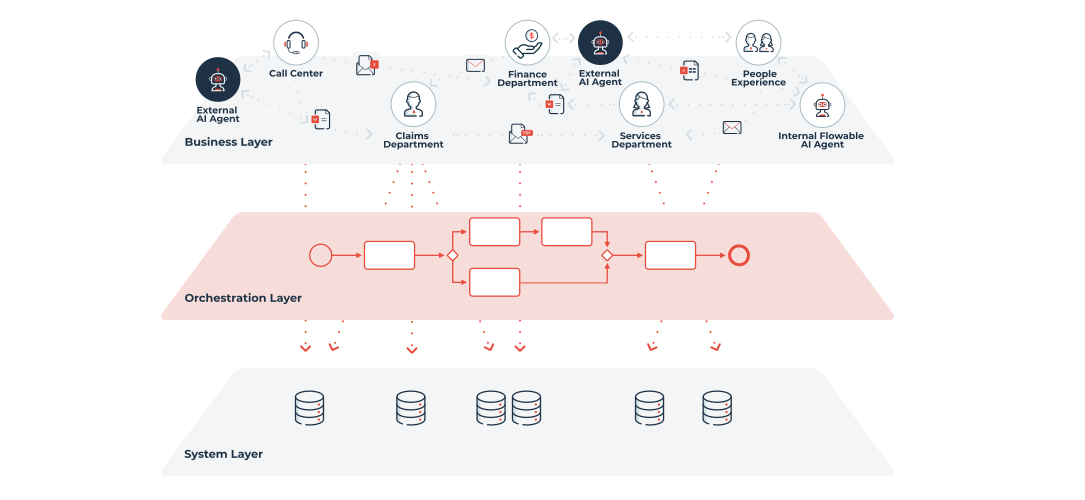
Forrester Research predicts the emergence of "adaptive process orchestration" as a new market category that combines integration, process application development, and management support to build AI agents and achieve autonomous business goals. This realization represents a fundamental shift from thinking about technology as a collection of independent applications to viewing it as a unified, intelligent system.
The power of this approach becomes evident when you consider how orchestration platforms function as enterprise operating systems. Just as your computer's operating system manages hardware resources and provides a platform for applications to run, enterprise orchestration platforms manage business resources and provide a foundation for all organizational processes to execute. They handle the complexity of coordinating multiple systems, managing data flows, and ensuring that business rules are enforced consistently across all operations.
Flowable's process orchestration approach exemplifies this concept. The platform provides comprehensive process coordination while maintaining the flexibility to adapt as business requirements evolve.
The transformation from orchestration tool to master application doesn't happen overnight. It begins with specific use cases such as automating a critical workflow, connecting two essential systems, or streamlining a customer-facing process. These initial implementations demonstrate value and build organizational confidence in the orchestration approach.
But something remarkable happens as orchestration coverage expands across the enterprise. The platform begins to hold a definitive view of how the organization actually operates. It knows which processes are running, which systems are involved, where bottlenecks occur, and how performance varies under different conditions. This comprehensive visibility transforms the orchestration platform from a coordination tool into the authoritative source of operational truth.
This evolution also reflects a broader shift in enterprise architecture thinking. Traditional models focused on databases as the source of truth, with applications providing interfaces to manipulate and view the data stored within them. The orchestration-centric model recognizes that in complex enterprises, truth lies not just in one dataset, but in the relationships between datasets, the processes that manipulate them, and the systems that house them.
Also, as artificial intelligence becomes more prevalent in enterprise operations, orchestration platforms will play an increasingly critical role in coordinating AI agents and traditional systems. The ability to orchestrate both human and artificial intelligence within unified processes will become a key differentiator for organizations seeking to maximize the value of their AI investments while maintaining human oversight and control.
Under the hood, a microservices architecture supports this master application role by providing the scalability and resilience required for enterprise-wide coordination. Unlike monolithic applications that become bottlenecks as usage grows, microservices-based orchestration platforms can scale individual components based on demand while maintaining overall system performance.
Organizations that establish orchestration as their master application see advantages that extend far beyond traditional automation benefits. The most significant is the ability to understand and optimize enterprise operations as a complete system rather than a collection of independent processes.
Centralized coordination enables real-time operational intelligence that would be impossible in fragmented architectures. When all processes flow through a single coordination layer, organizations gain visibility into how their enterprise actually operates. They can identify bottlenecks that span multiple systems, understand the true cost of complex processes, and optimize operations based on complete rather than partial information.
This comprehensive visibility also enables predictive capabilities that transform how organizations manage operations. Instead of reacting to problems after they occur, orchestration platforms can identify patterns that indicate potential issues and trigger preventive actions.
The coordination capabilities of modern orchestration platforms also enable new forms of operational resilience. When disruptions occur, whether from system failures, process exceptions, or external events, the orchestration platform can automatically reroute processes, activate backup systems, or escalate issues to human operators. This automated resilience reduces the impact of disruptions and frees operational teams to focus on strategic rather than reactive activities.
The organizations that will dominate their markets in the coming decade are those that master the art of connectivity. The path forward involves treating orchestration not as a project but as a platform: a foundational capability that enables all other enterprise initiatives. Organizations that adopt this perspective find that their orchestration investments compound over time, with each new process or system integration adding value to the entire enterprise rather than just solving isolated problems.
The connected enterprise isn't a distant vision; it's an achievable reality for organizations willing to invest in orchestration as a strategic capability. The technology exists, the patterns are proven, and the competitive advantages are clear. The question isn't whether orchestration will become central to enterprise operations, but how quickly organizations will recognize and act on this opportunity.
Business process management software covers very different tools in 2026. See how the category shifted towards BOAT and what buyers should evaluate.
Client lifecycle management in banking goes beyond onboarding. See how case management keeps client context intact through KYC, reviews and offboarding.
n agentic workflow is more than a multi-agent diagram. See what the standard patterns omit once workflows meet exceptions, oversight, and audit requirements. Primary keyword: agentic workflow