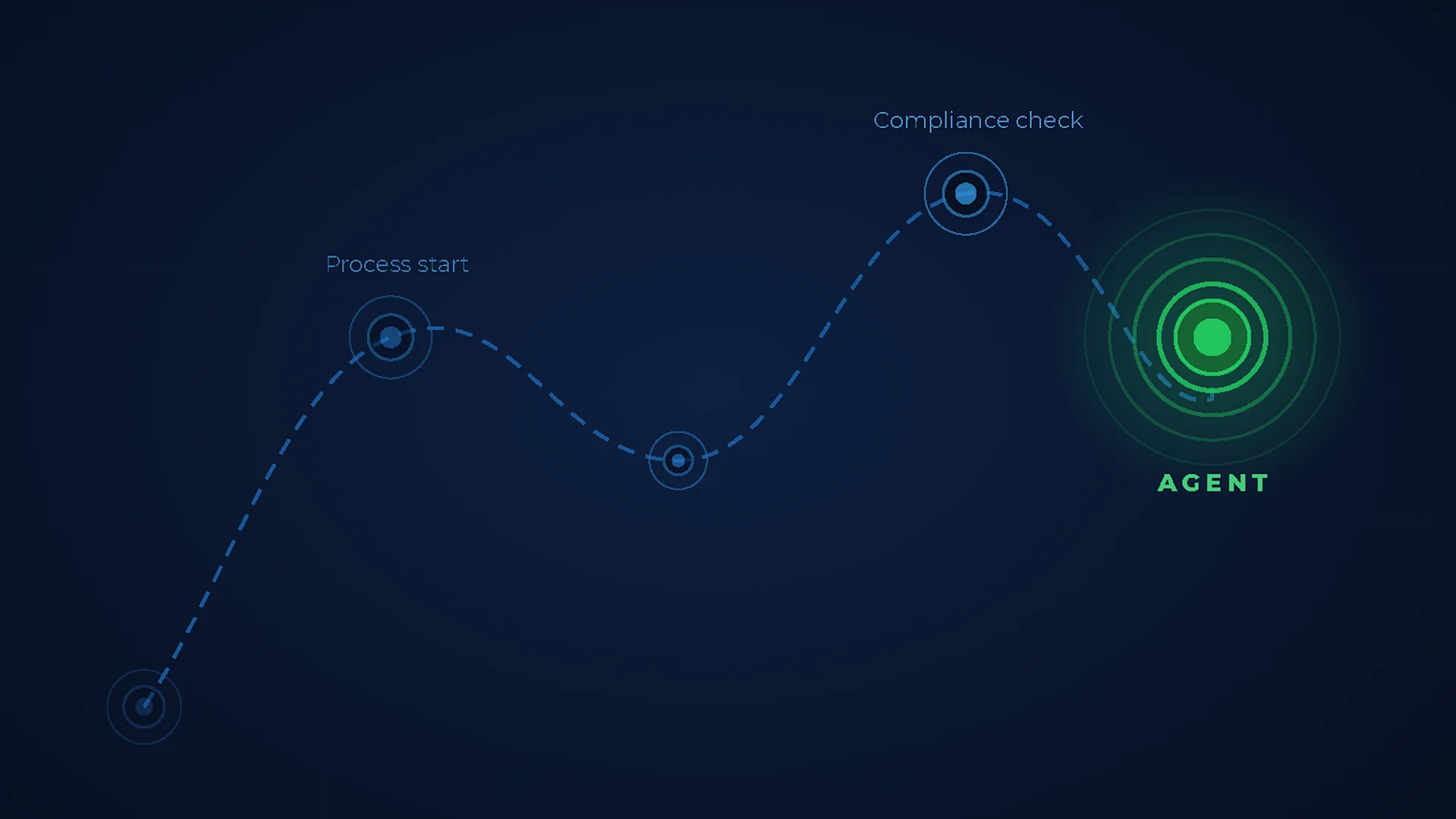
When an automated process makes a decision, compliance teams expect to know why. That question is often harder to answer that it should be.
Different systems hold the decision logic, handle approval processing, and leave the business reasoning behind the outcome outside the process itself. The original plan to reduce human effort suddenly transforms into even more manual compliance work.
At this point, the issue is straightofrward: whether the organization can explain its own behavior with confidence. The cost is not just time, but credibility and avoidable exposure to risk.
The problem doesn’t sit with the audit, but with how the automation is designed. Most automation platforms execute tasks and record activity. They don’t preserve the relationships between decisions, approvals, and the context for the choice. So, while the process completes successfully, it is rarely audit ready. The explanation of how a process reached its outcome is often difficult to find.
As AI plays a greater role in these processes, this gap becomes ever more critical. Decisions influenced by AI models introduce additional layers of complexity, making it even harder to explain outcomes. If you can’t justify decisions, you cannot rely on them in production environments.
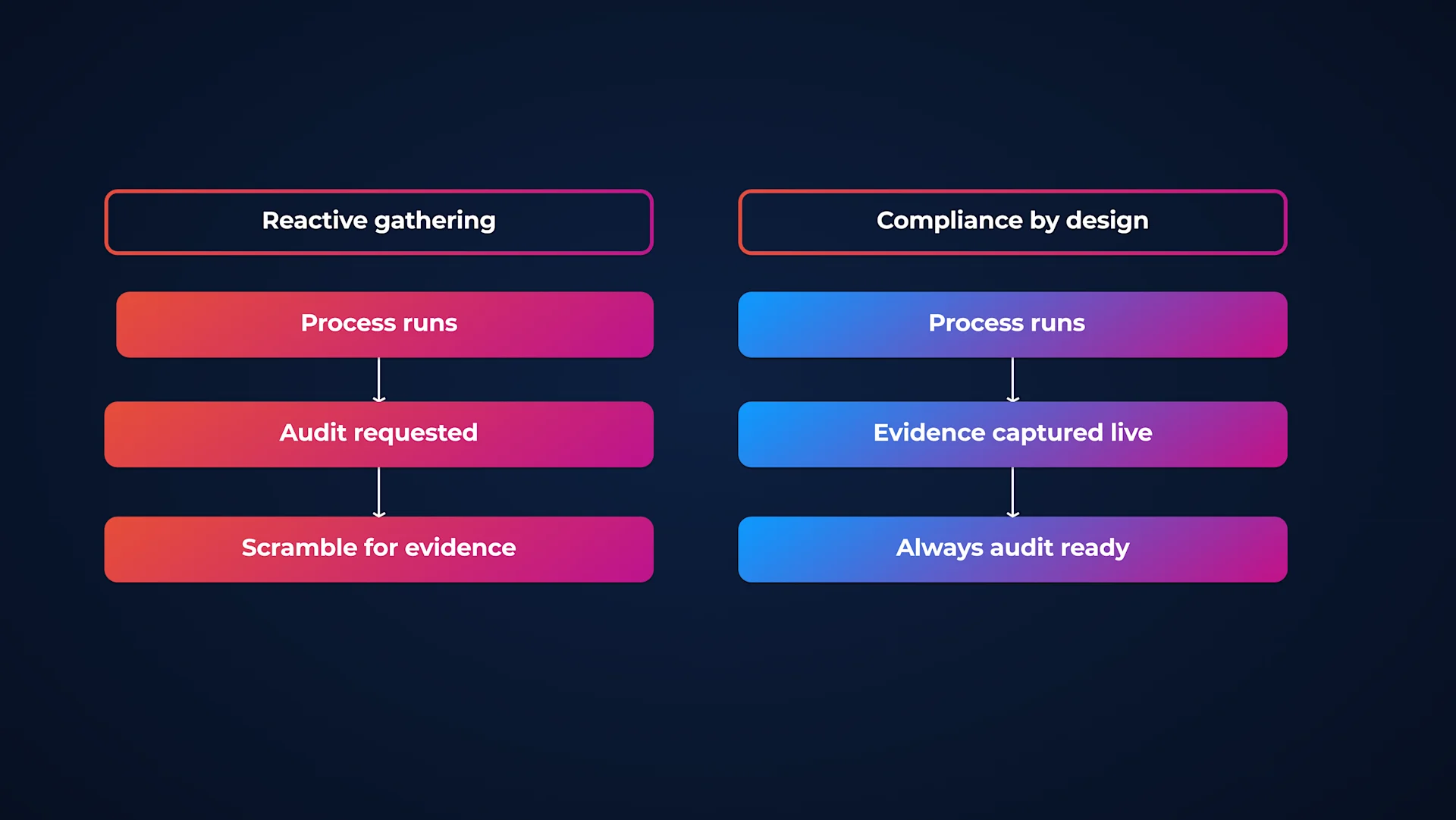
To compensate, some compliance software attempts to assemble this explanation after the fact. Automated evidence collection continuously monitors system logs, exports relevant records, and helps teams reconstruct the sequence of events as accurately as possible. While this can produce an answer, it rarely provides the clarity or confidence the business needs.
Compliance automation takes a different approach: it embeds trust directly into the process. Instead of collecting evidence after execution, it embeds traceability into the process itself. The workflow manages approvals, rule checks, and handoffs, and each action produces a structured record as it occurs. By capturing the context of adecision as it executes, organizations remove the need for retrospective interpretation.

As automation expands across multiple systems, teams, and AI agents, the challenge grows. Organizations need to go beyond individual tasks to understand how they work together and audit how they do so.
This is where process orchestration serves as the ideal compliance automation software platform. Instead of relying on each system to record its own actions, orchestration controls the activity from start to finish. It controls the steps, the decision conditions , and approval points. More importantly, it maintains a continuous view of the process as it runs.
In practice, this changes how organizations achieve auditability. Rather than assembling evidence from multiple sources, the process itself provides a structured account of what happened. By recording each step, decision, and exception as part of the same flow, teams can easily explain the journey and outcome of any case.
Orchestration provides a single view of how work moves across systems but aligning IT and business users on this view is equally important.
Modeling standards such as Business Process Model and Notation (BPMN) and Case Management Model and Notation (CMMN) play an important role here. Open standards provide a durable foundation to define clear processes for ongoing control and audit.
BPMN models the predictable parts of the process, where sequence matters, and outcomes depend on a defined set of steps. It makes approvals, decision points, and handoffs explicit so both business and technical users can follow and explain each stage.
CMMN supports more ad hoc work, where new information, further investigation, and manual decisions often reshape what happens next. CMMN keeps the focus on the state of the case and the actions that are relevant at that point in time.
Together, these standards ensure structured processes and judgment-driven work can be visible and auditable within the same environment.
AI-driven actions already sit within many automated processes, but many compliance programs treat them differently from other work. AI models must operate under the same level of structure and governance as human tasks or system steps. Without this control, organizations risk creating a gap in how they govern, audit, and explainthese decisions.
A more effective approach treats AI agents as regular workers inside the process rather than external black boxes. They take on specific tasks and contribute to outcomes in the same way as human users or system actions. This brings their behavior into the visible flow of work rather than leaving it outside the process's boundaries.
This is particularly important in industries with strict regulatory requirements, such as finance and healthcare, where AI must remain explainable, auditable, and governed at all times.
Teams can enforce approval rules, task boundaries, and access control whether a person or an AI agent does the work. Decisions are no longer just accepted but are subject to the same conditions and checks that govern the rest of the process. Autonomous behavior cannot sit outside governance. It must remain observable, reviewable, and accountable to provide real-time visibility into every outcome.
Putting these ideas into practice requires more than connecting systems or adding reporting layers. The right compliance automation platform moves auditability into the process itself, rather than treating it as something to be assembled afterwards. Every step, decision, and approval in a way that produces a clear, structured record as work progresses. The process does not need explaining because it already contains the context to show the decision logic.
This distinction becomes important when evaluating compliance automation software. Many solutions collect evidence after execution rather than creating it as part of the process itself.
Flowable's agentic case platform brings workflows, decisions, and AI-driven tasks together in a single environment, capturing every step and interaction in context as work progresses, whether handled by a person, a system, or an AI agent.
The result is a working environment where auditability is a property of how workflows, not an afterthought.
Ready to move beyond manual audit trails? See how Flowable brings workflows, decisions, cases, and AI together in a single governed environment and start your hands-on trial today.
Compliance automation ensures the recording of approvals, decisions, and controls as part of the process itself. This means that each step in a workflow produces a structured, traceable record that explains what happened and why.
BPMN and CMMN are open standards that provide a structured way to define workflows. BPMN ensures that predictable processes follow a clear, repeatable sequence. CMMN supports work that evolves based on decisions and new information. Together, they ensure that both structured and case-based work remain visible, consistent, and explainable over time.
AI models must operate under the same approval and control mechanisms as other tasks. This means compliance teams can review and audit AI decisions in the same way as any other activity.
By building governance into an automated process, organizations reduce the need for manual oversight and post-process correction. This clearly improves agility rather than limiting it. Teams can make changes with greater confidence because the impact is visible throughout the process design.
Compliance automation does not require replacing existing systems. By introducing it at the process layer, workflows coordinate interactions between systems, people, and decisions. By defining workflows and capturing evidence in real time, organizations can improve auditability and control.
Business process management software covers very different tools in 2026. See how the category shifted towards BOAT and what buyers should evaluate.
Client lifecycle management in banking goes beyond onboarding. See how case management keeps client context intact through KYC, reviews and offboarding.
n agentic workflow is more than a multi-agent diagram. See what the standard patterns omit once workflows meet exceptions, oversight, and audit requirements. Primary keyword: agentic workflow